








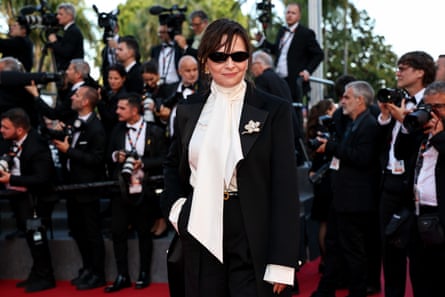
The shadow of Joseph McCarthy’s “red scare” loomed over the storied steps of this year’s Cannes film festival. Echoing the mid-20th-century blacklist, which shut out about 300 suspected communists from Hollywood, the French media group Canal+ announced an effective ban on twice that many French cinema professionals, including actors such as Juliette Binoche and film directors such as Jean-Pascal Zadi and Arthur Harari. Their crime? An open letter denouncing the growing influence on French media and cinema of conservative tycoon Vincent Bolloré, Canal+’s main shareholder.
The Canal+ chief executive, Maxime Saada, justified punishing the signatories on the basis that their claim was an “injustice” against the staff of Canal+ – who were, he said, committed to the organisation’s independence.
Bolloré has consolidated control over a significant portion of France’s news and entertainment media over the past decade, from the Fox News-like CNews to the Journal du Dimanche, Europe 1 radio, and the publisher Fayard. He is accused of having often shifted the editorial line of his acquisitions towards a rightwing ideological project à la Rupert Murdoch. Recently, his firing of the CEO of the literary publisher Grasset caused a walkout by more than 100 authors – from a political spectrum wide enough to include high-society philosopher Bernard-Henri Lévy and the feminist novelist Virginie Despentes.
In their petition, which has since garnered the backing of international celebrites such as Javier Bardem and Mark Ruffalo, the film professionals wrote: “By leaving French cinema in the hands of a far-right owner, we risk not only the standardisation of films but a fascist takeover of the collective imagination.”
The impact of Canal+ scything its connections with actors, writers, directors and technicians could also have stark consequences for the industry: Canal+ represents more than 40% of all private funding that flows into French broadcasting, streaming and cinema. And given the propensity of French productions to be co-financed by some combination of public and private funds, that number probably undersells the critical importance of Canal+. From Mulholland Drive to Paddington in Peru, few other European producers and distributors have the group’s international reach.
Should one person, or a handful of people, be able to meaningfully impact a nation’s cultural output based on their desire to control the political speech of artists? And should the nation’s government intervene?
In the case of Canal+, the temptation might be towards intervention. After all, there was more public regulatory involvement in its creation than being a “private enterprise” might suggest. Launched in 1984 as France’s first subscription channel, Canal+ has been legally obliged to devote a certain percentage of its budget to French and European cinema.
But trying to legislate against this apparent blacklist is also perilous. The French far right is closer than ever to political power. In countries led by illiberal, far-right parties, the government has become just as dangerous a source of media censorship as a billionaire owner might be.
Public funding for journalism and the arts is certainly part of the answer. Democracy is healthier where public media funding is high. In 2025, Reporters Sans Frontières (RSF), which underlines the importance of “predictability and sustainability” of public media financing, found strong levels of confidence in public service media across Europe – including in France, where 69% of people think public media functions well, even as 61% think public services as a whole do not. But the how of public funding also matters. RSF also notes that confidence levels fall in places where the far right is, or has recently been, in power, and where it has often used public media’s dependence on discretionary funding to exert editorial influence on it.
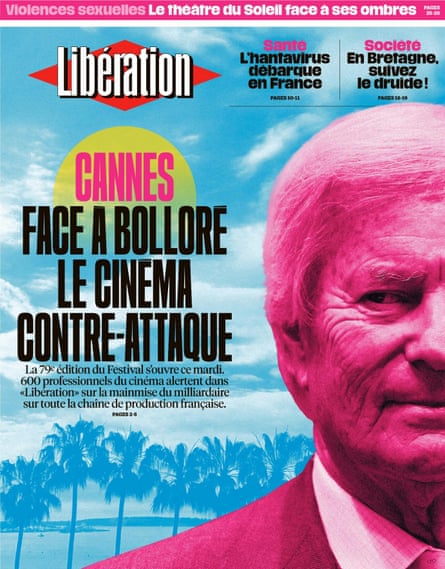
Bolloré has long denied political or ideological interventionism, insisting that his interests are financial, and to promote French soft power.
Yet his power is a reminder that nowhere in Europe is immune to the same dynamics of ideologically driven media consolidation that has unfolded in the US, or the pure and simple shift of public service media into far-right state media that took place in Hungary. The warning light is now flashing in a frenetic way, begging us to strengthen the finances and independence of public media organisations that already exist.
Emmanuel Macron, it is speculated, is attempting to “future-proof” various French institutions against a government led by National Rally. Similarly, there is a way that the EU as a whole, with its long history of funding public service media and the arts, could make that funding an independent counterweight to both billionaires with agendas and censorious governments: moving from annual, discretionary budgets, or even earmarked taxes (like a TV licence), to public media endowment funds answerable only to their governing boards, and nominations to which should stretch across multiple electoral cycles.
Creating such a “meta-endowment” at an EU level, and charging it with being a supplementary source of funding for national, regional and local public service media, journalism, publishing and cinema across Europe – from cross-border Arte, to independent magazines, to France Médias Monde, to a reconstituted Hungarian public broadcaster – would add an extra level of independence and resilience in between journalists, artists and writers, and whatever political and private pressures they might face.
Of course, I can already hear the critical voices, saying how substantial the price tag on such an initiative would be – eye-popping, some will surely say. Except, such an endowment fund wouldn’t necessarily represent additional spending, but merely front-loading part of the billions that EU member states spend annually on public service media – €35bn across all member states in 2023. By following the 4% spend rule that pension funds and university endowments adhere to, a public media fund like this could make inflation-adjusted grants to European media in perpetuity, regardless of shifting political will or priorities.
At any rate, even “eye-popping” fizzles when put in the context of defence budgets, which increased by €495bn in Europe and Canada from 2024 to 2025, and then by tens of billions more in 2026, particularly in Germany. Democracy runs on information; what is the point of spending money to defend the territorial integrity of a democracy, but not its cultural and intellectual integrity?
-
Alexander Hurst writes for Guardian Europe from Paris. His memoir Generation Desperation is out now