






What do you want from the Turner prize in the year of our lord 2026? Are you after wild, shocking, disturbing, era-defining cultural moments? Please, it’s not the 1990s. How about hard-edged, ultra-conceptual, high-minded aesthetic experimentation? Come on, we haven’t had that for decades. Maybe you expect some culture-war-mongering, super-identitarian, polemically explosive political invective? A bit 2022, I reckon.
No, the 2026 Turner prize is something else, something way more appropriate for the age: a bit timid, a bit fearful, a bit safe.
Not that there’s anything wrong with that, to quote Seinfeld. That’s just life in 2026 – we’ve all been worn down by the whole thing. This year’s list of nominees is mainly notable for what’s missing compared to past editions: there are no older artists, no artists from non-traditional art backgrounds such as last year’s winner Nnena Kalu, there’s no painting, no video art, there’s nothing angrily political. Instead, there’s sci-fi utopianism, jazz performance poetry, ephemeral sculpture and anti-corporate satire. It’s missing the anger of previous years, the radicalism, the transformative joy.
But there is still plenty to like. Marguerite Humeau’s weirdly organic biomorphic sci-fi sculptures imagine a future where humans survive by working collectively, modelling their society on those of ants and bees – it’s eco-survival through communism. Her sculptures are filled with lattice-like structures and honeycomb forms, and shot through with a sense of hope that if we come together we might just be able to get out of this mess we’re in. Her work with AI hasn’t always hit the mark, but the sculptures are pretty damn good.
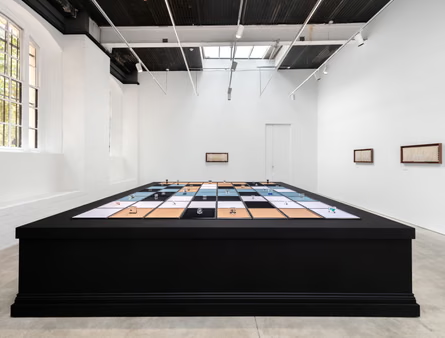
Things are a little bleaker in Tanoa Sasraku’s world, where military aesthetics meet the grim, slimy, greedy world of oil exploitation. Sasraku’s show at the ICA was filled with paperweights from petroleum companies, each infused with a dollop of crude oil. It was an unsettling, grotesque, clever, satirical takedown of the exploitative oil industry and the depressing role it plays in geopolitics. In short, everything you want conceptually focused art to be.
Seeing a Kira Freije installation is like stumbling into a haunted scrapyard, where all the rusty nuts and bolts have come alive but froze just as you walked in. Her work at The Hepworth in Wakefield was a theatrical scene made of lifesize human figures, their metal hands and faces cast from life, but attached to bare steel skeletons like a bunch of diet Rodins.
Freije’s work is unusual among the nominees – and wider contemporary art, really – for not really being “about” anything, necessarily. It doesn’t deal with social inequality or ecology, it’s not about aesthetics or the history of art, and it’s not hugely dependent on some kind of conceptual grounding: it is figurative sculpture, and that’s kind of it. It’s ephemeral, mysterious, clearly very emotional and strangely traditional compared to everything else here.
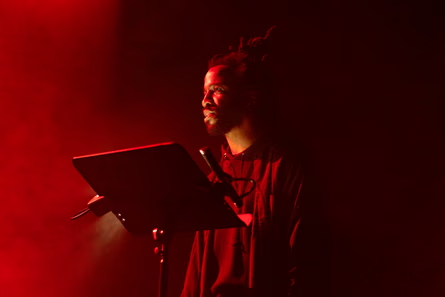
Simeon Barclay’s work is usually a mishmash of cultural signifiers – Darth Vader, football, Donald Duck, clubbing, Stannah stairlifts, Joseph Beuys – smashed together to explore ideas of class, race and masculinity in crumbling, post-Thatcher Britain through the eyes of someone who grew up black in Huddersfield. He is a genuinely interesting artist, if often over-referential and a little obtuse. But the work he’s nominated for – The Ruin, shown at the ICA, The Hepworth and the New Art Exchange in Nottingham – is not his best. It’s a spoken word performance poem about his upbringing in Huddersfield, accompanied by a guy making burbling noises on a horn and a bloke scratching about on some percussion. A darkened stage, stark yellow spotlights, poetry about the M62 – it all feels like someone being over serious about something rather silly. It reads like a piss-take, but it’s not.
I like all of these artists, but they are pretty familiar names, nominated for shows at pretty familiar places. It’s another Turner prize shortlist drawn up by curators who see the same artists at the same institutions and biennials year after year, in exhibitions curated by their mates, funded by their mates, and attended by their mates. It’s hard to escape the feeling that it’s self-preservational, insular and elitist. It gives the whole thing the feel of a corporate conference for the art world. There is nothing wrong with any of it, but they’ve got to start casting the net a little wider, otherwise everyone is going to stop caring. Maybe they already have.