






After my father’s will banned me and my siblings from his funeral, I wrote a novel about some brothers and sisters stealing their dad in his coffin. The emotions were drawn from my painful experiences, but I invented the characters and the tragi-comic narrative in Stealing Dad. Despite growing up in England, I’ve lived in and written about Athens for 25 years, and it came naturally to create several Greek characters. Alekos is a wild sculptor who dies in London, and his daughter Iris (one of seven dispersed half-siblings) lives off Victoria Square – one of Athens’ most fascinating corners.
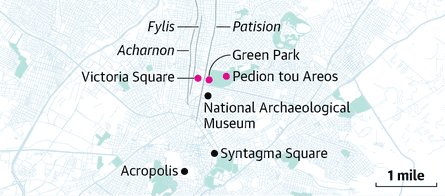
In the 1960s, Plateia Viktorias was a fashionable neighbourhood with the fanciest restaurants, shops and theatres. Townhouses from the interwar period were being demolished and Athenians were occupying the new six-storey apartment blocks so fast that construction dust and the constant drilling were the main problem. Today, through wrought-iron and glass doors, elegant, marble-lined halls reveal concierges’ desks and traces of a vanished bourgeois life.
After the 1980s, middle-class families started leaving the polluted centre for the suburbs; students, migrants and others seeking cheap rentals moved in. The 2008 global economic crisis was disastrous. Older businesses faded, drug use became increasingly visible, then around 2014, refugees started arriving. Afghans and Syrians fleeing war already knew about Victoria Square and went straight there on reaching Athens. It became an encampment, with sleeping bags and tents surrounding the imposing bronze sculpture Theseus Saving Hippodamia. Desperate, traumatised people lived on the street with no facilities, queueing at soup kitchens already catering for elderly and unemployed Greeks devastated by the crash.
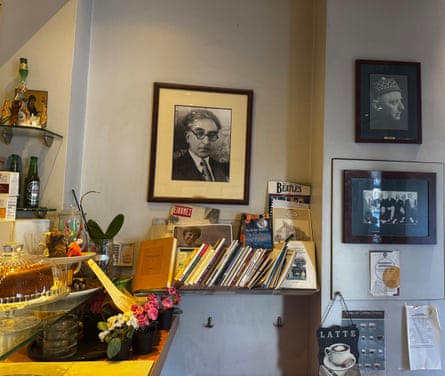
Brought up in Victoria Square during its heyday, Maria-Liza Karageorgi runs the alluring Café des Poètes. Photographs of Greece’s poets, including CP Cavafy and Nobel laureates Giorgos Seferis and Odysseas Elytis, line the walls. Karageorgi allowed the refugees to wash and use the toilets, then, as numbers grew, she admitted only women and children. Today, though, a balance has been established in the leafy square. “It’s a real neighbourhood,” she says. “People look out for each other.” Her devoted clientele of ageing Greek intelligentsia clearly agree, and gather every morning. “It’s like Buena Vista Social Club,” quipped a younger customer.
Now the most multicultural area in Athens, Victoria Square honours the 19th-century British queen, recognising her empire’s return to Greece of the Ionian islands, including Corfu, in 1864. British foreign policy also lurks in the histories of some newer arrivals. Victoria, the Afghan-Persian restaurant, bakes delicious roasted vegetable briam; Lebanese-born George at Enjoy Just Felafel produces jars of homemade delicacies and preserves; and Bangladeshi grocers stock the African staples sought by Nigerian, Somali and Congolese residents. The area is scented by the Georgian bakery with its flatbreads cooked in a stone oven.
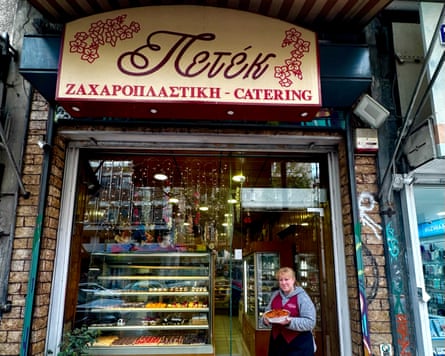
Refugees and migrants are supported by various NGOs that sprang up after 2014. Nadina Christopoulou runs the Melissa Network, a flourishing organisation for women and children housed in an elegant 1920s villa. “Refugees follow the paths of the older refugees,” says Christopoulou. “This area had many Greeks from the diaspora, who came from Egypt, Lebanon, Turkey. You can see their shops, like Petek [honeycomb in Turkish], the patisserie owned since 1964 by the same Istanbul Greeks.” They are still making their delectable galaktoboureko custard pie. Also on 3 Septemvriou is Arkeuthos, another Istanbul-Greek shop overflowing with herbs, spices, teas and honeys.
Older Greek establishments are also flourishing. Krouskas, a traditional, no frills restaurant favoured by locals since the 1970s, still serves the same recipes cooked by the family matriarch. On pedestrianised Elpidos (Hope St), Ouzeri tou Laki (Laki’s Ouzo Taverna) has served excellent seafood since the 80s at tables under bitter orange trees that are intoxicatingly scented in spring. The gay-friendly Diva Café, owned by former dancer and singer Michalis Razis, holds live events and standup comedy.
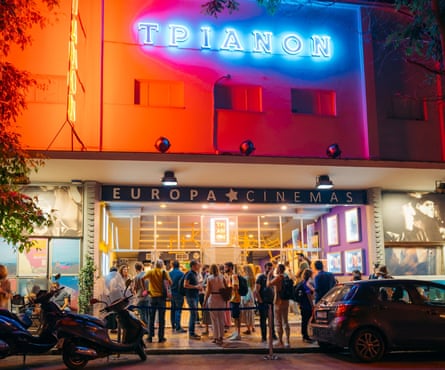
Victoria’s longstanding theatrical traditions are thriving. On Kodrigktonos (Codrington Street, named after a British admiral) is the renowned Trianon cinema. The Greek romantic comedy Never on Sunday premiered there in 1960 with Melina Mercouri in attendance, and on summer nights the roof opens. Next door, cafe-bar Foyer D’Athènes is packed with theatre and cinema memorabilia.
Newer attractions include Montreal, a gallery-hairdresser where you can admire the art before the charming artist Lambros Vouvousiras cuts your hair. Opposite, Café Apoteka is popular with a young crowd who gather in the nearby Kypseli – well established as a more hipster multicultural neighbourhood. There, Airbnb is already pricing out locals, following the example of the Acropolis-adjacent neighbourhoods, now overwhelmed by tourists.
When my friend, the journalist Katerina Bakogianni, relocated six years ago to a fifth-floor flat in Victoria Square, her suburban friends thought it daring. However, she wakes to the sunrise over Mount Hymettus, a bird’s-eye view of mulberry trees, and she’s one minute from the 1940s Victoria station on Metro Line 1, with its gorgeous sage-green tiles.
Katerina takes me and her dog Robbie for a stroll. We cross Patission, the bustling boulevard once compared to Paris’s Champs-Élysées and with a breathtaking vista to the Acropolis. The revamped park Pedion tou Areos (Mars Fields) has transformed from the days when Athenians feared to cross it, especially after dark. It is now one of Athens’ loveliest green spaces and we stroll past heroic marble sculptures and admire athletes training and pampered dogs sporting bandanas. We end up at Green Park, a stylish restaurant-cafe in an art deco 1930s building.
“When Green Park reopened a few years ago, after years of decline,” says Katerina, “we read it as a small but telling sign that Victoria – long dismissed – was beginning to reclaim its dignity.”
It is not a cheap place but there are weekend musical shows, and on Sundays the garden fills with families ordering ice-creams and club sandwiches. Green Park offers a taste of the “golden days” about which Victoria’s older residents reminisce. And it’s not alone: various theatres, cinemas and live music joints have been resurrected after nearly not making it. After everything else, Covid hit hard.
The streets below the square have a rougher reputation. Graffiti reflects local preoccupations: “Cops for Dinner”; “Refugees Welcome”; “Support your local sex worker”. Fylis street is lined with white door lights identifying its notorious brothels. Customers come and go, day and night. Squats open and close, some organised by community-minded activists, others by homeless migrants. “Do you live here?” asked an appalled taxi driver dropping me off. “But you look like a nice lady.” Fylis has seedy elements, but locals dispute the idea that you’re not safe; just behave as in any inner city.
On Wednesdays, the fabulous farmers’ market on Fylis provides excellent seasonal fruit, vegetables, fish and flowers, along with household goods and clothes, including giant, no-shame underpants. Musicians serenade shoppers with bouzouki songs, mobile canteens roast souvlaki and the air resounds with a Babel’s Tower of languages.
The area becomes less well off as you go westwards downhill, eventually hitting the railway tracks. Tasos Chalkiopoulos creates excellent short videos (@Athensville) of these changing Athenian neighbourhoods: the convenience stores on Acharnon where Bangladeshi and Pakistani owners sell goods to new arrivals, from mobile phones and blankets to Asian shampoo. Or farther north, where Syrian patisseries vie with Iraqi kebab shops, shisha cafes and fancy barbers. Athenians love their souvlaki as street food, but now also debate who makes the finest falafel. Despite steep competition, Tasos votes for the tiny Tarbosch on Acharnon.
I loved writing about Victoria Square in Stealing Dad. Like so much of Athens, one needs to gaze up, peer inside and glance back to understand the intricate tangle of its history. Look closely, and you appreciate the beauty, sympathise with the chaos and relish the energy.
Stealing Dad by Sofka Zinovieff (Little, Brown, £10.99). To order a copy for £9.89 go to guardianbookshop.com. Delivery charges may apply.