


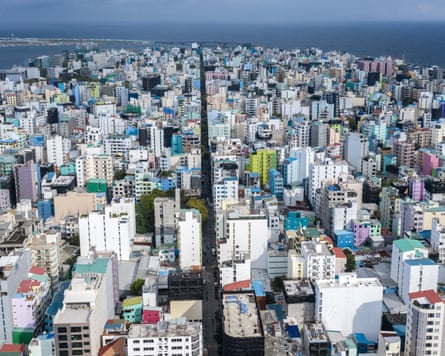
Malé is one of the world’s most overcrowded cities, but it faces double pressure. As well as a growing population, the capital of the Maldives is also threatened by rising sea levels. Owing to climate breakdown, its living space is shrinking.
So the justification for a land reclamation project seemed clear. Take sand from elsewhere in the archipelago and use it to build up the land available for Malé’s people. What could go wrong? After all, it’s only sand, right?
Around the world, urban development and industry is using sand at a rate of 50bn tonnes a year, a figure that is expected to grow. But a new UN report warns that sand is being extracted faster than it can be replenished, and that this is threatening livelihoods, ecosystems and the very structure of the natural world.
Pascal Peduzzi, the director of the Unep global resource information database Geneva, which prepared the report, said: “Sand is sometimes referred to as the unrecognised hero of development, but its essential role in sustaining the natural services on which we depend is even more overlooked. Sand is our first line of defence against sea level rise, storm surges, and salination of coastal aquifers – all hazards exacerbated by climate change.”
The most extracted solid material on Earth, sand is mined to build homes, roads and sea walls in concrete production, building foundations and masonry work. It is used to manufacture windows, silicon chips and solar panels. But it is just as crucial left in place: it regulates rivers, protects coastal aquifers, filters water and sustains biodiversity.
The report argues demand exists for sand in both its “dead” and “alive” states, and each is in competition.
In 2019, the Maldives government commissioned a Dutch company to fill in the lagoon in the island of Gulhifalhu, close to Malé. The 192-hectare (475-acre) land reclamation demanded 24.5m cubic metres of sand dredged from 13.75 sq km of northern Malé atoll. Six months later, an environmental assessment concluded that the environmental damage would be irreversible. But the ink on the contracts had already dried.
The Gulhifalhu project destroyed 200 hectares of coral reef and lagoon habitat, including marine protected areas (MPAs), Unep’s report said. The UN found that about half of dredging companies were operating in MPAs, accounting for 15% of the volume of dredged sand.
The result will be the loss of critical habitats for fish, turtles, birds, crabs, and other species supporting ecosystems, fisheries and tourism, the report said. “Land reclamation inevitably leads to the permanent modification of the substrate, the destruction of flora and fauna, and coastal erosion.”
In the Philippines, the dredging of 155m cubic metres of sand for a 1,700-hectare airport project devastated fishing communities. Once the floor of Manila Bay had been scraped away, the fish did not return. In South Sulawesi, Indonesia, the dredging of 22m cubic metres of sand in prime fishing grounds for another urban development cut fishing communities’ incomes by 80%.
According to Unep, solving the dilemma of sand extraction – whether it is better to take it or leave it – requires an overhaul of governance processes. Planners need better data, mapping and monitoring to identify areas of high ecological value. But they must also offer greater transparency and adhere more faithfully to environmental rules.
The Maldives is particularly exposed. With more than 80% of its land mass less than a metre above sea level, it is one of the world’s most climate-vulnerable nations. Without building up its islands, it will be overrun.
But even if that fate is averted, for Malé’s inhabitants the future seems bleak. According to a technical analysis of the Gulhifalhu land use plan, taking into account the infrastructure allocation for the expected population density, the new land mass is engineered for nothing less than “urban disaster”.