







Nathan Law, an exiled leader of the Hong Kong student protest who lives with a £100,000 bounty on his head from the Chinese authorities, was not surprised to discover a spy ring had photographed him entering the Oxford Union for an evening debate in November 2023.
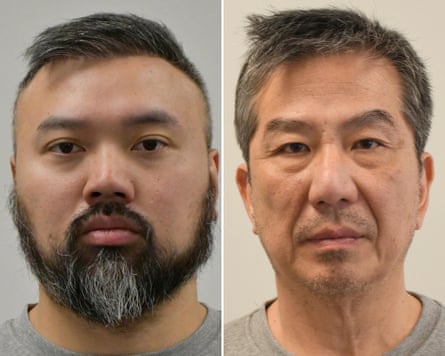
The conviction at the Old Bailey of Chi Leung “Peter” Wai, 38, and Chung Biu “Bill” Yuen, 65, for assisting a foreign intelligence service, was a sobering first – no Chinese spies had been convicted in British criminal history before Thursday – but the details that came out in the nine-week trial mainly served to confirm his suspicions.
Law, 32, was already aware he was a target and had taken his usual precautions before and after the debate, at which he had been arguing in favour of the case that China’s rise was a risk. He was, as he always is, studious in checking who was around him. He was picked up in a car to get home. “There is no public information that anything sensitive about my whereabouts has been compromised,” he said of that day.
It was also unsurprising to him that Yuen, the older of the two men convicted, who was said to have orchestrated the spying, worked as a senior manager at the Hong Kong Economic and Trade Office (HKETO) in Bedford Square, Bloomsbury, central London.
As the official overseas representation of the Hong Kong government, the HKETO’s role is to promote trade, investment and cultural ties. But every arm of the Hong Kong special administrative region back home had been politicised and used to enforce so-called national security since pro-democracy protests erupted across the territory in 2019, Law said.
“In Hong Kong ‘national security’ means like you disagree with the government,” he said. “And that extends to the role of HKETO; it is also used to punish people who disagree with the government. Having a new function, which is like doing espionage work, surveilling dissidents, I don’t think we are that surprised.”
But there was one rather key aspect of the trial that did cause Law some sharp concern: the access that Wai, the younger of the two men, had as a consequence of his role as a UK Border Force official and volunteer special constable with the City of London police.
In a message in which Wai used a derogatory term for pro-democracy protesters, the court heard that the dual British-Chinese national had boasted he was able to tally up monthly totals of “cockroaches” entering the UK.
“He had access to the system that contains information on us,” said Law. “I think there’s a part of the evidence showing that he used those systems to search for addresses or any other sensitive personal information for me.
“I can only do so much to protect myself. I can try to spot anyone following me and take different routes and do different things to sort of like get rid of them. I can hide my digital footprints. But I can’t not give details to the [British] government, and if their databases are so accessible and there are no safeguards to protect people like us, who are obviously targets of intelligence and secret operations from hostile governments, then that is a worry.”
In evidence given last year by Hong Kong Aid (HKA), an NGO that assists asylum seekers in the UK, to parliament’s joint committee on human rights, the threat the Chinese authorities pose to dissidents in the UK when armed with such data stood out.
In 2024, they reported, the addresses of Hongkongers in Britain had been exposed online and anti-immigration protesters were urged to “visit” them. HKA wrote: “The messages from an anonymous user incite anti- immigration activists and groups to physically approach the addresses and potentially create riots, creating a serious security concern,” HKA wrote.
The NGO’s helpline had been receiving suspicious phone calls from Hong Kong three times a day, consistently, since 2022, it said. It later found that the number from which the calls were coming was associated with the Hong Kong police. There had been threats made by the Hong Kong national security police to family members of UK-based individuals advocating for democracy. In 2022, the dragging of a Hong Kong pro-democracy protester into the Chinese consulate in Manchester where he was beaten was said to highlight “the People’s Republic of China’s willingness to extend repression on to UK soil”.
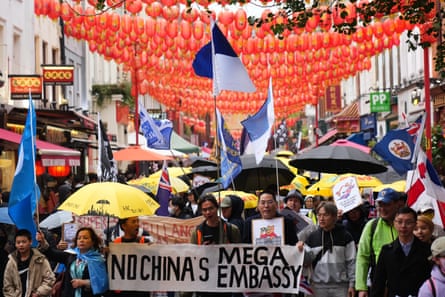
In January, the UK government approved plans for a new, large Chinese embassy at Royal Mint Court in London, ending years of fraught debate over the security risks it would pose. For Law and others, the risks are evidently just as real right now.
“The Hong Kong diaspora in the UK has become increasingly fearful,” the HKA wrote in its submission. “Many avoid political engagement, stop attending community events, and self-censor to avoid repercussions.”
That rang true for Law. He takes no risks, he offers the Chinese authorities few opportunities, and the outcome of the trial will not change that: “I am cautious about things.”