





One of Britain’s most shocking miscarriages of justice began before dawn on a summer day in Salford more than 20 years ago.
A young woman had walked the darkened streets alone for about five miles when she was honked at, wolf-whistled and was so frightened she hid for a while in undergrowth.
“I’m so scared,” she texted her sleeping boyfriend at 4.26am when she heard a man order her to get into the bushes “cause he had a gun pointing to my head”.
After enduring this ugly harassment from three different men, the third went on to brutally rape her.
The attack was so vicious she passed out from strangulation. Her left cheekbone was fractured and left nipple partly severed from a bite.
When she dragged herself into the road, sliding in and out of consciousness, people drove past ignoring her cries for help.
The young woman was failed on that harrowing morning in 2003 – and let down again and again over the next two decades by almost every official body responsible for getting her justice.
She was forced to relive the experience again last month as her attacker, the convicted rapist Paul Quinn, went on trial after evading justice for nearly two decades while an innocent man, Andrew Malkinson, spent 17 years in prison.
Quinn was found guilty on Friday after a five-week trial at Manchester crown court, three years after Malkinson’s rape conviction was quashed.
A catalogue of official failure will now be examined by a judge-led public inquiry. It will examine the role of police and prosecutors in Malkinson’s wrongful 2004 conviction, and how a golden opportunity was missed to help exonerate him just three years later.
Quinn’s trial raised further damaging questions. Why was a man with previous convictions for raping a child – who lived locally and was known to police – not a person of interest at the time? Why did a police officer seemingly destroy vital evidence in 2016? Were doubts about Malkinson’s guilt covered up by Greater Manchester police (GMP)?
And, perhaps most pressingly, did Quinn carry out further violent sexual assaults in the 19 years he was at large?
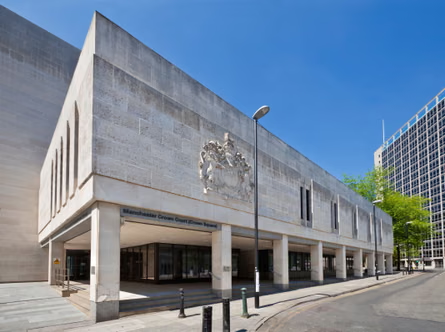
Twenty-two years after she last entered the witness box at Manchester crown court, the victim, now in her late 50s, returned on the third day of Quinn’s trial. Dabbing her face with a tissue, she held the hand of a member of court staff for support and sobbed as she recited the oath.
Then she dropped a bombshell.
To a silent courtroom, she admitted having doubts that Malkinson was the attacker from the moment she saw him in the dock in 2004. Not only that, she said, she raised these concerns with police at the time.
“I remember telling one of [the police] that I wasn’t too sure it was the right man,” she told the jury last month. “And they said: ‘Don’t worry, it’s just trial nerves, it will all be OK.’”
Her revelation stunned the dozen or so journalists present. Jurors looked gripped. It even seemed to take Quinn’s barrister, Lisa Wilding KC, by surprise, as she had to remind the victim that she had told Malkinson’s trial she was “more than 100% sure” he was the attacker.
“I was very naive,” she said remorsefully. “I listened to what police said and I was scared coming into the courtroom. I just went with what people told me to do and I was reassured it was fine – it was the right man.”
Who exactly had she told about her concerns? And what did she mean by “what people told me to do?”
These questions were not answered during the trial but will now be examined by the public inquiry and a separate investigation by the police watchdog, the Independent Office for Police Conduct (IOPC).
GMP said it had no record of the woman raising these doubts at the time.
Steven Bell, the detective who led the original investigation and who retired months after the 2004 trial, told the court he had no recollection of hearing of her concerns.
A handwritten note by Bell suggested he had met the victim in the witness suite at Manchester crown court at the time but, again, he said he had no memory of ever meeting her.
Five GMP officers are currently under investigation by the IOPC on suspicion of gross misconduct, including one who could face criminal charges on suspicion of perverting the course of justice over their involvement in the 2003 inquiry into Malkinson and the subsequent trial. A sixth officer, still serving at GMP, is being investigated on suspicion of misconduct.
The IOPC inquiry is examining whether police failed to disclose the criminal histories of its two key witnesses, Beverley Craig and her partner Michael Seward, and whether they were offered any incentive to provide evidence against Malkinson.
Seward, a heroin addict who later died, was facing charges for motoring offences and was alleged to have received lenient penalties after identifying Malkinson. The police watchdog is also assessing whether officers followed proper processes after Craig initially picked out another man in a digital ID parade – but changed her mind and selected Malkinson after speaking with a police officer.
Another focus of the IOPC investigation is GMP’s destruction of vital evidence, including the victim’s clothing, in February 2016, while Malkinson was challenging his convictions.
This and two other deletions, in 2011 and 2013, appear to be a clear breach of the law under the Criminal Procedure and Investigations Act 1996, which states all material that may be relevant must be held until the defendant is released from custody – which in Malkinson’s case was December 2020.
Fortunately, samples from the victim’s clothing had been retained in a forensic archive, allowing them to be tested using new methods.
In late 2022, these tests confirmed a one-in-a-billion match to Quinn from the victim’s vest and – crucially – linked him to evidence taken during an intimate medical examination.
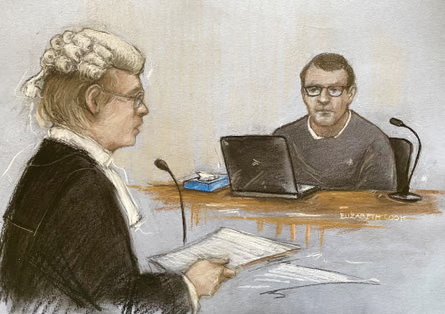
Quinn, 52, sat making notes in the dock throughout the trial. Middle-age had caught up with the man described by witnesses at the time as lean and muscular. He needed reading glasses and breaks after 30 minutes during his evidence, when prosecutor John Price KC was told to put questions in simple terms.
A striking moment came when the court was shown a 2003 photograph of his victim’s swollen and battered face.
It had been nearly 23 years since he last saw the woman he dragged down a motorway embankment and raped, but he did not flinch.
Quinn was 29 at the time, a father of two and married to his childhood sweetheart. They would go on to have three more children, plus a step-child Quinn raised as his own.
They lived on a typical redbrick terrace estate in Little Hulton in Salford, nine miles north of Manchester. Their house was a 10-minute walk from where he first spotted his victim in the early hours of 19 July 2003.
Quinn was identified as a suspect in November 2022 as a result of a fresh DNA analysis of a sample he had provided to police a decade earlier.
Why he had provided that crucial sample the jury was not told, but he was one of thousands of serious ex-offenders whose DNA was sought in 2012 because their convictions predated the national DNA database, which was established in 1995.
It can now be reported that Quinn was known to the police at the time as a violent sex offender.
He was convicted of twice raping a 12-year-old girl in 1990 and 1991, when he was 16. Four years earlier, barely out of primary school, he received a criminal caution for the indecent assault of a woman.
By the end of his teens, Quinn’s criminal record extended to burglary, actual bodily harm, possessing an air gun and arson with intent after setting fire to a wheelie bin outside the home of an ex-girlfriend while she was inside with her children. For that offence he spent his 20th birthday in a young offender institution.
Detectives now believe he is likely to have committed other sexual offences, potentially including some while he was at large.

Investigators are examining possible links to three unsolved stranger rapes – in 2005, 2010 and 2013 – that took place within three miles of the 2003 attack.
Despite being a known sex offender who lived locally, Quinn was never on the radar of the original police inquiry. Instead, officers homed in on Malkinson.
In the witness box, Quinn painted a picture of a hard-drinking grafter, who was out partying in the sticky-carpet pubs of Farnworth when he wasn’t installing fences. He was also, he admitted, a terrible husband.
A central part of his defence was that he was prolifically unfaithful over an 18-year period, including the time of the 2003 rape, claiming he had cheated on his wife “hundreds of times”.
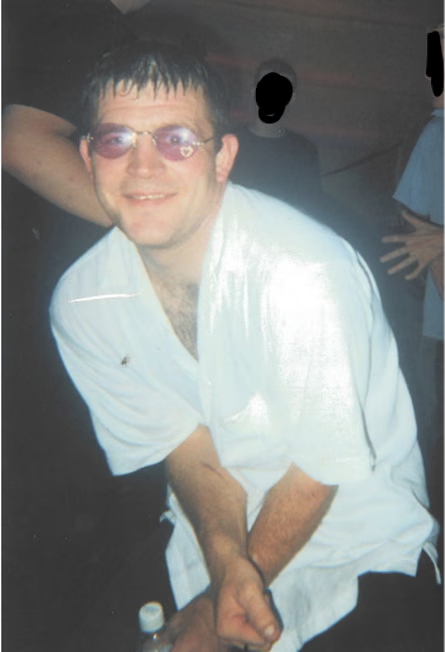
He knew during his police interview that his DNA had been found on the victim and suggested they may have had a consensual encounter, even though he did not recognise or know the woman.
By his account, Quinn “copped off” – as he put it – with about 2,000 women in the area over the years. Police believe this to be a carefully constructed lie: their inquiries found barely a handful of women who admitted sleeping with him.
He knew by this point that a substance found in condom lubricant was discovered on the victim, and claimed never to have used a condom in any of his extramarital activity.
When officers expressed surprise he had never caught a sexually transmitted infection, he replied: “Call me bloody lucky.”
After divorcing his wife and moving to Exeter in 2017, Quinn appeared to drop off the radar. Police believe his move to the south-west was prompted by a drugs dispute and a debt that he owed; he was convicted for producing cannabis in January 2013.
When GMP officers knocked on his door on the afternoon of 13 December 2022, Quinn was living in a modern redbrick house with his new partner in a suburb about two miles east of Exeter.
A neighbour, who asked not to be named, said: “He lived here until a few months ago. He was quiet and polite. We never had a problem with him. I had no idea he was in court for anything. He just disappeared a little while ago.”
Quinn told jurors he was “in shock” and “overwhelmed” at being arrested – but it seemed he feared that knock on the door for years.
In September 2019, a year before any widespread publicity about the Malkinson case, Quinn looked up a Manchester Evening News article from the original trial. Tellingly, four minutes later he searched for “wrongly convicted cases uk”.
“It was just something I had an interest in, wrongful convictions and true crime,” he told jurors. Price, prosecuting, asked: “In September 2019 there were two people who knew that Mr Malkinson was a wrongful conviction: him and you?” “No,” Quinn replied.
When the Guardian revealed in 2022 that a fresh DNA analysis linked another man to the crime, Quinn’s online activity rocketed. Over the following weeks, he searched “how long is dna kept in database”, “dna matches from skin”, “Is my DNA in a database UK” and, in the dead of night, “why am I sweating so much all of a sudden”.
Why had he made these searches, if not out of concern that police were finally on his tail? The timing was a “complete coincidence”, he claimed, adding it was “just a general inquisitiveness”. “We used to watch a lot of crime programmes and one of them probably was DNA and that prompted the question,” he said.
It is mainly thanks to the work of Malkinson’s legal team at Appeal, a charity and law practice that challenges wrongful convictions, that Quinn and his victim have finally got justice.
The Criminal Cases Review Commission (CCRC) has admitted several important failures after it twice decided not to refer the case to the court of appeal, despite compelling evidence exonerating Malkinson and implicating another man.

Nearly a quarter of a century later, the victim was understandably reluctant to trust the police again. But she returned to court and was determined to face Quinn, refusing the protective screen that often shields sexual assault victims from the view of her attacker.
“She was determined to be seen, and to be seen that she’s not backing down from the person responsible,” said Rebecca McKendrick, the detective who led the Quinn investigation.
For Quinn, a lengthy prison term awaits. For the police, prosecutors and the CCRC, the reckoning may only just be beginning.
Additional reporting by Steven Morris