




Tensions in France over how to respond to a rise in antisemitism have been running high. A government-backed bill that aimed to deal with the problem was rightly denounced as an attack on freedom of expression before being quietly shelved by the government last month.
Introduced in 2024 by Caroline Yadan, a member of the national assembly, the draft legislation was intended to counter “new forms of antisemitism”. But while its explanatory memorandum raised legitimate concerns about the sharp rise in incidents of antisemitism recorded since the Hamas massacres in Israel on 7 October 2023, its wording quickly veered toward a different objective: curbing the ability to criticise Israel.
It must be possible to denounce the many crimes – extensively documented – committed by Israel, and to do so repeatedly without risking sanctions. Freedom of expression in France allows individuals to voice any form of sentiment towards any country as long as there is no incitement to violence.
But the purpose of Yadan’s bill seemed clear. It proposed widening the existing offence of “glorifying terrorism” so that “indirect incitement” could be punished. The draft introduced a new offence penalising the act of “inciting the destruction or denial of a state”.
Originally elected for Emmanuel Macron’s party to represent French citizens abroad, including in Israel and Palestine, Yadan distanced herself from the president’s political movement last year when he announced France’s recognition of Palestinian statehood.
Her draft legislation raised concerns on several levels. First, the creation of “indirect” or “insidious” – and therefore implicit – offences of glorifying terrorism would effectively force courts to infer a person’s intent. This is an impossible task. It would, as the former anti-terrorism investigating judge Marc Trévidic warned, lead to “total arbitrariness”. How can one prove what a person is implicitly suggesting?
Similarly, a prohibition on “inciting the destruction or denial of a state” would run counter to the fundamental right to decolonisation. How, then, would challenges to the expansion of illegal Israeli settlements – or calls for a single “binational” state – be treated?
Under the proposed legal framework, what would become of the right to question France’s own borders? France’s overseas departments are former colonies in the Caribbean, the Pacific and the Indian Ocean. Independence movements in these territories have not disappeared.
A petition opposing the bill filed on the Assemblée nationale website gathered a record 700,000 signatures. Rights bodies warned of the dangerously illiberal trajectory of the proposal. The Ligue des droits de l’homme saw in the text a troubling attempt to “shield the state of Israel from criticism linked to its grave and repeated violations of international law”.
Five special UN rapporteurs issued an open letter expressing concern that the bill threatened “the exercise of protected rights, in particular the right to freedom of expression and opinion, including media freedom”.
The bureau of the Commission nationale consultative des droits de l’homme warned members of parliament of “the risks these provisions pose to freedom of expression and academic freedom, due to their vague and imprecise nature”. Despite refusing to consider the public petition, the government suddenly withdrew the Yadan bill at the eleventh hour. Instead, it is signalling it will bring forward broader legislation against racism. The prime minister, Sébastien Lecornu, argued in a recent speech that anti-Zionism had become “the mask of an old antisemitism.”
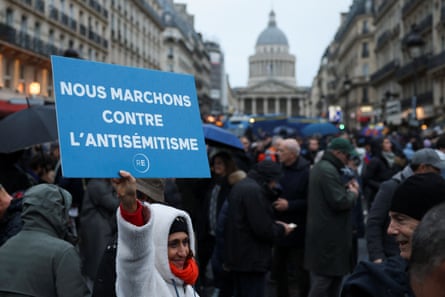
Clearly there should be no tolerance for antisemitism, wherever in society, or on the political spectrum, it manifests. But the Yadan proposals should be seen as part of a broader pattern of structural criminalisation of pro-Palestinian activism.
In the aftermath of the 7 October attacks, the French interior minister attempted to ban Palestinian solidarity demonstrations on the grounds that they are “likely to generate public disorder”. This failed after the Conseil d’État rejected a blanket prohibition. But that ruling did not stop the drive to suppress the movement.
University students who mobilised against the Yadan bill faced violent police repression. The International Federation for Human Rights and the World Organisation Against Torture condemned the police conduct as “a further worrying step in the restriction of freedom of expression and peaceful assembly in France”.
Prosecutions for alleged cases of glorifying terrorism have multiplied since 2023, targeting a wide range of individuals, from influencers to athletes to trade union activists – and even members of parliament. The media outlet Orient XXI noted that while some of those prosecuted had described the attacks by Hamas and Islamic Jihad as acts of resistance, “few explicitly glorified the 7 October 2023 massacres or rejoiced in the deaths of Israeli civilians”.
High-profile figures, including the academic François Burgat, were charged with “apology for terrorism” before ultimately being acquitted.
The French-Palestinian MEP Rima Hassan of the radical left La France Insoumise party, a prominent voice for Palestinian liberation, was arrested last month, taken into police custody and questioned for “glorifying terrorism”. Her alleged offence was an X post (since deleted) quoting Kozo Okamoto, a Japanese terrorist convicted of a 1972 attack at Ben-Gurion airport in Tel Aviv that killed 26 people.
In a sign of the pressure Hassan is being made to face, news of her detention leaked as she was being questioned, appearing in Le Parisien alongside bogus claims that synthetic drugs had been found among her personal effects. The drug probe was dropped, but only after days of negative media coverage. Le Parisien later published an acknowledgement that it had jumped the gun and that the drug claims were entirely baseless. But it then emerged, via a Mediapart investigation, that Hassan’s phone had been under police surveillance from the start of the year, without her knowledge. Hassan, a lawyer and a former Palestinian refugee who will be tried in July on charges of online “apology for terrorism”, says she intends to refer the matter to an independent UN rapporteur and to the European parliament.
The disproportionate response to pro-Palestinian activism over what human rights groups have called a genocide raises questions about the lengths deployed, apparently to restrict a form of expression that is essential in a democracy.
The Yadan bill is dead, but that such provisions were ever considered should be seen within a broader dynamic – one that seeks systematically to conflate anti-Zionism with antisemitism and narrow the space for, if not undermine, the legitimacy of any pro-Palestinian discourse.
-
Rokhaya Diallo is a writer, journalist, film director, activist and Guardian Europe columnist.