








‘One does like to make one’s mummy just as nice as possible.” So James Abbott McNeill Whistler said about his triumphant painting of his mother Anna – or Arrangement in Grey and Black No 1 as he christened it. Whistler was not a man given to undue modesty, but in 2026 his words sound like a rare understatement. Over the past century and a half, Whistler’s Mother, as it is commonly known, has become America’s equivalent of the Mona Lisa. Anna has never stopped travelling around museums in the US and beyond in those years. This month, for the first time in almost two generations, it will return to London, the city where Anna was painted in Whistler’s Chelsea studio, as part of Tate Britain’s Whistler show.
I got to know every inch of the picture over many months, as I restored it for the Musée d’Orsay to the state it is in now (I was commissioned by the Louvre, the owner of the painting). Whistler is the only artist whose portrait of his mother has reached such superstar status – and its history is fascinating.
The artist was a larger-than-life personality, with a never-ending store of dazzling aphorisms. The young Oscar Wilde was a disciple of his mordant wit and once exclaimed, “I wish I had said that”, to which Whistler rapier-like retorted, “But you will.” However, he was far more than just an amusing man. Walter Sickert, who worked as Whistler’s assistant, called him, “A beacon of light and happiness to everyone who was privileged to come within its comforting and brightening rays.”
Nevertheless, when Anna sat for her son in 1871, nobody would have predicted the success of the painting. Whistler’s life at the time was at a nadir, and London critics panned his work. Arrangement in Grey and Black No 1 was painted in a moment of despair. He had spent four years as an American in Paris, living la vie bohème, garret, mistresses and all. Realising that he stood little chance against his friends and French contemporaries Manet and Monet, he moved to London where the art scene was stuck and ripe for a revolutionary artist.
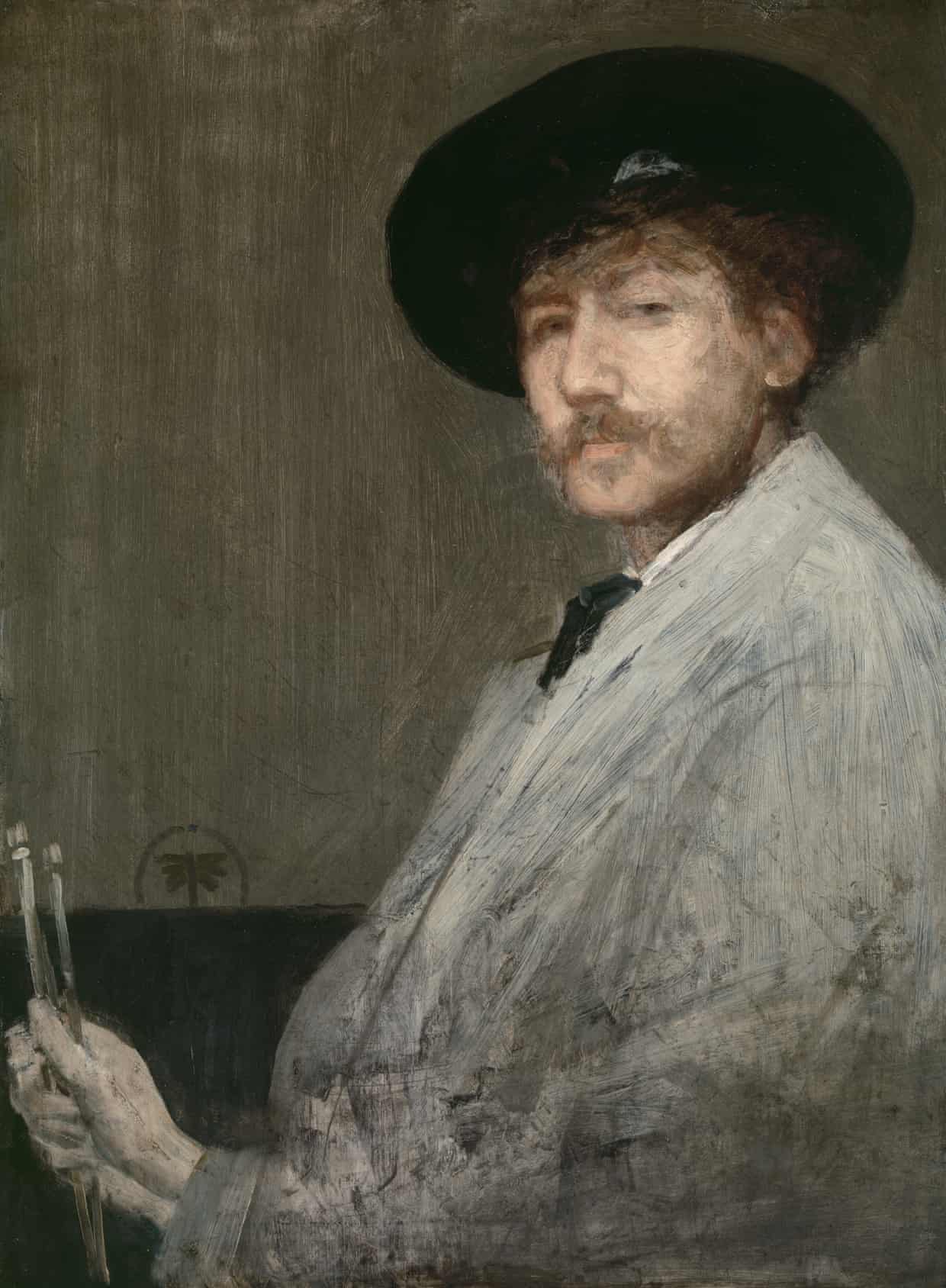
After the initial success of his dreamy masterpiece At the Piano (1858), painted when Whistler was only 25, things had steadily gone downhill, however. English collectors rigidly expected a painting to tell a story and he, by then in his 30s, was doggedly pursuing what he called “the poetry of sight”. This was radically different from the impressionists taking Paris by storm with their interest in capturing light. Whistler was not that interested in nature.
The portrait actually came about by chance. In 1871, the 15-year-old daughter of William Graham MP had run off from posing for a lucrative society portrait. Whistler asked Anna instead (it is painted on the reverse of a used canvas, possibly the one he had been labouring on). His mother could sit for him in his studio rather than stand on account of her poor health. The footstool in the painting may even have been another concession: a footwarmer in the cold, crepuscular, north-facing studio of the house on Cheyne Walk.
Everything suddenly came together in flashes of genius. Whistler was far from an intellectual, but he had the equivalent of perfect pitch for art. He was interested in its texture and painted its deep blacks almost like ink as an experiment. What colour there is lies in thick traditional paint. The background of Whistler’s Mother is his minimalist studio. Very modern today, it was alien to the riot of Victorian colours, tchotchkes and tapestries in fashion in London at the time.
When Whistler’s Mother was exhibited at the Royal Academy after much arm-twisting by his friends, art experts were perplexed. A critic for the Examiner newspaper gave Whistler the benefit of the doubt that the likeness of the room and his mother were “probably” true, but otherwise concluded “it is not a picture”, decrying the use of only grey and black. Only when the admiring French government bought the painting in 1891 did Britain’s art establishment agree that it had let a valuable treasure slip through its fingers. It would take Britain another three decades to recognise the revolution that had happened under its nose.

With Mother, Whistler became the first in the line of America’s own great painters: Edward Hopper, Andy Warhol, Mark Rothko to name but a few. As a restorer, I can clearly see how Whistler’s burst of creative energy was uniquely American. Warhol once remarked, “My pictures won’t last. I used cheap paint”, and Whistler could easily have said something similar. The blacks of Anna’s skirt already looked different when the French state bought the painting for the Louvre. Whistler didn’t help matters by having it relined too soon for the occasion, soaking the paint into the canvas like butter into toast. In many ways, the painting was as tricky to restore as the now quietly decomposing Rothkos in the cellars of museums around the world.
At the same time, the heart of the painting is indestructible as a touching portrait of the affection between a mother and son. In a letter she wrote, she revealed how Whistler “had no nervous fears” and that he kissed her when it was done. There is no artifice here. Anna always dressed in a widow’s plain black dress with a white bonnet. She was as devoted to her Puritan religion as Whistler was to his art and they respected each other’s devotion without question.
Whistler accompanied his mother to Sunday mass, and when she moved in with him and his girlfriend Jo Heffernan on Cheyne Walk, she fused seamlessly into his artistic milieu of louche and outrageous friends, including Aubrey Beardsley and Algernon Swinburne. Only once, when she opened the door to his studio and found the maid posing in the “all over”, did she quickly close the door.
During the long process of her restoration, Whistler’s Mother ended up by chance next to Ingres’s enormous portrait of Napoleon decked out in all his imperial pomp. Yet the emperor struggled to overpower the widow from the Carolinas. Which makes sense: after all, if everyone’s life had one empress, wouldn’t it be one’s mother?