





Giant “kraken-like” octopuses that used powerful beaks to crunch through bones of prey were among the most formidable predators of the Cretaceous oceans, according to research.
Analysis of dozens of newly identified fossils reveals that some ancient octopus species reached up to 19 metres in length, meaning they would have rivalled – and possibly even preyed upon – apex predators such as mosasaurs and plesiosaurs.
Distinct wear patterns on the enormous fossilised beaks, which date back up to 100m years, suggest they would have routinely crushed hard bones and shells.
“Our study shows that these were not simply large versions of modern octopuses,” said Dr Yasuhiro Iba, a palaeontologist at Hokkaido University and lead author of the research. “They were giant predators at the very top of the Cretaceous marine food web. This changes the view that Cretaceous seas were dominated only by large vertebrate predators.”
Until now, relatively little has been known about ancient octopuses, whose soft bodies are very rarely preserved as fossils. The study relied on detailed analysis of fossilised beaks, a hard, structure that is the only rigid part of an octopus’s body.
The team re-examined 15 large fossil beaks that had previously been assigned as vampire squids, but which the latest analysis concludes belonged to a group of ancient octopus relatives known as Nanaimoteuthis. Using digital imaging, the team also uncovered an additional 12 octopus beaks hidden within Cretaceous rocks, dating to 72m to 100m years ago.
One species, Nanaimoteuthis haggarti, was found to have a beak larger than that of the modern giant squid, a creature that reaches about 12 metres in length and until now had been regarded the largest known invertebrate.
By using the relationship between jaw size and body length in modern finned octopuses, the team estimated that N haggarti was between 7 and 19 metres in total length, which could make it the largest invertebrate on record.
Dr Thomas Clements, a palaeobiologist at the University of Reading, who was not involved in the research, said: “To see a beak this size is quite amazing, to be honest. It was a massive animal. I certainly wouldn’t have wanted to go swimming in the ancient oceans if these things were swimming around.”
Modern octopuses do not swallow prey whole but use their long, flexible arms to capture and subdue the prey and then dismantle it with their beak. The ancient specimens showed distinct patterns of wear that pointed to a similar predation strategy.
In the largest individuals, the beaks showed extensive wear, with once sharp features, as seen in small juveniles, becoming blunted and rounded over time, and chips and scratches also visible.
Iba said: “It probably used its long arms to seize prey and its powerful lower jaw to crush hard structures such as shells or bones. The strong wear on the jaws indicates frequent processing of hard prey.”
This would have included bony fish, shelled animals and, possibly, giant marine reptiles such as mosasaurs, which would have been comparable in size.
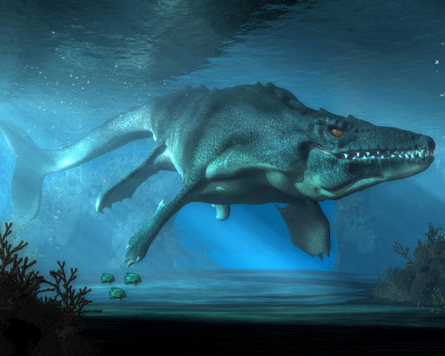
Clements said: “Whenever you see artistic reconstructions, it’s always a vertebrate eating a cephalopod. It is quite nice to imagine an octopus eating a large vertebrate for once. As a cephalopod researcher I’m very excited to see invertebrates that may have rivalled vertebrates.”
The beaks appeared more worn on one side more than the other – evidence of so-called lateralised behaviour. This suggests they may have had arm preferences (handedness) for specific tasks, as modern octopuses do, favouring some arms for exploration and others for feeding.
Iba said: “This indicates that these animals were not only powerful, but also behaviourally sophisticated predators.”
The findings are published in the journal Science.