





In R&B, soul, funk, disco and other forms of African-American popular music, no performer is more valuable than the drummer who can find “the pocket”: the name given by musicians to that elusive place where the rhythm propelling a song is both profound and irresistible. James Gadson, who has died aged 86, seemed to live his entire working life deep in that pocket, giving momentum to such 1970s hits as Bill Withers’ Lean on Me, Marvin Gaye’s I Want You, Diana Ross’s Love Hangover, the Jackson 5’s Dancing Machine, Gloria Gaynor’s I Will Survive, Smokey Robinson’s Cruisin’, Peaches & Herb’s Reunited and many more in future decades during his career in the recording studios of Los Angeles.
Other artists in related fields also made grateful use of his gifts. He played on Boz Scaggs’ Slow Dancer (1974) and Elkie Brooks’s Live and Learn (1979), Leonard Cohen’s The Future (1992) and, in this century, Rickie Lee Jones’s The Evening of My Best Day, Paul McCartney’s Chaos and Creation in the Backyard, Lana Del Rey’s Paradise, and several albums by Beck, among others.
Gadson came up in an era when every major American city had an elite group of drummers who were on first call for local recording sessions. The busy studios of LA were home to Earl Palmer and Hal Blaine, followed by Jim Keltner, Jim Gordon, Paul Humphrey, Ed Greene and Gadson, the one whose work would later be regularly sampled by artists of the hip-hop and breakbeat generations, including NWA and Kendrick Lamar.
He had begun his career in the early 60s as an adventurous jazz drummer before resetting his sights on what seemed, at first hearing, to be a less challenging form of music. He recognised, however, that more commercial idioms imposed their own demands, particularly when the music was aimed at the dancefloor.
“Most grooves, especially for dance music, are very simple,” Gadson said while discussing his work in an interview with the magazine Modern Drummer in 2007. “Even so, to learn them, you have to slow them down. A lot of times we do all these rudimental things to see how fast we can play. I think you have to slow it all down and simplify it. Then you can kind of feel whether it’s danceable or not.”
Although much of his work was done away from public view, his gifts were on show in a tiny London television studio one night in 1972, as a member of Withers’ four-piece accompanying band playing Ain’t No Sunshine and Use Me to the viewers of BBC2’s The Old Grey Whistle Test. Soon thereafter Withers and the band travelled to New York for concerts released as the classic Live at Carnegie Hall album.
Gadson never drew attention to himself. Everything he played was aimed at enhancing the song. When he unleashed rapid 16th notes (semiquavers) on the hi-hat or snare with a single stick, the virtuosity involved was not intended to draw attention to itself. Neither were the subtly syncopated bass-drum patterns he inserted behind Ross on Love Hangover, at a time when the drummers on most disco records were content to keep their right foot hammering out an unvarying 4/4.
He was born and raised in Kansas City, the son of a drummer, Harold Gadson, and his wife, Arlethia (nee Hopson). Harold played with big bands but did not want his two sons to follow him into a career in music, although he did buy them cornets to play in a marching band. But by the time James reached his teens, he was singing with his brother, Tutty, in a doo-wop group called the Carpets. He was also sneaking into nightclubs under the legal age, and falling in love with the music he heard. On returning home after spending two years in the US Air Force, aged 21, he decided to become a drummer.
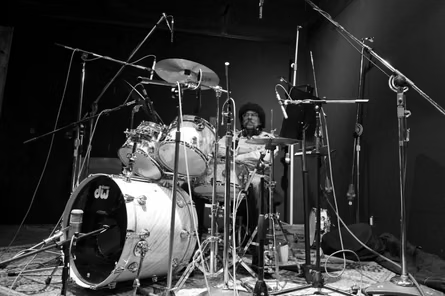
The first name-artist with whom he went on the road was Hank Ballard, the originator of the Twist, from whose band members he learned about the advanced jazz of John Coltrane. Returning once more to Kansas City, he played in clubs with organ trios and free-jazz groups, but the turning point came when he moved to Los Angeles towards the end of the 60s and joined the band of the singer Charles Wright, a former member of an LA doo-wop group called the Shields.
Wright ordered him to forget all the fancy jazz stuff. “Just play it straight,” he told his new drummer, as the musicians – soon to become known as the Watts 103rd Street Rhythm Band – rehearsed a set of songs that included Love Land and Express Yourself (later sampled by NWA), which became big hits on the US pop and R&B charts in 1970. Gadson listened widely and worked hard to meet Wright’s requirements, and the laconically funky rhythm of Express Yourself in particular showed how thoroughly he had absorbed the New Orleans drumming of the Meters’ Zigaboo Modeliste.
Gadson called Los Angeles “the melting pot of rhythm”, taking influences from everywhere: the “second line” rhythm from New Orleans, the Mississippi shuffle, Motown beats, Chicago’s new jack swing, Latin patterns from New York, disco’s four on the floor – “a dip of this and a dash of that”, as he put it. He blended it all into a loose-jointed style that throughout his life attracted employers from BB King, Bobby Womack and Ray Charles, through Herbie Hancock and Herb Alpert to Helen Reddy and Sturgill Simpson. His final recordings included playing on recent albums by Keith Urban and Michael Kiwanuka.
In 1968 he married Barbara, who survives him, along with their children, grandchildren and great-grandchildren, and by a sister, Robbie.