



惯性聚合 高效追踪和阅读你感兴趣的博客、新闻、科技资讯
阅读原文 在惯性聚合中打开

推荐订阅源

博客园 - 司徒正美
aimingoo的专栏
aimingoo的专栏
MongoDB | Blog
MongoDB | Blog
云风的 BLOG
云风的 BLOG
OSCHINA 社区最新新闻
OSCHINA 社区最新新闻
酷 壳 – CoolShell
酷 壳 – CoolShell
博客园 - 聂微东
Y
Y Combinator Blog
T
Tailwind CSS Blog
奇客Solidot–传递最新科技情报
奇客Solidot–传递最新科技情报
S
SegmentFault 最新的问题
让小产品的独立变现更简单 - ezindie.com
博客园 - 【当耐特】
IntelliJ IDEA : IntelliJ IDEA – the Leading IDE for Professional Development in Java and Kotlin | The JetBrains Blog
J
Java Code Geeks
美团技术团队
Google DeepMind News
博客园_首页
Apple Machine Learning Research
T
The Blog of Author Tim Ferriss

The Guardian

Wes Streeting insists he can win Labour leadership race despite ‘underdog’ status What does sex mean to you? I’m a sex educator – here’s why I don’t define it at all Pentagon releases second batch of UFO videos and first-hand testimony Suspected Ebola cases triple in a week as WHO warns of rapid spread in DRC Chinese fast-fashion company Shein to buy eco-friendly retailer Everlane WSL academy sides heading for third tier in England despite backlash Judith Chalmers, presenter of TV series Wish You Were Here, dies aged 90 Gaza flotilla activists allege sexual assault and rape in Israeli detention Nobody better represents Israeli politics today than Itamar Ben-Gvir Premier League team news: predicted lineups for the weekend action Leinster desperate to tear up Bordeaux’s script in Champions Cup final cauldron De Zerbi defends absent Spurs captain Romero after Hoddle’s ‘selfishness’ jibe What’s at steak: myths about masculinity and meat eating pose a challenge for the climate crisis ‘Everyone is proud of it’: dismay in Halifax at Lloyds’ threat to historic brand Keeping my dead wife’s books safe for our son helped me let go of guilt ‘Maybe the suffering is the point’: what does it take to run 163km up and down a mountain? Roddy Doyle: ‘When you’re a Dublin writer, you’re inevitably asked about Joyce, and it’s tedious’ ‘Venice is beautiful, but inside there is a struggle’: Bangladeshi candidates eye historic breakthrough Teenage boys’ non-custodial sentences for rape ‘unduly lenient’, says Jess Phillips Primary schools lose out as Labour slashes sport funding ‘I’m not trying to replace him’: meet the media mogul taking over Stephen Colbert’s time slot on CBS Nine Sixteenths review – what Janet Jackson’s ‘Nipplegate’ scandal really exposed ‘This is his legacy’: Marco Rubio nears goal of toppling Cuba’s government Hull City owner Acun Ilicali: ‘People think I changed coaches because of ego. It was lack of ego’ What am I bid for a blown-up van? The bizarre art auction aiming to build an eco power station in Reform-held Clacton The best fans to keep you cool: 14 tried and tested favourites to beat the heat Screentime swaps: how to quit doomscrolling without quitting your phone What is immunotherapy and how does it treat cancer and other conditions? Relief all round as Bad Bunny brings back regular length shorts ‘He made us laugh and he never flinched’: America says goodbye to the Late Show and Stephen Colbert ‘The sport won’t be the same’: Nascar world reacts to sudden death of driver Kyle Busch Palantir hits back at Sadiq Khan after £50m contract with Met police blocked Coward review – soldiers find escapism and romance in wartime theatrical troupe ‘Men and boys need to see this’: Jo and Kush and the joy of Race Across the World Pressure mounts on Democratic national committee chair over delayed 2024 election autopsy report – US politics live The Pep years: season by season, how Guardiola’s Manchester City evolved Why an immense marine heatwave off the US west coast has alarmed scientists ‘We will not survive’: jailing of Daria Egereva highlights plight of Russia’s Indigenous people Little glitz and underperforming auteurs: how Cannes 2026 went – and who will win Hundreds protest over Ireland's 'George Floyd moment' after death of Congolese-born man – video Post your questions for Sister Sledge’s Kathy Sledge Health alerts issued for bank holiday weekend as record May heat forecast in UK Mind the drone gap: war games begin inside secret Nato bunker in London tube station Jury discharged at trial of men accused of murdering child abuser Ian Watkins Flotilla video: Ben-Gvir’s template of televised abuse was honed on Palestinians Instagram, X and others blocking Saudi dissidents’ accounts Here’s a potential witness for the police officers investigating Andrew: the police ‘The days I had to have sex with randoms, I thought thank God!’ Jamie Bell on eye-popping drama Half Man Cocktail of the week: Circle 13’s cherry kalimotxo – recipe Driven, outspoken, inspiring: Salah leaves Liverpool having met Kop legend goal San Diego’s Muslim community picks up the pieces after mass shooting: ‘We’re just your neighbors’ Why is Elon Musk so threatened by the casting of The Odyssey? | Arwa Mahdawi ‘My parents didn’t talk about the past’: how director Caroline Huppert recovered her family’s wartime secrets Near death experiences, ‘crip memes’ and the tyranny of the DWP: the new exhibition powered by illness and disability ‘He’s a natural’: Andy Burnham’s allies give his social media style a thumbs up Digested week: memories of Covid resurface with hantavirus and Ebola news The Mandalorian and Grogu shows Star Wars is a cursed franchise – on the big screen at least Spring snow and record-breaking melons: photos of the day – Friday Tosca review – Puccini’s high-octane bloodbath bonanza makes for a shocking festival kick-off Uranium and control of strait of Hormuz key as talks to end US-Iran war continue Lo-fi sci-fi, hollow metal people and Churchill’s big guns – the week in art Carlo Petrini, Slow Food movement founder, dies aged 76 ‘We’ve got 25 to 30% already shot’: sequel to Michael Jackson biopic on way, says studio Children and teens roundup – the best new picture books and novels Britain braces for busy roads as May bank holiday temperatures set to pass 30C Hyperlocal, seasonal and eco-friendly: British flower farms are coming up roses Add to playlist: the virtuoso prog-metal-folk of Brazil’s Papangu and the week’s best new tracks First there were coalmines, then came the windfarms. Why Colombia’s Wayúu people fear Colombia’s green energy boom Standard Chartered boss apologises for ‘lower-value human capital’ comments amid job cuts Electoral reform and reversing Brexit: they’re more connected than you might think Pep Guardiola’s perpetual revolutions have changed face of English football | Jonathan Wilson UN’s climate crisis vote shows political momentum is growing, say experts Dido and Aeneas review – close your eyes and this was a tremendous performance Manchester City confirm Pep Guardiola is leaving after 10 years as manager Doja Cat review – pop superstar or true freak? US iconoclast plays the tension to perfection Michael Carrick appointed Manchester United’s new permanent head coach Trump self-deals, lies and seems to fall asleep in meetings. The media treats it all as ‘priced in’ Venezuelan makeup artist who was deported to El Salvador seeks asylum in Spain: ‘I feel safe here’ Boots Riley: ‘Theft is not outside of capitalism, it’s what it was built on’ Unhappy with your garden plot? Try pretending you’ve just moved in CBS News Radio ends today. It’s a major loss for the US Healey asks Farage if any of £5m gift may have come from Russia-linked profits Revolution Days review – fearless aid worker bears witness to the Arab spring Will this be a glorious summer? You can bet on it: the Stephen Collins cartoon ‘We needed a Hitler who really vibed with the dog’: meet Lexie, the world’s first cinemadographer Mars colony and Grok warnings: five strange details in SpaceX’s pitch to investors Number of air conditioned UK homes doubles to more than 4m in three years England’s final World Cup squad confirmed: Spence and Toney in, Alexander-Arnold out The best mattresses in 2026: sleep better with our 14 rigorously tested picks Estée Lauder ends merger talks with Gaultier owner Puig Biggest drop in petrol purchases in six years hits retail sales in Great Britain Burnham to launch byelection campaign as Green candidate quits after just nine hours – UK politics live Trump’s ‘disappointment’ with Nato will be discussed at leaders’ summit in July, Rubio says – Europe live Slow-moving bands of heavy rain trigger flooding and landslides in parts of China Is This Thing On? to Fuze: the seven best films to watch on TV this week The dinosaurs of international aid must adapt or die – their expensive era is over Mabe Fratti and Bill Orcutt: Almost Waking review – cellist and guitarist unite for tender harmonies and torrid tangles Miles Davis: Ascenseur pour l’Échafaud review – harmonic openness for Louis Malle’s haunting noir thriller Green party candidate for Makerfield byelection quits after less than 12 hours England’s World Cup 2026 squad to be revealed by Thomas Tuchel: football – live
What can Arsenal teach Keir Starmer about politics? You need a clear vision, a tight grip – and hope
Jonathan Fre · 2026-05-23 · via The Guardian

Obviously, I know that politics and football are different. One is a high-stakes endeavour that affects the lives of hundreds of millions of people, with an impact felt around the globe and down the generations – and the other is politics. I know too that there will be plenty of readers who will be like I was until nearly a couple of decades ago: cheerfully indifferent to the beautiful game, even after a week like this one, when the top prize in English football was won. But stick with me, because there are lessons to be learned from what just happened – lessons for politics, for the prime minister and for all of us.

I am referring, of course, to Arsenal winning the Premier League, ending a 22-year long wait that it sometimes seemed would never end. I claim no objectivity here. I became a fan just a few years into that drought, brought into the Arsenal fraternity by my young sons. So there I was, in the crowd that instantly converged on the Emirates Stadium late on Tuesday night, Arsenal shirt and scarf on, singing loudly and beaming at strangers.

Keep politics out of sport, they used to say. But there are things politics could learn from sport – and specifically, from Arsenal’s long-awaited success. And before you dismiss as fanciful the very idea of politicians taking advice from the dugout, recall that it does happen: former Manchester United boss Alex Ferguson confirmed that Tony Blair once sought his guidance on how to manage a star player who refused to obey instructions. (The source of Blair’s trouble was the man in the No 11 shirt, Gordon Brown.)

Start with stability. Mikel Arteta took over in December 2019, a week after Boris Johnson won a landslide election. While Arteta has remained in his post, there have been four prime ministers, with a fifth presumed to be on the way. Downing Street has become like Chelsea, changing bosses with every bad run of form. But the Arsenal way is different.

Even when the team struggled – coming eighth in two successive seasons, which for a club of Arsenal’s standing is the equivalent of taking back-to-back wallopings in local elections – Arteta stayed put. In December 2020, Arsenal were in 15th place. At a moment when most clubs would have shown the manager the door, Arsenal stuck with their leader.
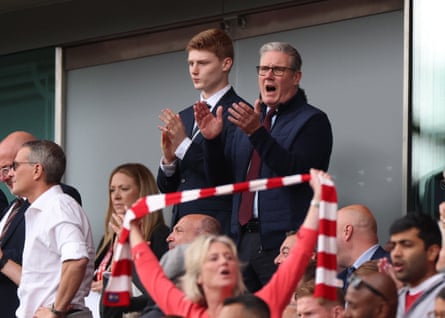
Keir Starmer at the Emirates Stadium last year.
Keir Starmer at the Emirates Stadium last year. Photograph: Hannah McKay/Reuters

Call it strategic patience. The club owners had picked Arteta for the job and they gave him the time to do it. Strange to think that while politics demands instant gratification, it’s sport that can demonstrate the value of waiting.

Patience was the necessary companion to what has been a defining aspect of the Arsenal project: long-term thinking. I learned this week that the club has a “football intelligence unit”, which five or six years ago laid out a timeline and potential route back to the top. According to James McNicholas, who covers the club for the Athletic and is known to fans as Gunnerblog, the unit surveyed the competitive landscape, working out when Arsenal’s rivals might weaken, factoring in everything from the contract expiry of Manchester City’s Kevin De Bruyne to the expected physical decline of Liverpool’s Mohamed Salah. With that, they “plotted a potential window for Arsenal to come to the fore”, working out that the most propitious period would be the one we are in right now. “Everything strategically the club did was about fine-tuning, calibrating a squad to peak in that window,” says McNicholas. That quiet work went on in the shadows for years – and this week we saw the result.

Now compare that kind of long-termism, devising a plan and executing it, with the way government operates. It’s usually, and understandably, focused on the short-term – scrapping a planned rise in fuel duty, for example, to address immediate pressure on the cost of living, rather than advancing the gradual, necessary shift away from fossil fuels. The furthest horizon ministers can see is the next election; sometimes they can’t look beyond that day’s news cycle. On those rare occasions when government does attempt a truly long-term project, the results are too often disastrous: this week we learned of yet another over-run on HS2, set to cost more, take longer and deliver less than anyone ever agreed to.

Of course, patience and long-termism require a third element: a plan. Or, more grandly, a vision. And it’s this that makes Arteta’s achievement an object lesson for one of Arsenal’s best-known fans: Keir Starmer. “Arteta had a rock-solid vision in his 20s,” recalls my colleague Nick Ames, who got to know the Spaniard in his days as a player. Even then, Arteta had developed a philosophy of how the game should be played.
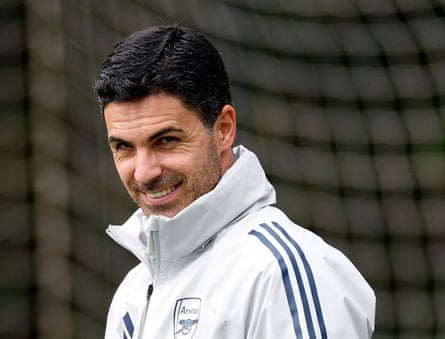
The Arsenal manager, Mikel Arteta, during training this week.
The Arsenal manager, Mikel Arteta, during training this week. Photograph: Peter Cziborra/Action Images/Reuters

The same cannot be said of Starmer. His inability to articulate a vision for the country, or even a plan for this parliament, has been perhaps his greatest weakness. The PM’s defenders might say that he would have done fine, if only the voters had allowed him the space and time Arsenal’s owners granted Arteta. But that kind of patience has to be earned. And the way to earn it is by telling a story so compelling, people are prepared to give you the time to get to the end. Arteta did that, but Starmer never did.

An essential ingredient is hope. Arteta never stopped assuring fans that success was coming, that they could and should dream of the biggest prizes. But, from the start, Starmer lowered expectations, warning weeks into his tenure that things would only get worse. He confused optimism with complacency, moving quickly to stamp it out. People will walk through a storm with you if they think you’re leading them to sunshine. But if the destination is grim, or never adequately described, they’ll soon drift away.

Naturally, vision alone is not enough. It has to be combined with a pragmatic willingness to adapt when necessary – and by something else too. “Arteta is a control freak,” says Ames, noting that the Arsenal boss is across every detail, getting involved with what and when his players eat, adjusting the layout of the training ground, recruiting players personally. He has what politicians like to call “grip”. Contrast that with Starmer, who was happy to leave the handling of Peter Mandelson’s appointment as UK ambassador to Washington to others, with calamitous consequences. A PM who had read the Arteta playbook would have insisted on knowing everything, so he could make the right call.

Still, there are lessons from Arsenal’s victory that go beyond the fan in Downing Street and indeed Westminster. It’s worth saying, after this week’s tumbling migration figures were greeted with such delight, that Arsenal and the rest of the Premier League are only as good as they are because of migration, that ability to draw on talent from all over the world. But there is something deeper to say too.

It’s become commonplace to insist that Britain is broken, that multiculturalism has failed and that London in particular has become a shabby, fearful and unhappy shadow of itself. But that is not what I and thousands of others saw on Tuesday night. The impromptu crowd that assembled, the honking cars and the hugging fans, was made up of all those diverse communities, and generations, so often said to be at each other’s throats. And as longtime Gooner Piers Morgan noted, it looked a whole lot bigger than the rally summoned last weekend by Tommy Robinson, supposedly to “unite the kingdom”. The red kingdom of north London was united this week, in joy and pleasure and relief. Even if you can’t cheer the team – and if you’re not an Arsenal fan, why would you? – you can certainly cheer that.

  • Jonathan Freedland is a Guardian columnist