








Vladimir Putin suggested that the war in Ukraine may be “coming to an end” on Saturday – comments that raise the question of why the Russian president might want a possible end to the war now, given how the fighting is evolving.
1. Russia is losing battlefield momentum
After Ukraine’s failed counteroffensive in the summer of 2023, Moscow had been gradually taking Ukrainian territory. Though the Russian attacks were slow, grinding and costly in terms of casualties, they had created a sense that Ukraine was slowly but inevitably losing. But that has changed.
Ukraine’s recapture of Kupiansk in December – claimed by Moscow to have been taken a month earlier – surprised even western military experts. An agreement that prevented the invaders from using the Starlink satellite internet service in February – and Russia’s own curtailing of Telegram, also widely used for communication – helped Ukraine reverse territorial losses in Zaporizhzhia region of about 100 sq miles.
In April, according to the Institute for the Study of War, Russia lost control of 45 sq miles of Ukraine. It was the first time Russia had suffered a net loss of territory since August 2024 (the month of Ukraine’s surprise attack into Russia’s Kursk region), and comes after the invaders made negligible gains in February and March. A slow-motion victory for Moscow no longer looks certain.
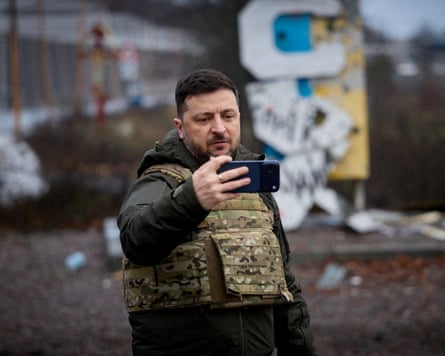
Volodymyr Zelenskyy recording himself in front of a sign that reads ‘Kupiansk’ in December, as Ukraine retook the area from Russia. Photograph: Ukrainian Presidential Press Service/Reuters 2. Russian casualties may exceed replacements
Ukraine says that for the past five months it has killed or wounded more Russian soldiers than are being recruited. Though the figures are hard to verify, Ukraine bases its statistics on combat footage. It said its military had killed or wounded about 35,000 Russian soldiers a month in March and April, overwhelmingly from drone strikes.
Russian recruitment levels, meanwhile, have dipped to about 800 to 1,000 a day in 2026 (24,000 to 30,000 a month), according to the economist Janis Kluge, based on an analysis of regional budget data. That would be in line with statements from the former president Dmitry Medvedev, head of Russia’s recruitment commission, who said “more than 80,000” had signed up in the first quarter.
There is also no immediate sign that Putin has the appetite to launch a second public mobilisation, after the social unrest caused by the first in September 2022.
3. Ukrainian refinery attacks expose Russia to a fall in oil prices
Russia’s economy was faltering early in 2026, but the sudden hike in oil prices prompted by Donald Trump’s attack on Iran has prompted a recovery. Oil export earnings, critical for the Russian treasury, were $19bn (£14bn) in March, up from $9.8bn in February – the highest monthly figure since autumn 2023, according to the Kyiv School of Economics.
However, recent long-range missile and drone attacks by Ukraine on Russian oil export terminals at Primorsk and Ust-Luga on the Baltic, two of 14 refineries or terminals Ukraine says it bombed in April, have slashed export volumes. Daily exports fell from 5.2m barrels a day to 3.5m, according to Sergey Vakulenko from the Carnegie Foundation.
For now, the higher oil price was more than enough to offset estimated falls in Russian exports, Vakulenko concluded, but that could rapidly change if the US and Iran reach an agreement to reopen the strait of Hormuz and oil prices tumble.
4. Ukraine is becoming a missile and drone superpower
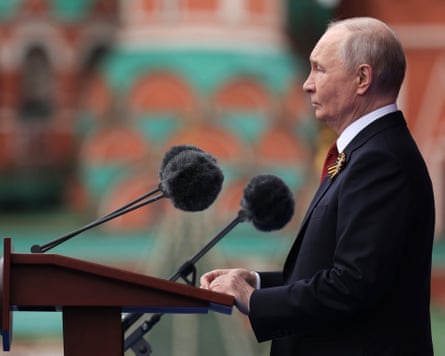
Putin giving a speech during the Victory Day military parade at Red Square in Moscow. Russia feared Ukraine could target the parade with drones. Photograph: Vyacheslav Prokofyev/AFP/Getty Images At first, after Ukraine was invaded, it was heavily reliant on western military equipment and training. Once, Kyiv placed heavy hopes on western F-16 fighters to try to achieve a breakthrough – and on US Patriot air defence systems to protect its skies.
Gradually, it became clear that western stockpiles were running short, prompting Ukraine to invest more in its own knowhow and equipment. Success has been demonstrated by the deep strikes on Russian oil infrastructure – which include three drone attacks in the past fortnight on a refinery in Perm, 930 miles from the frontline.
The arrival of cheap interceptors on the frontline in early spring has given Ukraine fresh hope it can knock out all but the faster Russian missiles as Patriot missile stocks become scarce. Ukraine said its interceptors, including Sting from Wild Hornets, shot down 33,000 drones during March, double the month before. It has begun to export the technology to Saudi Arabia, Qatar and the UAE, all countries attacked by Iran in the spring.
Russia even feared Ukraine could target its Red Square victory parade over the weekend, prompting Zelenskyy to issue a decree saying he would allow the event to proceed.
5. Putin may hope to reignite dormant White House interest
Russia’s main effort has, for some time, been diplomatic. Putin hopes that he can persuade Trump to force Zelenskyy into giving up the rest of Donetsk, to make up for stalling frontline progress. It was this offer that Putin made at the Alaska summit in August and, while the US considered it, Trump did not force it on Ukraine.
Despite Putin’s comments at the weekend, and a suggestion that he could work with the former German chancellor Gerhard Schröder as a mediator, there is no sign that Russia’s maximalist demands have eased. Last week, Yuri Ushakov, a key Kremlin aide, said peace talks could not start until Ukraine withdrew from all of Donetsk.
Trump has been distracted by the Iran crisis, but Putin may be hoping to re-engage the White House with fresh language, if nothing else.

