








Jeremy Beecham, who has died aged 81, was an outstanding figure in local government as the Labour leader of Newcastle city council from 1977 to 1994.
He built on the work of his immediate predecessors in restoring faith in the integrity of the council following the corruption of the T Dan Smith era, and guided it through the unfamiliar territory of collaboration with the new Tyne and Wear county council.
He and his team focused on the basic local government responsibilities of council housing, education and social services – the latter his special interest. Initially these priorities led him to allow council staffing levels to run out of control. As a reporter for the Newcastle Chronicle throughout his leadership, I noted in 1978 that the council was employing more than 18,000 people: in the very different circumstances of 2025, the number of full-time equivalent posts was below 7,000.
However, Beecham maintained a cool head and a legal budget at a time when leaders elsewhere such as Ted Knight in Lambeth and Derek Hatton in Liverpool were making firebrand reputations for themselves by openly defying Margaret Thatcher’s Conservative government. He held his position as council leader not through the backing of a powerful faction within the Labour group, but by his formidable intellect and amicable, if somewhat aloof, personality, which always enabled him to avoid giving offence. A talented debater, he put down the opposition in the council chamber with wit, but never unkindly.
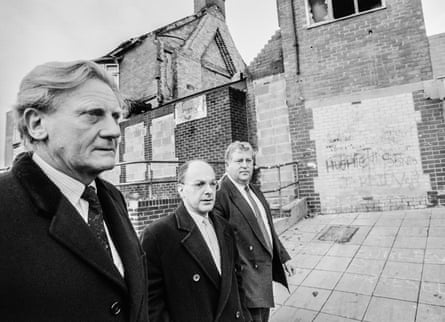
He was never part of the drinking culture that affected parts of the council, as so many other parts of society at the time. He did not depend on gladhanding for his control of his colleagues, but commanded respect as much as popularity. Often he could be seen walking briskly through the city centre, a small, dapper figure with umbrella in hand, between the Civic Centre and the offices of his law firm, and was happy to be greeted with shouts of “Y’alreet, Jeremy?”.
The council under Beecham designated Newcastle’s most impoverished wards along the north bank of the Tyne, from Scotswood to Walker, as priority areas, and poured millions of pounds into their improvement, regeneration and public services. These were his people, in spite of their very different backgrounds, and they voted for him time and again.
Thousands of old terrace slum houses from the Victorian era were modernised instead of being cleared and replaced by new slums. Where there was an exception, as in the case of the now Grade II-listed Byker Wall – Ralph Erskine’s estate built in the 1970s to provide 1,800 homes – it was carried through in close consultation with local people.
During the extensive redevelopment of the 1970s, much of the city centre was a building site. Part of the neo-classical Eldon Square was demolished to make way for a shopping centre.
A motorway was being driven through the centre, and tunnels and underground stations were being created below to create the Tyne and Wear Metro, Britain’s first urban light rail transit system. Its original network was completed in 1984.
There was little that the city council leader could do about the motorway and the Metro, since in 1974 responsibility had passed to the new Tyne and Wear authority. In the 80s and 90s, Beecham supported its Quayside development, to a plan by the architect Terry Farrell to revitalise the banks of the River Tyne – Newcastle on the north and Gateshead on the south – with arts and leisure amenities filling the gaps left by run-down docks and industries.
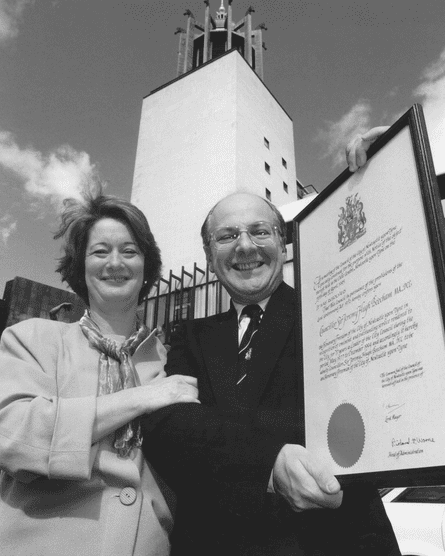
The city emerged from Beecham’s leadership as a regional capital with professional jobs at two universities – Newcastle and Northumbria – and a range of thriving professional services. There was a limit to what his administration could accomplish at a time when unemployment was rising as the region’s mining, shipbuilding and engineering industries were in decline: as he acknowledged, there is much left to do when inequality remains high in the 53rd (out of 326) most deprived local authority area in the country.
Born in Newcastle, Jeremy was the son of Freda (nee Cohen), a teacher, and Leo Beecham, a tailor, and he attended the city’s Royal grammar school. At University College, Oxford, he gained a first-class degree in law (1965), and went on to qualify as a solicitor.
Once back in Newcastle he was elected to the council at the age of 22 for the Benwell ward (later Benwell and Scotswood), one of the city’s most deprived. He remained its representative for more than half a century, even after being appointed to the House of Lords in 2010. There he served as a shadow minister for communities and local government and for justice, retiring in 2021 due to ill health. He stood down from the city council in 2022, and at the end of his life suffered from Alzheimer’s.
His one attempt to enter the Commons came in the 1970 general election, when he could not overturn what was then the safe Conservative seat of Tynemouth. Beecham chaired the city council’s social services committee from 1973 to 1977, and in 1991 became chair of the Association of Metropolitan Authorities (AMA). He was knighted for services to local government in 1994, at the end of his leadership of the council. When the Local Government Association was formed from the merger of the AMA and other organisations in 1997, he was its first chair. In the Labour party, he joined the national executive committee in 1998 and was its chair in 2005-06.
In 1968 he married Brenda Woolf, and they were both active in the Jewish community. She died in 2010, and he is survived by their son, Richard, and daughter, Sara.