






Angel Otero is on the brink of tears. He’s describing the feeling of being part of fellow Puerto Rican artist Bad Bunny’s La Casita – a set the musician used on stage during his 31-show residency on the island last year, a recreation of a typical single-storey home found across Puerto Rico and the wider Latin American diaspora.
“When I was invited, of course, I accepted,” Otero tells me, standing in his temporary studio in Somerset. “Although I tend to shy away from things like that. The replica is a very similar setting to the one I grew up in, and I had multiple feelings when I got there. Of course, there’s the spectacle of being on the stage of a significant artist of our time, who is from my island. But it also transported me into the subject I’ve been working on for so long. It was a sort of validation, seeing people enjoying the culture, people specifically from my kind of upbringing.”
Otero, 45, was born in the Santurce neighbourhood of San Juan, the Puerto Rican capital, “literally facing the ocean”. Santurce has since been gentrified, but in the 1980s his grandmother Maria Luisa – who Otero grew up with – experienced a series of robberies. The family built a home above Otero’s mother’s apartment in Bayamón for her, where Otero spent most of his childhood while his mother worked in a full-time job at a bank. “I grew up with women – the men all left early.”
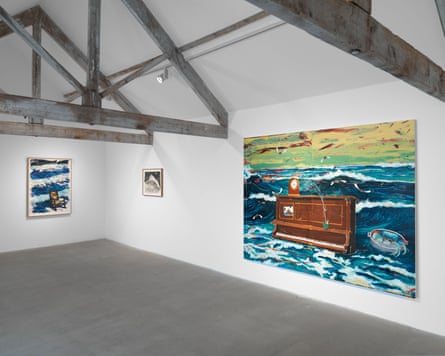
That humble apartment and its furniture, knick-knacks and photographs, into which a myriad memories are distilled, have been the recurrent subject of Otero’s dreamlike, large-scale, semi-abstract paintings since he was a student in Chicago. The flowers and house plants, pink vanity cabinet, four poster bed, piano, birdcages and clocks that float against a background of a turbulent sea in his new paintings all directly reference his childhood home.
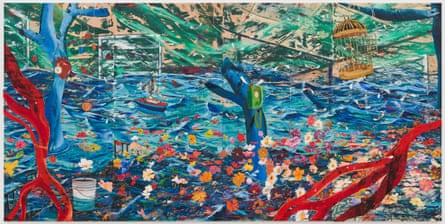
For almost two decades, these motifs have been an indirect way of representing Otero’s family and culture. As a student, he had trepidation about painting direct portraits of his family members. He developed an ingenious painting style that wrestled with the traditional canon of oil painting, by applying paint skins – sheaths of paint dried on Perspex panes – to the canvas. It was born out of resourcefulness at first, but the process began to resonate with what Otero wanted to say: the worked, sculptured, wrought surfaces of his works are an expression of the tensions that reside within us, the layers of our existence colliding. His early experiments were warmly received by his peers and tutors, and the paint skins are now his trademark, a kind of collapsing of collage and sculpture into painting.
We’re standing in front of a larger-than-lifesize diptych that is the most figurative painting he’s done. It’s based on a photograph of Otero’s grandmother holding him on his first birthday, dressed in a sailor suit, depicting the pair from two different angles. Visceral striations of paint have been applied over the portrait, so that it seems to struggle with the surface. The image of the two of them is distinct, but distant, fading fast under life’s fast-moving current, like memories.
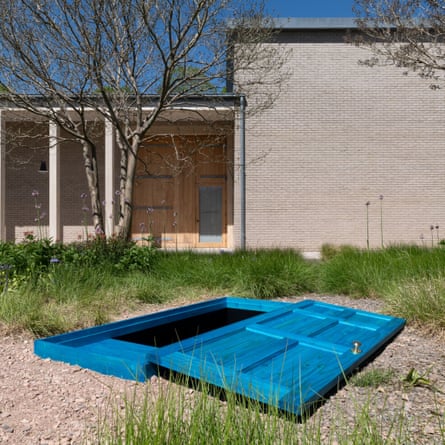
Until recently, Otero admits he felt “uncomfortable and vulnerable putting my story and my background in such a spotlight as the art world. I felt I was opening a door, but I couldn’t let people out.” Doors feature in the new work, too – there’s a painting of a door mysteriously opening in the midst of a flower-covered sea. Stairs lead down, but you can’t see where. Otero is also installing a similar sculpture of a door in the ground at Hauser & Wirth Somerset, as part of his solo exhibition.
Otero’s new, more boldly personal works reflect “where I am in my journey as a father and as a man”. His daughter is now a teenager; his father, who was largely absent throughout his childhood, is terminally ill with lung cancer. (Otero recalls a visit to the Met museum in New York with his father – “but he wouldn’t come in, he just wanted to stay outside smoking”.) His grandmother Maria Luisa died years ago, but Otero is still coming to terms with the loss. “These are the layers of life – my relationship with my grandmother, the person who took care of me, educated me, loved me and made me who I am today. Now I have someone under my wing, and I have to think about who I am gonna be for this person.”
The sea also features heavily in all the new paintings – and lends the show its title, Agua Salada (Salt Water), an apt metaphor and image, with its ability to calcify and heal. It also evokes tears: the works have a kind of melancholy, as if all these things of life will be dragged into the current and flow of time in the end. “I don’t want to be ashamed of vulnerability, sensitivity,” Otero says. “I’ve navigated so many different environments in the art world, and it’s so superficial.”
Otero has been living in Bruton for several weeks now, creating this work and thinking about home. He’s spent many evenings at the local pub, the Blue Ball, chatting to local people. “It reminds me of the bars back home in San Juan,” he says. He didn’t go last night, though, as he was seeing his paintings off. “The day before the works leave the studio for a show, I like to spend a full night with them. I open a bottle of wine and put some music on and just celebrate and pay my respects.”
Agua Salada is as much about letting the past go as it is about holding on to the present as tightly as you can. It’s also about home. “I’m happy where things are with this exhibition and with myself – I’m looking forward to putting it on the walls, not just me and my story. Opening the door for people to come to my casita.”