


惯性聚合 高效追踪和阅读你感兴趣的博客、新闻、科技资讯
阅读原文 在惯性聚合中打开

推荐订阅源

Microsoft Azure Blog
博客园_首页
Forbes - Security
Forbes - Security
WordPress大学
WordPress大学
P
Proofpoint News Feed
T
Threat Research - Cisco Blogs
L
LINUX DO - 热门话题
L
Lohrmann on Cybersecurity
Spread Privacy
Spread Privacy
D
Darknet – Hacking Tools, Hacker News & Cyber Security
大猫的无限游戏
大猫的无限游戏
博客园 - 三生石上(FineUI控件)
P
Privacy International News Feed
A
About on SuperTechFans
T
Tailwind CSS Blog
I
InfoQ
S
Securelist
云风的 BLOG
云风的 BLOG
罗磊的独立博客
Recent Announcements
T
The Exploit Database - CXSecurity.com
B
Blog RSS Feed
V
Visual Studio Blog
Know Your Adversary
Know Your Adversary
The GitHub Blog
The GitHub Blog
Jina AI
Jina AI
腾讯CDC
Cyberwarzone
Cyberwarzone
有赞技术团队
有赞技术团队
AWS News Blog
AWS News Blog
博客园 - 【当耐特】
cs.AI updates on arXiv.org
F
Full Disclosure
S
Secure Thoughts
博客园 - 司徒正美
J
Java Code Geeks
Y
Y Combinator Blog
Google Online Security Blog
GbyAI
GbyAI
N
News and Events Feed by Topic
Help Net Security
Help Net Security
freeCodeCamp Programming Tutorials: Python, JavaScript, Git & More
Project Zero
Project Zero
T
Tenable Blog
cs.CV updates on arXiv.org
T
Tor Project blog
MyScale Blog
MyScale Blog
Scott Helme
Scott Helme
小众软件
小众软件
K
Kaspersky official blog

The Guardian

Rory McIlroy surges into six-shot Masters lead with stunning second-round flourish ‘That’ll be the end’: actor Sam Neill joins fight to stop controversial goldmine near his New Zealand vineyard Roberto De Zerbi targets ‘Ange-ball’ revival to save Spurs from relegation Bath hit back to reach semi-final after stunning Northampton in 11-try epic Secret Garden to Outcome: the week in rave reviews Zebras, wealth and power: Hungary’s election tests Orbán’s grip on power ‘TikTok effect’ brings sellout crowds and younger fans to Grand National meeting The war over Omagh’s gold: the £21bn mine plan tearing a community apart Britain’s shadow workforce is paid as little as 65p an hour. Who cares for the carers? From You, Me & Tuscany to Euphoria: your complete entertainment guide to the week ahead Six great reads: the man who let snakes bite him, masked heavy metal and the brutal reality for foreign students in the UK American Classic review – I defy you not to fall in love with Kevin Kline and Laura Linney’s tender comedy Cuba’s doctors were a lifeline for the world. Now the Caribbean is shamefully complicit in the US drive to expel them An environmental disaster in Moldova has Russia’s fingerprints all over it RMIT drops misconduct case against student who accused university of being ‘complicit in Gaza genocide’ Ichiro Suzuki statue unveiling goes awry as bronze bat snaps during ceremony Survivors of Epstein’s abuse accuse Melania Trump of ‘shifting burden’ on to victims European football: Real Madrid held at home by Girona to extend winless run Arne Slot insists he is ‘aligned’ with Liverpool board and fans as squad is rebuilt Kamala Harris ‘thinking about’ running for president again in 2028 JD Vance warns Iran against trying to ‘play’ the US in peace talks West Ham double up twice to thrash Wolves and put Spurs in relegation zone Trump administration releases new renderings of so-called ‘Arc de Trump’ Crispin Odey drops £79m libel claim against FT over sexual misconduct allegations Bafta apologises for events surrounding John Davidson’s Tourette’s outburst Cocktail of the week: Bar Shrimp’s la rosita – recipe New drug may extend survival in aggressive ovarian cancer, trial shows One dead and 27 injured after bus with British passengers crashes in Canary Islands Pope adds to Smith’s mass of Surrey runs with England woes a world away OpenAI CEO Sam Altman’s home targeted with molotov cocktail Reform UK local election candidate was twice disciplined by Tories over ‘racist comments’ Remaining in Nato is in best interests of US, says Keir Starmer Prince Harry sued for defamation by charity he co-founded Anthropic’s new AI tool has implications for us all – whether we can use it or not Concerns raised about motorbike tourist trail after death of British teenager in Vietnam The Guardian view on Trump’s civilisational threats: the words that fuel war must be condemned The Guardian view on dystopias for our times: the American nightmare Doctors’ leader claims new reduced pay offer killed chances of ending strikes in England Netanyahu-ism has achieved nothing for Israelis – and come at a monstrously high price Deborah Levy: ‘CS Lewis’s White Witch terrified me – but I wanted to meet her’ How I Shop with Michelle Ogundehin: ‘We grownups have enough stuff already’ Trump’s war and Melania’s Epstein statement, with US editor Betsy Reed – The Latest We have to stop killer motorists on Britain’s roads UK starts crackdown on EU citizens’ post-Brexit rights Londoners aren’t unfriendly – but don’t compare us to New Yorkers The religious right and the perversion of faith Artemis II images reignite moon mission memories Orbán and Magyar trade accusations in last days of Hungary election campaign Reckonwrong: How Long Has It Been? review | Safi Bugel's experimental album of the month Martin Rowson on Middle East peace talks – cartoon Masters magic, the Grand National and Premier League drama – follow with us Fears of UK and EU flight cancellations as airports warn of jet fuel shortages Reform’s petulance over slavery reparations shows it just doesn’t grasp Britain’s place in the modern world Peers vote to ban pornography depicting sex acts between stepfamily members Starbucks’s retail arm gets £13.7m tax credit even as sales increase Flyby review – interstellar musical is a voyage of epic strangeness Grand National preview: Jagwar can deny Irish cohort in Aintree classic Week in wildlife: an ostrich on the lam, a tortoise crossing a road and surfing seals Anger as swifts’ nesting holes in Derbyshire rail viaduct ‘blocked up’ Peter Mandelson faces fixed-penalty notice for urinating in public ‘There’s no shortage of terrifying technology’: how AI became TV drama’s new go-to villain ‘Fresher than anything in a shop’: the best recipe boxes and meal kits for time-poor foodies, tested Who was Hilma? Af Klint exhibition to highlight exclusion of women from abstract art Critics assemble! Here’s my list of the greatest superhero movies of all time US inflation soars in March as war on Iran drives economy into uncertainty Amazon to finally launch Leo satellite internet in ‘mid-2026’, says CEO Grand National 2026: horse-by-horse guide to all the runners Pete Hegseth’s holy war: the militant Christian theology animating the US attack on Iran Add to playlist: the beautifully dazed, countrified indie-rock of Tracey Nelson and the week’s best new tracks Not just about Gaza: the Muslim voters turning from Labour to the Greens ‘I’m worried there’s too much of me,’ says a birch: inside the interspecies council giving nature a voice Why is anyone surprised by the US and Israel’s latest war? It’s only what the world allowed them to do in Gaza Tori Amos review – fans hang on every note of this dramatic deep dive into her back catalogue Coachella 2026: Justin Bieber launches a major comeback in the desert Super Mario what?! The seven best obscure Mario games ‘An abomination’: the Lancashire town kicking up a stink over reopened landfill Pillion to Roofman: the seven best films to watch on TV this week Holly Humberstone: Cruel World review – Taylor Swift fave trades gothic melancholy for pop glow-up Thrash review – cursed shark thriller sinks like a stone on Netflix Gulf states rethink security in light of US-Israel war on Iran Go Gentle by Maria Semple review – a joyfully clever New York romcom Welcome to Y’all Street: bullish Dallas aims to steal New York’s financial crown Margo’s Got Money Troubles to Beef: the seven best shows to stream this week I baulked at the idea of ‘friction-maxxing’. But there’s more to it than meets the eye Reich: The Sextets album review – Colin Currie celebrates the minimalist master’s joy of six Benjamina Ebuehi’s sweet and salty chocolate chip cookies recipe Experience: my house was taken over by 70,000 bees Malcolm in the Middle: Life’s Still Unfair review – the TV magic they’ve created here is absolutely miraculous Lava bursts forth as Hawaii’s Kilauea volcano erupts Sonos review: Are these the best portable speakers that money can buy? I tested to find out Buy bread in the evening, hit the sales on a Tuesday: retail workers’ top tips to cut your shopping bill The best water flossers in the UK, tested for that dentist-clean feeling Where to start with: Muriel Spark You be the judge: should my girlfriend stop mixing gold and silver jewellery? The best carry-on luggage in the UK, tested on an assault course How games capture the awe and terror of cosmic isolation I never text back – and it’s ruining my relationships The pet I’ll never forget: Beau, the labrador who saved my life Life Is Strange: Reunion review – a decade-long story comes to an impassioned close Why is gaming becoming so expensive? The answer is found in AI
The pope’s African tour shows the continent is vital to the future of Catholicism
Nesrine Mali · 2026-04-29 · via The Guardian

Almost a year after his election, Pope Leo XIV made his first visit to Africa, the longest international trip of his tenure so far. The visit is heavy with symbolism at a time of global unsettlement, one during which the stature and importance of the pope extends far beyond the church. I spoke with Father Ambroise Tine, formerly secretary general of Caritas Senegal, and currently of the diocese of Thiès in Senegal, about the significance of the papal visit.

An Africa – and her diaspora – growing in importance
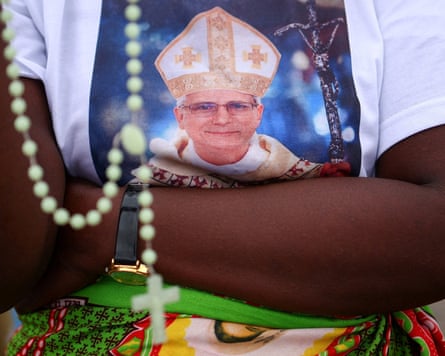
A person wearing a T-shirt with a picture of the pope on it
Crowds gathered in Kilamba, Angola, for a mass lead by Pope Leo XIV. Photograph: Guglielmo Mangiapane/Reuters

While the number of Catholics has been increasing globally in recent years, the concentration of growth has been in Africa and the Americas. More than half of the increase in 2022-23 was in Africa, according to the latest figures from Agenzia Fides, the information service of the Pontifical Mission Societies. This is part of a longer trend that started in 1970 with a shift towards the global south.

The result is a region that is not only home to an increasing number of Catholics, making it the demographic future of the faith but, according to Father Ambroise, the intellectual and spiritual engine of global faith. “The growing centrality of Africa and its Black diaspora for pastoral practice,” he told me, “should be viewed in terms of a potential to influence the evangelisation of the world.” There is a striking irony in the fact that, in some western countries, preserving Christianity is tied to far-right messaging about race and immigration, but church attendance and affiliation are propped up by Black diaspora worshippers from Africa and the Caribbean.


A subtle but frank visit
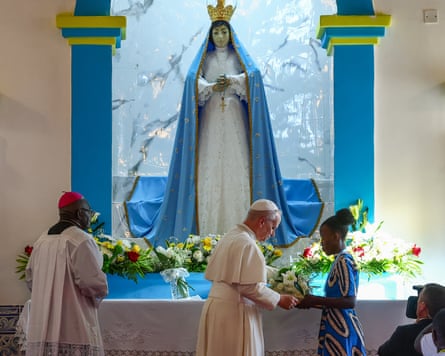
The pope being handed a bunch of flowers beneath a statue of the Virgin Mary
Pope Leo XIV in the Church of Our lady of Muxima in Angola, a hub of the 16th-century transatlantic chattel slave trade. Photograph: Guglielmo Mangiapane/AP

Pope Leo’s visit touched on themes that recognise the limitations of the continent’s untapped potential. On his visit to Cameroon, in a pointed reference to the leadership of 93-year-old president Paul Biya, who has been president since 1982, the pope denounced “the chains of corruption, which disfigure authority and strip it of its credibility” and which “must be broken”.

The state TV coverage of his speech was interrupted at times, as the pope went on to say that “hearts must be set free from an idolatrous thirst for profit”, a condemnation that Father Ambroise said called out the “breaches of integrity and corruption that push youth to migrate, facing the dangers of oceans, deserts”.

The pope also acknowledged that Africa falls under a double burden – corruption at home and exploitation of its rich resources from abroad, as outsiders “continue to lay their hands on the African continent to exploit and plunder it”. “This is a great scandal,” Father Ambroise said, “that calls out to both African leaders and those from other continents who pursue their interests without shame at the expense of the populations. An industrialist once said, ‘In Africa, I am interested in what is beneath the ground, not in what is on the surface.”’

Less direct was the pope’s approach to the continent’s history of enslavement. In Angola, he visited the Church of Our Lady of Muxima, a hub of the 16th-century transatlantic chattel slave trade. He said that people had prayed there “in times of joy and also in moments of sorrow and great suffering in the history of this country”, but did not address enslavement or its transatlantic diasporic legacies directly. A particularly interesting demurring considering that Pope Leo is descended from Creole people of colour, with his maternal grandparents identified as “Black” or “mulatto” in historical records.


A focus on smaller countries and minorities
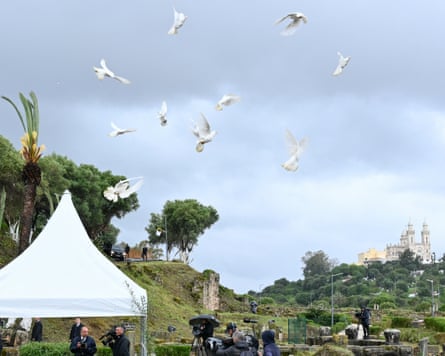
Birds flying in the sky above marquees with people gathered underneath
White doves are released as the pope arrives to visit the archaeological site of Hippo in Annaba, Algeria. Photograph: Alberto Pizzoli/AFP/Getty Images

For his first visit, the pope made a deliberate decision not to visit the larger Catholic countries in Africa, such as Nigeria, the Democratic Republic of Congo and Tanzania, travelling instead to Equatorial Guinea, Cameroon, Angola and Algeria. In doing so, he made the broader point about countries subject to exploitation and corruption, and another about the historic significance of the continent. In his trip to Muslim-majority Algeria, he visited a mosque and urged interfaith dialogue. But there was also a homecoming element at play.

Pope Leo is an Augustinian, following the teachings of Saint Augustine, who was bishop in the Algerian town of Hippo, now a historical site, around AD395. The cornerstone of Saint Augustine’s teachings is that the church should have friendly relations with secular authorities, but not shy away when Christian values, such as protecting the weak, are assailed.

The pope “seized this opportunity”, Father Ambroise told me, “to raise awareness about Africa’s contribution to the development of theological and pastoral thought in the universal church.” In doing so, he added, it should urge the church to “reincarnate that influence on thought in the contemporary world”.


A pope thrust into politics
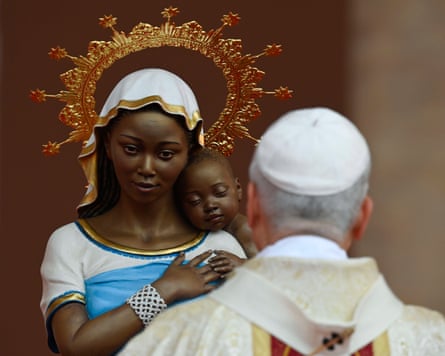
The pope facing a statue of a woman and a baby with a gold halo around them
Pope Leo leading mass in Malabo, Equatorial Guinea. Photograph: Imago/Vatican Media/Avalon

It is in that contemporary world that Pope Leo’s visit, and his position in general, has come into sharp relief. The Vatican stated that the pope, who is American, will not visit the US this year. And he has been involved in a fierce row with Donald Trump and his vice-president, JD Vance. When the war on Iran started, Pope Leo said that Jesus rejects the prayers of those who wage war; quoting scripture: “even though you make many prayers, I will not listen: your hands are full of blood”. In his Easter message, he said: “Let those who have weapons lay them down! Let those who have the power to unleash wars choose peace! Not a peace imposed by force, but through dialogue! Not with the desire to dominate others, but to encounter them.”

The White House issued a severe rebuke. In a post on Truth Social, Trump said that the pope was “WEAK on Crime and terrible for Foreign Policy”. He went on to accuse the pope of being a “very liberal person” who is “catering to the Radical Left”. Vance, a Catholic convert, told the pope to “stick to matters of morality”. In Cameroon, the pope did not hold back, appearing to stick to his position in the face of such criticism, saying that the world is being “ravaged by a handful of tyrants who spend billions on war”.

In doing so, Pope Leo drew himself into global politics in the way his predecessor, Pope Francis did, when he condemned the assault on Gaza in the strongest of terms and made nightly video calls to the Catholic parish in Gaza City. The pope’s visit to Africa, and the themes he touched on, can be seen as an anchor of this wider role that the church has moved into in a time of moral collapse and need for guidance. It is a role, Father Ambroise said, that is “particularly significant in a world now characterised by the complexity of crises, conflicts and wars”. Religious leaders are now, he said, the “shepherds, bearers of values, and influencers of policies” in the service of “dignity and human rights, gifts from God, intended for all”.