

惯性聚合 高效追踪和阅读你感兴趣的博客、新闻、科技资讯
阅读原文 在惯性聚合中打开

推荐订阅源

月光博客
月光博客
L
LangChain Blog
Jina AI
Jina AI
WordPress大学
WordPress大学
人人都是产品经理
人人都是产品经理
S
Secure Thoughts
T
The Exploit Database - CXSecurity.com
钛媒体:引领未来商业与生活新知
钛媒体:引领未来商业与生活新知
博客园 - 聂微东
小众软件
小众软件
Apple Machine Learning Research
C
Cyber Attacks, Cyber Crime and Cyber Security
Project Zero
Project Zero
T
Threat Research - Cisco Blogs
量子位
G
GRAHAM CLULEY
腾讯CDC
让小产品的独立变现更简单 - ezindie.com
C
CERT Recently Published Vulnerability Notes
The Hacker News
The Hacker News
C
Cisco Blogs
Scott Helme
Scott Helme
Spread Privacy
Spread Privacy
宝玉的分享
宝玉的分享
V
V2EX
博客园 - 三生石上(FineUI控件)
T
Tor Project blog
P
Proofpoint News Feed
雷峰网
雷峰网
D
Darknet – Hacking Tools, Hacker News & Cyber Security
V
Vulnerabilities – Threatpost
PCI Perspectives
PCI Perspectives
博客园_首页
L
LINUX DO - 最新话题
IT之家
IT之家
有赞技术团队
有赞技术团队
博客园 - Franky
Hacker News: Ask HN
Hacker News: Ask HN
Last Week in AI
Last Week in AI
The Cloudflare Blog
Exploit-DB.com RSS Feed
freeCodeCamp Programming Tutorials: Python, JavaScript, Git & More
美团技术团队
博客园 - 【当耐特】
OSCHINA 社区最新新闻
OSCHINA 社区最新新闻
Security Archives - TechRepublic
L
LINUX DO - 热门话题
AWS News Blog
AWS News Blog
S
Security Affairs
T
Tailwind CSS Blog

The Guardian

Rory McIlroy surges into six-shot Masters lead with stunning second-round flourish ‘That’ll be the end’: actor Sam Neill joins fight to stop controversial goldmine near his New Zealand vineyard Roberto De Zerbi targets ‘Ange-ball’ revival to save Spurs from relegation Bath hit back to reach semi-final after stunning Northampton in 11-try epic Secret Garden to Outcome: the week in rave reviews Zebras, wealth and power: Hungary’s election tests Orbán’s grip on power ‘TikTok effect’ brings sellout crowds and younger fans to Grand National meeting The war over Omagh’s gold: the £21bn mine plan tearing a community apart Britain’s shadow workforce is paid as little as 65p an hour. Who cares for the carers? From You, Me & Tuscany to Euphoria: your complete entertainment guide to the week ahead Six great reads: the man who let snakes bite him, masked heavy metal and the brutal reality for foreign students in the UK American Classic review – I defy you not to fall in love with Kevin Kline and Laura Linney’s tender comedy Cuba’s doctors were a lifeline for the world. Now the Caribbean is shamefully complicit in the US drive to expel them An environmental disaster in Moldova has Russia’s fingerprints all over it RMIT drops misconduct case against student who accused university of being ‘complicit in Gaza genocide’ Ichiro Suzuki statue unveiling goes awry as bronze bat snaps during ceremony Survivors of Epstein’s abuse accuse Melania Trump of ‘shifting burden’ on to victims European football: Real Madrid held at home by Girona to extend winless run Arne Slot insists he is ‘aligned’ with Liverpool board and fans as squad is rebuilt Kamala Harris ‘thinking about’ running for president again in 2028 JD Vance warns Iran against trying to ‘play’ the US in peace talks West Ham double up twice to thrash Wolves and put Spurs in relegation zone Trump administration releases new renderings of so-called ‘Arc de Trump’ Crispin Odey drops £79m libel claim against FT over sexual misconduct allegations Bafta apologises for events surrounding John Davidson’s Tourette’s outburst Cocktail of the week: Bar Shrimp’s la rosita – recipe New drug may extend survival in aggressive ovarian cancer, trial shows One dead and 27 injured after bus with British passengers crashes in Canary Islands Pope adds to Smith’s mass of Surrey runs with England woes a world away OpenAI CEO Sam Altman’s home targeted with molotov cocktail Reform UK local election candidate was twice disciplined by Tories over ‘racist comments’ Remaining in Nato is in best interests of US, says Keir Starmer Prince Harry sued for defamation by charity he co-founded Anthropic’s new AI tool has implications for us all – whether we can use it or not Concerns raised about motorbike tourist trail after death of British teenager in Vietnam The Guardian view on Trump’s civilisational threats: the words that fuel war must be condemned The Guardian view on dystopias for our times: the American nightmare Doctors’ leader claims new reduced pay offer killed chances of ending strikes in England Netanyahu-ism has achieved nothing for Israelis – and come at a monstrously high price Deborah Levy: ‘CS Lewis’s White Witch terrified me – but I wanted to meet her’ How I Shop with Michelle Ogundehin: ‘We grownups have enough stuff already’ Trump’s war and Melania’s Epstein statement, with US editor Betsy Reed – The Latest We have to stop killer motorists on Britain’s roads UK starts crackdown on EU citizens’ post-Brexit rights Londoners aren’t unfriendly – but don’t compare us to New Yorkers The religious right and the perversion of faith Artemis II images reignite moon mission memories Orbán and Magyar trade accusations in last days of Hungary election campaign Reckonwrong: How Long Has It Been? review | Safi Bugel's experimental album of the month Martin Rowson on Middle East peace talks – cartoon Masters magic, the Grand National and Premier League drama – follow with us Fears of UK and EU flight cancellations as airports warn of jet fuel shortages Reform’s petulance over slavery reparations shows it just doesn’t grasp Britain’s place in the modern world Peers vote to ban pornography depicting sex acts between stepfamily members Starbucks’s retail arm gets £13.7m tax credit even as sales increase Flyby review – interstellar musical is a voyage of epic strangeness Grand National preview: Jagwar can deny Irish cohort in Aintree classic Week in wildlife: an ostrich on the lam, a tortoise crossing a road and surfing seals Anger as swifts’ nesting holes in Derbyshire rail viaduct ‘blocked up’ Peter Mandelson faces fixed-penalty notice for urinating in public ‘There’s no shortage of terrifying technology’: how AI became TV drama’s new go-to villain ‘Fresher than anything in a shop’: the best recipe boxes and meal kits for time-poor foodies, tested Who was Hilma? Af Klint exhibition to highlight exclusion of women from abstract art Critics assemble! Here’s my list of the greatest superhero movies of all time US inflation soars in March as war on Iran drives economy into uncertainty Amazon to finally launch Leo satellite internet in ‘mid-2026’, says CEO Grand National 2026: horse-by-horse guide to all the runners Pete Hegseth’s holy war: the militant Christian theology animating the US attack on Iran Add to playlist: the beautifully dazed, countrified indie-rock of Tracey Nelson and the week’s best new tracks Not just about Gaza: the Muslim voters turning from Labour to the Greens ‘I’m worried there’s too much of me,’ says a birch: inside the interspecies council giving nature a voice Why is anyone surprised by the US and Israel’s latest war? It’s only what the world allowed them to do in Gaza Tori Amos review – fans hang on every note of this dramatic deep dive into her back catalogue Coachella 2026: Justin Bieber launches a major comeback in the desert Super Mario what?! The seven best obscure Mario games ‘An abomination’: the Lancashire town kicking up a stink over reopened landfill Pillion to Roofman: the seven best films to watch on TV this week Holly Humberstone: Cruel World review – Taylor Swift fave trades gothic melancholy for pop glow-up Thrash review – cursed shark thriller sinks like a stone on Netflix Gulf states rethink security in light of US-Israel war on Iran Go Gentle by Maria Semple review – a joyfully clever New York romcom Welcome to Y’all Street: bullish Dallas aims to steal New York’s financial crown Margo’s Got Money Troubles to Beef: the seven best shows to stream this week I baulked at the idea of ‘friction-maxxing’. But there’s more to it than meets the eye Reich: The Sextets album review – Colin Currie celebrates the minimalist master’s joy of six Benjamina Ebuehi’s sweet and salty chocolate chip cookies recipe Experience: my house was taken over by 70,000 bees Malcolm in the Middle: Life’s Still Unfair review – the TV magic they’ve created here is absolutely miraculous Lava bursts forth as Hawaii’s Kilauea volcano erupts Sonos review: Are these the best portable speakers that money can buy? I tested to find out Buy bread in the evening, hit the sales on a Tuesday: retail workers’ top tips to cut your shopping bill The best water flossers in the UK, tested for that dentist-clean feeling Where to start with: Muriel Spark You be the judge: should my girlfriend stop mixing gold and silver jewellery? The best carry-on luggage in the UK, tested on an assault course How games capture the awe and terror of cosmic isolation I never text back – and it’s ruining my relationships The pet I’ll never forget: Beau, the labrador who saved my life Life Is Strange: Reunion review – a decade-long story comes to an impassioned close Why is gaming becoming so expensive? The answer is found in AI
‘Ordinary people are being erased’: one director’s audacious fightback against AI – featuring Frinton
https://www.theguardian.com/profile/ryangilbey · 2026-06-18 · via The Guardian

In Marc Isaacs’ latest film, the subversive documentary maker reveals that an AI research laboratory recently licensed his entire body of work. That’s a quarter-century of droll, deadpan studies of ordinary life in Britain – from the poetic Lift, about the comings and goings in a London tower block, and The Curious World of Frinton-on-Sea, set in the sleepy retirement town dubbed “God’s waiting room”, to Philip and His Seven Wives, in which a secondhand furniture dealer declares himself to be a Hebrew king. Isaacs agreed to let data analysts at the University of Southern England feed these and other documentaries into their system to harvest authentic human emotions from which AI characters could then be created. His film about the experience takes its name from the university’s lab: Synthetic Sincerity.

But how synthetic is the film itself? “Well, we made up the University of Southern England,” admits Isaacs, 59, over lunch at Etles, a Uyghur restaurant near his home in London. The choice of venue is no accident: its chef and owner, Ablikim Rahman, who flutters around us today bearing bowls of thick, glossy leghmen noodles, appears in Synthetic Sincerity being photographed by the AI boffins and turned into an avatar. This is Rahman’s first film, though he hasn’t seen it yet: “Soon,” he says with a sheepish smile.

Sitting across from Isaacs is the film’s 67-year-old writer, Adam Ganz. “Making it a fictitious university meant we didn’t need anyone’s permission,” Ganz explains. So has Isaacs genuinely been approached to license his work for AI? “No,” the director says with a shrug, “but I’ve heard about people who have.”

A head and shoulders shot of Isaacs, wearing glasses and a green jacket over a dark T-shirt
Subversive … Marc Isaacs.

He and Ganz aren’t trying to pull a fast one with Synthetic Sincerity. Rather, they use its artificiality to wriggle into places that more straightforward documentaries can’t reach. These wilful fabrications began with their two previous pictures. The Filmmaker’s House, confined largely to Isaacs’ home as he is inundated by visitors over the course of one day, and This Blessed Plot, about a Chinese student shooting a film in a pretty rural corner of Essex, each departed radically from documentary convention. This Blessed Plot stars several figures who appeared as themselves in Isaacs’ earlier work but are recast in the newer film as fictional characters; one even plays a ghost.

Though the three pictures have the appearance of documentaries, they all feature non-actors performing scenarios and dialogue written by Isaacs and Ganz. In Iran, the technique has proliferated, producing masterpieces such as Abbas Kiarostami’s Close-Up, which Sight and Sound magazine named as one of the 20 greatest films of all time. In the UK, the staged or scripted reality genre is more readily associated with TV mainstays such as Made in Chelsea and The Only Way Is Essex, though it has also resulted in homegrown cinematic gems: Michael Winterbottom’s 2002 refugee drama In This World, say, or A Bigger Splash, Jack Hazan’s 1973 film about David Hockney, which is often described erroneously as a documentary.

Isaacs, who counts Louis Theroux among his admirers, was never an orthodox director even before this bold swerve sideways. As someone who rejects the idea of “pure” documentary, meddling has always been part of his repertoire. In Outsiders, from 2014, he filmed casual conversations at a roadside fast-food van in the East Midlands without revealing that the customers had all been cast in advance and bussed in. But when TV channels and streamers began clamouring for sensationalist “docbusters”, Isaacs seized the chance to, as he put it in 2021, “wake myself up” by venturing into the Iranian-style hybrid form. Had he gone to sleep? “I think so. And the industry had gone to sleep, too.”

He is no more optimistic now about the state of mainstream documentary. “It’s even worse,” he says, citing glitzy Netflix productions such as Beckham. Ganz agrees: “British documentaries used to be the best way you’d know what other people were up to. Every week on the BBC or Channel 4 there’d be an extraordinary diversity of different lives. Now ordinary people are being erased. You’re not encouraged to learn about anyone who either isn’t a celebrity or isn’t like you.” They both cringe at the memory of Sofia Coppola’s new film about Marc Jacobs, Marc by Sofia, which they recently saw together. “It was like watching AI,” says Ganz.
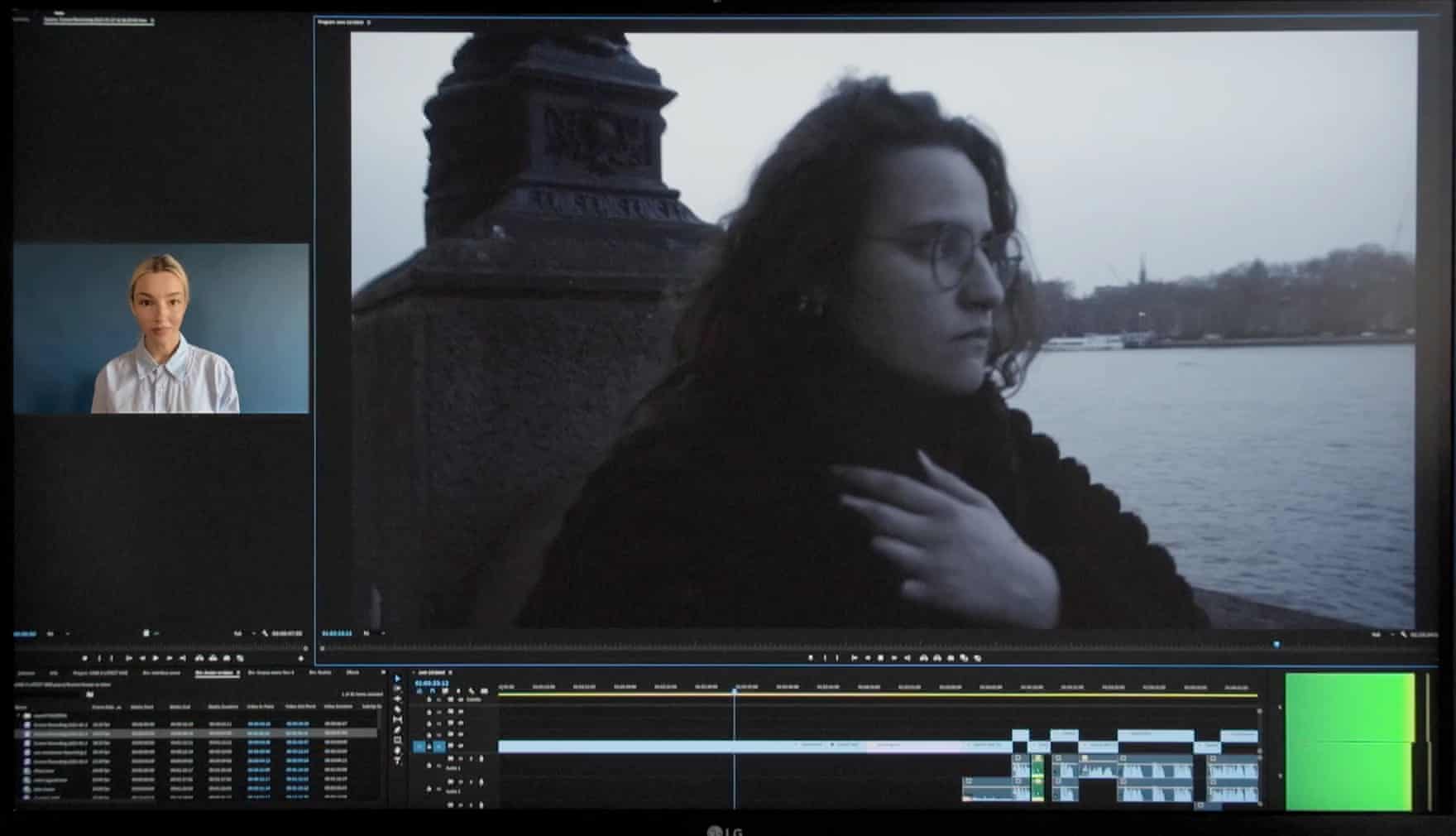
A computer screen with a window showing footage of a woman by the Thames, and another window with an AI face, and data
Going where more straightforward documentaries can’t reach … Synthetic Sincerity.

Synthetic Sincerity is quite the antidote. Before its nimble 70 minutes are over, the film has addressed the AI revolution, the democratisation of images and the concept of authenticity itself as well as touching on Israel’s bombing campaign against Lebanon, the displacement of the Uyghur people and the advent of pro-China censorship in UK universities. It is all handled with its director’s customary wit, humanity and lightness of touch.

Especially effective is the comic double-act between the ingenuous Isaacs, showing his face in one of his own films for the first time, and a female AI avatar who flatters, provokes and occasionally upbraids him (“It’s rude to interrupt, Marc”). She is played by Ilinca Manolache, the Romanian actor who used an AI filter to appear as an Andrew Tate-style toxic influencer in Radu Jude’s Do Not Expect Too Much From the End of the World; she is now shooting Martin Scorsese’s What Happens at Night alongside Leonardo DiCaprio and Jennifer Lawrence. For Synthetic Sincerity, Isaacs filmed her on Snapchat then fed the results through AI. “It’s funny that as an actor she is so enthusiastic about embracing …” Her own imminent extinction? “Exactly that.”

Isaacs is surprised that not everyone has twigged the film’s premise is a put-on; he thought one giveaway would be the scene early on in which the avatar invites him to “come to the place where I was made”, drawing him into the orbit of the AI lab. “Some people get quite annoyed,” he says, recalling a festival screening in Thessaloniki. “This guy came up to me afterwards and said: ‘OK, you’ve made your point. You’ve shown me you don’t believe in anything.’ I think his issue was that we had made him doubt what he saw. But right from the earliest documentaries, the idea of truth has always been complicated.”

A computer-generated face on a screen
‘It’s rude to interrupt, Marc!’ … Ilinca Manolache as the AI in Synthetic Sincerity.

It is for this reason that form and content are so harmoniously matched in Synthetic Sincerity. Common anxieties surrounding AI and its integrity are echoed in the more localised suspicions that viewers of Isaacs’ film will doubtless entertain as they ponder how much of what they are watching is real – and what “real” even means. To underline the point, Isaacs incorporates footage from a BBC documentary he made years ago which was never broadcast. The subject was a supposed Iraq war veteran and budding bounty hunter who turned out to be a liar and a fantasist. It isn’t only AI that can be inauthentic and prone to glitches.

The man in Thessaloniki may fume but feeling destabilised by the film is a good starting point, reckons Isaacs. “When people say: ‘What’s the takeaway?’… Ugh, I hate that phrase. The raising of questions is the whole point. Who are film-makers to provide the answers? Just because you’ve directed a film it doesn’t make you authoritative.”

It might come as a surprise that he and Ganz harbour a certain cautious practicality about AI. “Why not use it for fight sequences with hundreds of warriors?” asks Ganz. “You might as well. The real difficulty will be representing the world people live in.”

For his part, Isaacs was determined not to make a dystopian film. “We didn’t want to go down the road of doom and gloom. Audiences have responded to the scenes where AI gives Ablikim a voice to say things he can’t say as himself. As far as film-making goes, I’m genuinely waiting for some auteur to do something extraordinary with AI. But that can only happen if it’s being used to talk about itself in an interesting way. Even then, it won’t create an industry, or the next French new wave.”

When I ask how AI has impinged on his own working practices, he flashes a guilty look at Ganz. During preparations for their next film, which will star Manolache and be set among north-west London’s Romanian community, Isaacs took the initial script ideas and ran them past ChatGPT for suggestions. “Some of what came back wasn’t bad,” he says brightly. “Then I texted the results to Adam, and he replied: ‘Fuck off.’”