






Florentina Holzinger’s skinny dippers
She’s famous for her extreme performances and Florentina Holzinger upped the ante yet again in Venice with a postapocalyptic pavilion that opened with her suspended upside down from the clappers of a large bell. Inside, there was a woman riding a speedboat in circles, two others suspended at the top of a pole and another sitting entirely submerged in a tank. Oh, and no one was wearing any clothes. Viewers were invited to use two toilets so that their urine could be purified and pumped into the tank – but what looked like a sewage disaster in another section of the pavilion suggested that this project threatened to go dangerously awry. The whole thing was so transgressive that four cops turned up when I was watching to ask what the hell was going on. It was immediately the talk of the town. AN
Austrian pavilion, Giardini della Biennale
Sanya Kantarovsky’s eerie seances
One of the great things about the Venice Biennale is that it allows you to see contemporary art in incredible historical spaces. Kantarovsky, 44, is a brilliant painter who was born in Moscow and whose family emigrated to the US when he was 10. His paintings are like stills from very intense films – just what is going on in the one where a naked man is crouching in seeming despair at the foot of a bed while a dog cheerfully sits on the pillow? They’re displayed in book-lined rooms with incredible Murano glass chandeliers, and the show culminates with an incredibly detailed sculpture of the head of a boy, also in Murano glass. The atmosphere is like a weird seance between the centuries. AN
Basic Failure, Palazzo Loredan
Gabrielle Goliath’s hypnotic mourners
Goliath was one of several artists who were caught up in controversy leading up to the biennale. The South African government banned her from appearing at the event because her piece – called Elegy – was a “highly divisive” tribute to a Palestinian poet. Goliath has staged the work anyway in partnership with London arts centre Ibraaz, at the Chiesa di Sant’Antonin, which is a short walk from the Giardini and Arsenale. It’s well worth the trip and is arguably the exact kind of visceral hit the main show was missing this year. The performance itself is hypnotic, as screens show operatically trained female performers holding a single high note. Then, as their voice fades, they step down from a platform and are replaced by another singer. Made as a ritual of mourning for women killed in acts of sexualised or racialised violence, it was first conceived in 2015. LB
Elegy, Chiesa di Sant’Antonin
Carrie Schneider’s photographic curls
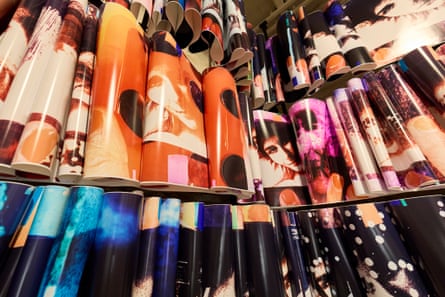
The main In Minor Keys show might have turned off some, but there were several standouts: Akinbode Akinbiyi’s street scenes, which are suspended from the roof and are taken all over Francophone Africa; the Chicano archive of Guadalupe Rosales; the devastating directory of lost businesses and lives in Gaza by Avi Mograbi. Perhaps chief among them though is Carrie Schneider’s 1.5km-long photographic curls, which repeat over and over a still from Chris Marker’s 1962 film La Jetée. Some work fails in the vast caverns of the Arsenale, but Schneider’s grabs hold. LB
In Minor Keys, Arsenale
Lydia Ourahmane’s coin-slot art
The British-Algerian artist Lydia Ourahmane has created a delicate sculptural show, quiet and formally poised, whose components are drawn entirely from the city of Venice, and will be reabsorbed into its world when it ends. A beautiful new wooden pier will be handed over to a local cooperative; a bead curtain of Murano glass was threaded by inmates of the Giudecca women’s prison; a contraption once used in a church to illuminate a Bellini now switches on the show’s lights when you put a euro coin in the slot. It’s a touching, thoughtful piece that works with, rather than against, the grain of the world. Next time, put her in the British pavilion. CH
5 Works, Nicoletta Fiorucci Foundation
Lawrence Abu Hamdan’s audio detective work
Canicula, an exhibition of eight new film works commissioned by Fondazione In Between Art Film, features a new installation by Lawrence Abu Hamdan in his guise as a “private ear”, whereby he investigates human rights abuses using sound as evidence. In 450XL: the Story of a Fugitive Sound, he gathers testimony from demonstrators in Serbia who appear to have been dispersed from their peaceful, silent anti-government protest by a form of sonic weapon. It’s beautifully installed in the hospital’s old music room, surrounded by frescoes of musicians, its 15 screens resembling protest placards. CH
Canicula, Complesso dell’Ospedaletto
Zhanna Kadyrova’s origami deer
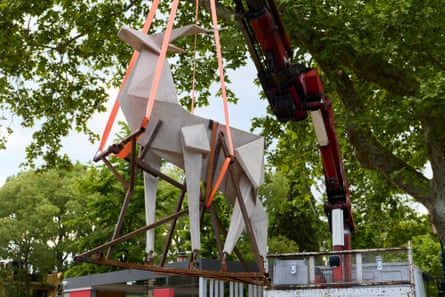
The huge concrete deer dangling irresolutely from a crane on a flatbed truck just beyond the entrance to the Giardini has come all the way across eastern and central Europe from the city of Pokrovsk in the Donetsk region of Ukraine. It was originally made for a park by artist Zhanna Kadyrova in 2018 – then, in 2024, on the fourth attempt and with difficulty, evacuated. In the Ukrainian pavilion in the Arsenale, watch touching footage of the origami deer’s journey as it travels by road, pauses in different European cities, and is greeted by refugees from Pokrovsk, which is now under Russian military control. CH
Ukrainian pavilion, Giardini della Biennale
Zhang Zhoujie’s digital chairs
There’s a hell of a lot in the main exhibition to make you despair about the state of the world – it really lives up to its title, In Minor Keys. But if you make it right to the end of the Arsenale, you’ll find that some Chinese artists have a very different take. In a cavernous, darkened space with a column of light in the centre, 10 of them have presented 10 off-the-wall proposals for how art might bring together human and artificial intelligence. There are sculptured model landscapes by Jiang Suxuan, a robot doing traditional calligraphy thanks to Nie Shichang and Chinese myth turned into a video game by the collective Game Science. Best of all, it ends in a lawn of “digital chairs” by Zhang Zhoujie – and after all that, you really will need a sit down. AN
Chinese pavilion, Arsenale
The gull
The Austrian pavilion might have been the biggest draw this year, but in its shadow was another part of the biennale that also drew a crowd and didn’t need nudity or someone hanging upside down in a bell to grab attention. Outside the Polish pavilion, surrounded by a neat white fence was a nesting gull, which caused confusion during the press preview. Was it an art work? Or some form of ornithological provocation? No, it was just a bird that had decided the Giardini was a good a place as any to set up shop. A selfie with the artist is essential. LB