







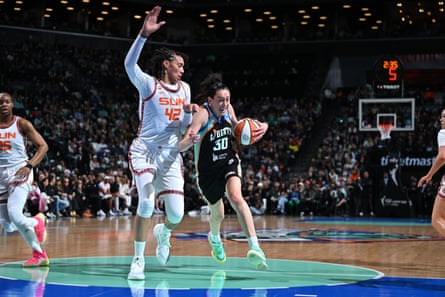
Opening night typically pulses with anticipation rather than gushes with nostalgia, but the New York Liberty wore a “court origins” uniform that alludes to their history as one of the WNBA’s eight founding members when they hosted the Connecticut Sun on Friday.
Protracted and pugnacious negotiations between the players’ union and the league threatened to delay or even wreck the new season. But an accord that hands the players significant pay rises means the league has much to look forward to, as well as plenty to reflect on, as it celebrates 30 years.
Commissioner Cathy Engelbert has described the 30th season as a “transformational moment” and the “beginning of a new era”. An economic boom suggests there’s some credibility to those cliches.
A $300m agreement reached in March to sell the Sun, based in Connecticut since 2003 and owned by the Mohegan Tribe, to Tilman Fertitta, an entertainment tycoon who owns the NBA’s Houston Rockets and was last year named US ambassador to Italy, is a symbol of the WNBA’s evolving fortunes. The league is leading the way as interest, salaries and team valuations soar in North American women’s professional basketball, soccer and ice hockey.
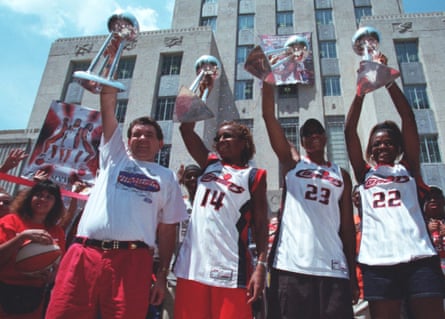
The setting Sun – whose departure has been met with disappointment by their New England fanbase – are expected to be renamed the Houston Comets, reclaiming the brand identity of an original franchise that dominated the nascent WNBA with their formidable Big Three of Cynthia Cooper-Dyke, Sheryl Swoopes and Tina Thompson.
Founded in April 1996 with the backing of the NBA, which shares ownership of the league with the individual team owners and other investors, the WNBA tipped off the following year, surfing a wave of enthusiasm after the US women won gold at the Atlanta Olympics. It has since expanded and contracted like an accordion’s bellows to its 15 teams this season. Only three of the original eight – the Liberty, Phoenix Mercury and Los Angeles Sparks – remain and are still playing in their initial city.
True to their name, the Comets got off to a blazing start then disintegrated. They won the first four WNBA championships but disbanded in 2008 because they could not find new owners for a franchise valued at $10m – about $15m in 2026 money. The Comets’ demise was an alarming indication of the league’s parlous state as the global financial crisis hit. Now, with Fertitta reportedly paying a league-record fee, the value of a WNBA franchise in Houston has climbed by 1,900% in under 20 years.
The numbers are dramatic even if only stretching back two years. In 2024 the owners of the Portland Fire (another legacy name, evoking a franchise that flamed out in 2002) reportedly paid an initial $75m to join the league this season. Fellow newcomers the Toronto Tempo, the first WNBA team in Canada, were charged $50m. Yet in June last year the league announced further expansions to Cleveland, Detroit and Philadelphia. The fee per team is said to be $250m, a new high for American women’s sports and above the NWSL-record $205m paid by Columbus, who will join in 2028.
One factor driving optimism – and inflation – is the instant success of the Golden State Valkyries, who share a principal owner and arena with the NBA’s Golden State Warriors. They paid $50m to start in 2025 and promptly set the WNBA record for average attendance with 18,064. (The overall league average last season was 11,148.) The Valkyries have set up a waitlist after selling more than 12,000 season tickets for the new campaign. On the back of their crowds and sponsorship deals, CNBC anointed the Valkyries the first $1bn franchise in women’s sports, with the WNBA’s second-most valuable team, the Liberty, valued at an estimated $600m. Sportico places the Valkyries at $850m, and judges the top NWSL club, Angel City, to be worth $335m. The Los Angeles-based team paid just $2m to enter the league in 2022.
Home to Silicon Valley, the San Francisco Bay Area is no stranger to hyped-up start-ups. Still, there’s a logic to the calculations: CNBC estimates the Warriors to be the NBA’s most valuable team, worth $10.8bn, and their estimated annual revenue of $840m, like their value, is roughly 10 times greater than the Valkyries’. Even the least valuable American team in CNBC’s WNBA ranking, the Atlanta Dream, is worth an estimated $330m, making $250m-$300m for a franchise seem like a solid investment despite uncertainty over the WNBA’s profitability. The WNBA is reportedly an annual money-loser, though NBA commissioner Adam Silver has argued that the two leagues are “one integrated business”, thus creating a complex financial picture.
“The WNBA’s growth is important because it changes the baseline perception of women’s sport. It signals to investors, sponsors, and media partners that women’s sports are credible, scalable and commercially viable,” Katie Lebel, a sports business professor at the University of Guelph in Ontario, says by email. “On one level, this is a market correction. For years, women’s sport properties were undervalued relative to their audience, cultural relevance, and growth potential. What we’re seeing now is investors catching up. They’re pricing the future value of women’s sport rather than judging women’s sport properties as risky investments based on limited past revenues.”
Could a professional women’s franchise one day be worth more than a men’s team?
“I don’t think we’re on the cusp of seeing a WNBA team surpass the value of the Dallas Cowboys in the near future,” Lebel says. “But franchise value isn’t really about gender, it’s about market size, scarcity, growth trajectory, and the strength of the business model. Women’s sport is in a high-growth phase right now. Their audiences are expanding, investment is increasing, and there’s a strong cultural tailwind. In contrast, men’s leagues are mature assets, so they have slower growth. In this sense, it’s more about growth potential versus market maturity. So yes, I can foresee it. In the right market, with the right ownership, it’s entirely possible.”
Valuations are speculative and variable, but player wages are matters of fact. The WNBA’s hotly contested seven-year collective bargaining agreement ratified in March calls for a minimum salary of $270,000, a vertiginous rise from 2025’s base of $66,079. Last season the maximum salary was about $250,000; now the top rate is $1.4m and the salary cap per team has increased from $1.5m to $7m.
The NBA rookie minimum salary is $1.27m – but that league’s existed since the 1940s. A fairer comparison may be with MLS, which kicked off in 1996. In MLS the minimum senior salary is $113,400, though its senior rosters comprise 20 players compared with the WNBA’s dozen.
“You now have professional athletes who can actually live and train like professional athletes and play their season and have an offseason and not have to think about where else in the world they’re going to play in order to earn money in the WNBA offseason,” says Michele Donnelly, associate professor of sport management at Brock University in Ontario.
“I think it also is a really excellent example – and I think we see some of this happening in the PWHL, the women’s hockey league, right now – [of] athletes really invested in and active in the governance of their own sport. I think the role of the WNBA players’ association can’t be overstated in this process, they really have been so productive and active and so effective in making their case for increased salaries, increased benefits.”
The expenditures, as well as vocal support from NBA superstars such as LeBron James, who attends WNBA games and this week sent a good-luck message to Caitlin Clark, the league’s most famous name, are “signalling a legitimacy”, says Vassilis Dalakas, professor of marketing at Point Loma Nazarene University in San Diego. “I remember in the past, the early years, a big part of the marketing, at least to sponsors, was like, ‘this is a good cause, do the right thing [and] support it’. It wasn’t along the lines of, ‘this is legitimate and a good investment for you’. That mindset has changed,” he adds. “Investment of that magnitude would not be made if there was not a strong belief this would be sustained.”
In 2024, the year Clark was selected first in the draft by the Indiana Fever, the WNBA announced an 11-year media rights agreement with multiple networks worth about $200m a year, more than tripling the previous deal. Add in sponsorships and the money and attention contrast with the relative anonymity and hardships experienced by earlier generations of WNBA professionals. Now WNBA stars are guests at the Met Gala.
Cooper-Dyke spent 10 seasons in Spain and Italy before the WNBA was born. There were times when after a big performance in Europe she felt “like … damn, I have to admit, it would have been nice to do that with 20,000 people chanting my name. Or it would have been nice to be on SportsCenter for some highlights, or in the sports section of the LA Times the next morning with a write-up,” she told the Players’ Tribune in 2020. “I wouldn’t say I felt cheated out of anything, necessarily – but I still definitely had these moments where I was aware of what I was missing out on, just by virtue of being a female player instead of a male player.”
This WNBA generation can enjoy widespread attention and adulation while earning much more than the $75,798 in base salary Cooper-Dyke collected with the Comets in 2000 as the league’s best-paid player. This season, all 44 regular-season Fever games will be shown on national television. Clark missed much of the last campaign through injury but viewing figures rose anyway.
“There’s so much potential but it really will require an intentional and ongoing commitment rather than an overly-celebratory kind of ‘oh look, we’ve arrived’ attitude,” Donnelly says, noting the buzz around the Tempo, who hosted the Washington Mystics in a close 68-65 loss on Friday. “Hopefully one of the things that will happen is that it can be a catalyst for those other leagues so they don’t have to wait 20-plus years to arrive at this stage that the WNBA has,” she adds. “People are ready. They’re ready to support more women’s sport … this has been such a long time coming.”