








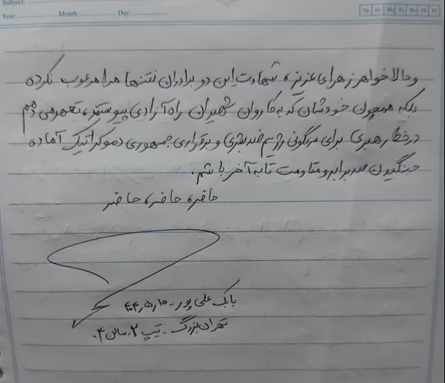
Writing from his cell in the Rajai Shahr prison in the northern Iranian city of Karaj, Babak Alipour wanted to tell his friends about those who had already gone to their execution.
There was Behrouz Ehsani, 69, the elder statesman of the group, who was “never angry” about their predicament. Then there was Mehdi Hassani, a 48-year-old father of three who he saw a couple of times in the prison hospital and who would ask him to pass on to the children the message that he was “fine”.
Despite the killings, Alipour, a 34-year-old law graduate with a passion for mountaineering who had been on death row for three years, recorded in his neat, tight, handwriting that he was not intimidated.
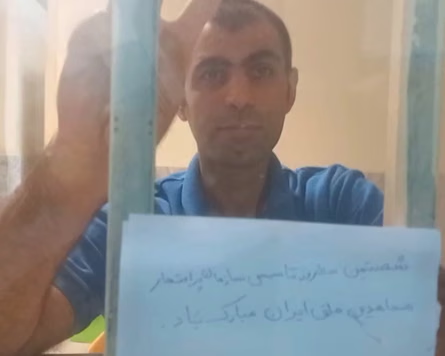
On 12 March he made a short video on a phone smuggled into his jail. “Dictators have come, been overthrown, died, and been killed, and now it is the turn of Khamenei-the-son’s dictatorship,” Alipour said of the accession of Mojtaba Khamenei to supreme leader after the death of Ali Khamenei in airstrikes by the US and Israel. By this time, Alipour’s brother Roozbeh, his sister Maryam, and mother Ommolbanin Dehghan had been arrested as they returned home from a vigil outside the prison in which he was being held.
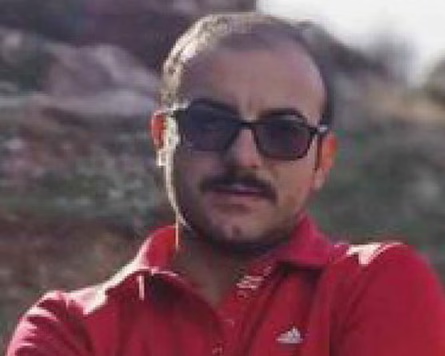
Just under two weeks later, on 31 March, Alipour was taken to the gallows at Ghezel Hesar prison, a short drive west of where he had been held, where he was hanged with another cellmate, Pouya Ghobadi, a 32-year-old electrical engineer. Alipour and Ghobadi were accused, as Hassani and Ehsani had been, of being part of an armed rebellion and member of the opposition group, the People’s Mujahedin of Iran (PMOI or MeK). Alipour’s father, a farmer, whose former clothes business had been crushed by the stagnant Iranian economy, has not been able to recover his son’s remains. Alipour’s brother has not been heard of for a month, according to sources close to the family.
In the last month, 16 men – eight political prisoners and eight protesters – have been hanged in Iran. There was a brief hiatus in the state killings when Donald Trump and Benjamin Netanyahu’s war began on 28 February but something changed after 18 March.
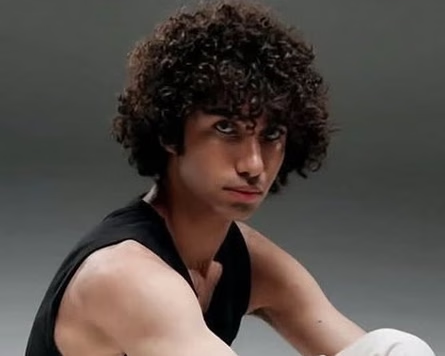
The youngest to die so far has been 18-year-old Amirhossein Hatami, who was hanged on 2 April after giving what was said to have been a forced confession to the charges of moharebeh (enmity against god) and efsad-fil-arz (corruption on earth) in relation to alleged involvement in an attack a Revolutionary Guard Corps base in Tehran during the January protests.
The most recent hanging was of Amirali Mirjafari, 24, a student and computer technician who was killed on Tuesday for alleged involvement in the protests. A further 11 political prisoners remain on death row, ranging in age from 23 to 68, according to human rights activists.
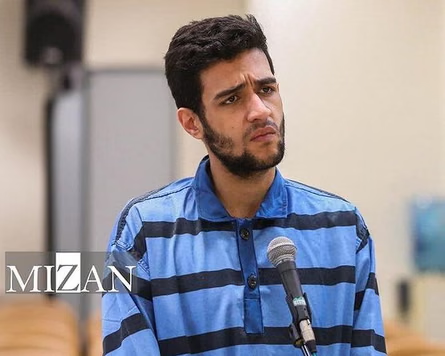
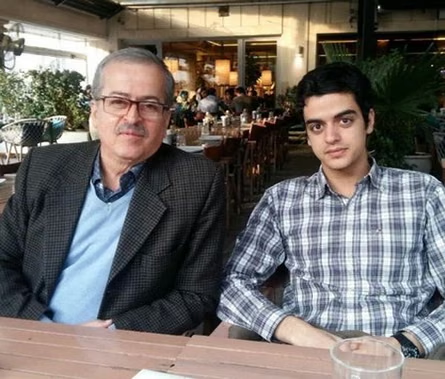
Reza Younesi, 45, is a professor in the chemistry department of Uppsala university in Sweden, where he has lived for two decades. His brother, Ali, 26, a prize-winning astronomy student, was arrested in Iran six years ago and his father, Yousef, 73, was taken from his home three years ago. Both men are serving custodial sentences for alleged links to the MeK. There was a worrying development a few weeks ago when Younesi’s father disappeared within the prison system and stopped making his calls back home.
“We had no idea for exactly nine days but yesterday he called my mum and he has been transferred to the same prison where my brother is now,” Younesi said.
For Younesi, it is the uncertainty as to how the regime will react as the war continues that is the most pressing concern.
“This is like a horrible, brutal regime that we are talking about,” he said. “When there is a war, of course, they become even more brutal. So they can do more or less anything to prisoners, as they know that the international society, international human rights organisation, they cannot do much, and even if they say anything, no one pays attention.”
The executions are said to be just another way to keep the people cowed at a moment of peril. “The US is not going to send any troops on the ground because of bad experience in Iraq so it’s not a big threat to the regime,” Younesi said. “If some of the top leaders are killed, the system is still alive and will not collapse. So the threat for them is people inside the country. They are using this penalty and executions as a tool to spread fear in society.”
Mahmood Amiry-Moghaddam, the director of Iran Human Rights, a Norway-based rights group, said the numbers of political prisoners being executed in the last month was unprecedented. “Normally, most of the those who are executed are for criminal charges: drugs, murder, mainly,” he said. “The aim of these executions is to create fear among people. The political cost of execution of a protester or political prisoner is much higher in normal times. However, now, everything is overshadowed by the war.”
On Thursday, Donald Trump claimed that he had persuaded Tehran not to carry out the execution of eight women. The Iranians have denied the White House claim that the women were due to die. The US president has – as yet – made no public comment about the men who have lost their lives.
In a final video secretly filmed in jail, Alipour, who was from Amol, a city 75 miles north-east of Tehran, and dreamed of a democratic, secular Iran, echoed the warning about the regime’s plans under the cover of war. “In the whirlpool of crises that engulf his entire government, Khamenei wants to display the height of his brutality and repression by increasing the number of executions in order to create fear and terror in the explosive Iranian society in order to save himself from overthrow, but he has read blindly,” the condemned man said. “Without a doubt, the day of freedom and happiness for the heroic people of the blasphemous mullahs will come soon.”