








Christian Cerna, 28, was driving with his partner and their two young children through Los Angeles, when two vehicles rammed his car and a group of men jumped out and trained their guns on them.
It was 11 June 2025, and as Cerna exited his vehicle with his hands raised, he realized the masked men weren’t street criminals as he initially feared. They were Immigration and Customs Enforcement (ICE) agents.
Cerna, a carpenter, is a US citizen and southern California native. But ICE was targeting him after a border agent reported that Cerna had “assaulted” him during a rowdy anti-ICE protest days earlier. The officers arresting Cerna detonated flash-bang grenades and pointed assault rifles at his car, with his infant and toddler inside.
The agents, court records show, were also filming high-quality footage of the arrest operation, which they would later post to social media.
The tactics, a federal judge later said, were part of ICE’s “vindictive effort” to “impose extrajudicial punishment”.
“It was like they were trying to make a movie,” Cerna said in a recent interview, speaking publicly for the first time about his arrest. “They were like the bullies in high school taking photos to humiliate me … and to prove a point – to say, if you say anything against what we’re doing, there will be consequences.”
The story of Cerna’s arrest and prosecution provides a window into the anger and fear sparked by the Trump administration’s brutal crackdown on immigrant communities and how federal officials have sought to forcefully suppress dissent and demonize protesters in the media – leaving a lasting impact on families caught in the crossfire.
A childhood shaped by deportation
For Cerna, the decision to protest was deeply personal.
Born in Long Beach, California, Cerna is the son of two immigrants from Mexico and spent his childhood frequently moving across southern California.
When Cerna was about 12 years old, he and his mother were pulled over by immigration agents who were looking for his father, he recalled. At the time, they were living in a desert community east of Los Angeles, and his father was out of town working at a marina. On the day of his father’s expected return, Cerna’s older brothers broke the news: ICE had arrested their dad.
Cerna was inconsolable, barricading himself in the family’s garage. When he had a chance to speak to his father by phone, he refused: “I didn’t want to talk to my dad on the phone. I wanted to see him.”
His father was deported, and the family moved in with an uncle, seven relatives crammed in one room. Cerna stopped going to school: “I hated ICE, because they ruined everything.”
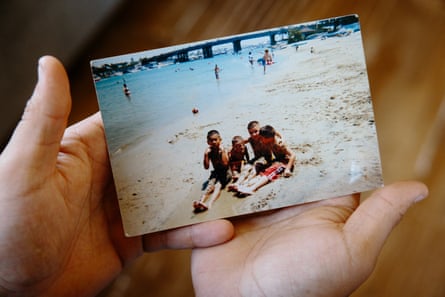
That memory was on his mind the morning of 7 June last year when a neighbor knocked on his door sharing rumors that ICE was at the Home Depot near his home in Paramount, a south LA suburb that is 81% Latino.
Cerna, now a father of two, thought of how powerless he felt as a child to save his dad. “I’m a grown man now. I have a voice. If I see something, I’m going to say something. I’m going to express the emotions I’ve held onto for so long.”
He hopped in his car and drove to Home Depot.
The protest: ‘Like a combat zone’
Tensions were high across LA that week. ICE had targeted the city’s garment district and day laborers with highly publicized raids, marking the Trump administration’s first large-scale surge of officers into a major city. As confusion reigned, local protests broke out in several parts of the city. It was unclear which federal agencies were in charge, and anxiety and uncertainty about ICE’s plans spread across the region.
When Cerna arrived at the Home Depot in Paramount, he didn’t see ICE. But down the street, while heading home, he spotted a vehicle with border patrol, another Department of Homeland Security (DHS) division working with ICE on the crackdown in the region. He pulled over.
“What are you guys doing here?” Cerna shouted while filming. “I’m a US citizen. I don’t want to see your guys around here!’”
Cerna got out of his car. The scene, outside a DHS office, quickly became chaotic. Dozens of federal agents arrived, as did more protesters and observers, some insulting and filming the officers and trying to block their vehicles, while agents shouted commands and at times got into heated confrontations with demonstrators. Many officers donned heavy tactical gear.
Cerna was outraged at the sight of their assault rifles and military garb, and cursed at and taunted officers while livestreaming, at one point saying if they gave him a gun, “I’ll take all you down.”
“All I could do was use my words … I tried to intimidate them like they were intimidating us, and I made ridiculous comments,” Cerna recalled. “They looked like they were preparing to do raids on al-Qaida … This is not a combat zone. You want to go to war with American citizens?”
Videos showed chaotic scuffles between officers and demonstrators. As tensions escalated, an agent was filmed forcefully shoving a protester before a group of officers took the protester and another demonstrator to the ground. Cerna was standing nearby, and grainy social media footage shows a border agent, later identified as Eduardo Mejorado, appearing to grab at Cerna and then shortly after Cerna swinging his hand at the agent’s face.
DHS officials have said Cerna “punched” the agent, striking him in the face. Cerna and his lawyers have said the agent “lunged” at Cerna and that Cerna is a trained boxer, who reflexively swung back at the agent with an open hand, but did not make contact. There were no allegations in the government’s follow-up reports that the agent was injured.
Soon after that encounter, officers, now in helmets and more riot gear, started firing projectiles. Cerna recalled being hit by multiple pepper balls. A teargas canister struck his face, which left a clear burn mark visible in photos.
Also on the scene was Gregory Bovino, a California border patrol leader who went on to become the face of Trump’s deportation agenda before he retired in March.
Body-camera footage disclosed in court captured him rallying his officers: “This is our fucking city!” Bovino said, though he and many others were stationed 200 miles away.
“Arrest as many people that touch you as you want,” Bovino said. “Those are the general orders all the way to the top. Everybody fucking gets it if they touch.”
The arrest: ‘I have kids!’
Cerna returned home from the protest with bruises, feeling depleted and anxious. After several sleepless nights, on the morning of 11 June, he and his partner, Abby Chavez, and their five-month-old daughter and two-year-old son got in the car to visit relatives and get tacos.
At around the same time, records show, officers with ICE’s homeland security investigations division, which focuses on criminal investigations, had used social media to confirm Cerna was the protester who “assaulted” an agent. As they prepared to arrest him, officers started filming themselves. Footage disclosed in court showed agents planning the arrest and arming themselves with assault rifles, combat vests and other weaponry.
An internal strategy document said ICE would use a drone to track Cerna’s movements, with four vehicles of officers monitoring and following him. An officer filmed from inside a vehicle as they followed Cerna on the freeway.
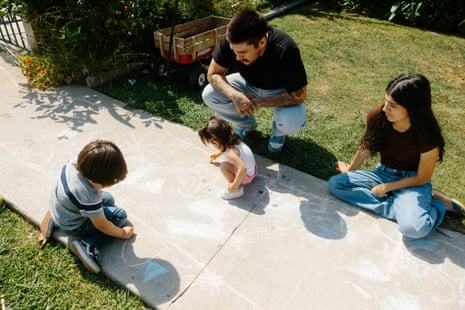
Cerna started to suspect he was being followed, he recalled, and changed lanes to see if the vehicle behind him would continue trailing him, but there were no sirens and he wondered if he was just being paranoid.
After Cerna exited the highway in the neighborhood of Boyle Heights, two unmarked ICE vehicles crashed into his car, surveillance footage showed. Cerna said he did not hear any commands to pull over before the collision. The video from a nearby business shows white smoke exploding by Cerna’s car as the officers fired flash-bangs within seconds. The officers exited their cars with assault rifles and handguns drawn.
Chavez said she initially thought it was a car accident, then worried the men were criminals trying to abduct them. Cerna exited the car in hopes of drawing the guns away from his children.
Soon, an officer arrived filming with what appeared to be a handheld tripod.
“I have kids!” Cerna said, as one officer pointed an assault rifle at him at close range.
“Shut the fuck up and listen!” another officer responded.
Chavez, hyperventilating inside the car, filmed officers pointing firearms at them. Her toddler held a toy car as he stared at the men.
Mejorado, the victim of Cerna’s alleged assault, was also present as Cerna was handcuffed, the videos show.
“Remember Saturday … Remember me?” asked Mejorado.
“I remember when … you put your hands on me,” responded Cerna, who had not been told of his Miranda rights, the right to remain silent before being questioned, as required by the constitution.
It was unclear why Mejorado was present. ICE’s strategy document shows neither he nor border patrol was part of the arrest team.
The agents transported Cerna to a DHS office where he was further questioned, and a public affairs official arrived to take photos. Chavez, who doesn’t drive, was left behind with their car and two children. She was concerned about possible injuries from the crash, and she and the kids were taken by ambulance to the hospital.
A DHS spokesperson said in an email that agents observed Cerna leaving his home and then saw him “driving erratically … putting other drivers and his passengers, who were later identified as his wife and two minor children, at risk”. The spokesperson did not answer questions about whether agents took steps to pull him over before the crash, saying he “refused to comply with a vehicle stop” and officers “performed a vehicle interdiction/pin maneuver to halt his vehicle”.
DHS declined to answer questions about why Mejorado was present and said Cerna was read his Miranda rights. Records show a different officer said he told Cerna of his right to remain silent at a later point in the day. Mejorado could not be reached for comment.
Kristi Noem’s ‘message’
As footage of the crash quickly spread online, local news initially reported the incident as a hit-and-run. DHS started posting its videos of the operation on X shortly after, writing: “This was a targeted arrest of a violent rioter who punched a [border patrol] officer,” and claiming he “attempted to flee”. The message directly contradicted the footage, which showed Cerna’s immediate surrender.
The post referenced then DHS secretary Kristi Noem, saying her “message to the LA rioters is clear: you will not stop us or slow us down”, adding, “If you lay a hand on a law enforcement officer, you will be prosecuted.”
ICE’s X account posted the high-resolution arrest footage that evening and shared it again the following day with a television emoji, along with a photo of him being handcuffed and a YouTube link to “watch the full video”.
Scott Tenley, Cerna’s lawyer and a former federal prosecutor, said in 20 years of criminal defense, he had never seen officers film themselves planning and executing an arrest: “You’re not making a documentary. You’re supposed to be fighting crime.”
DHS declined to answer questions about its social media strategy and why it filmed the arrest operation.
Cerna was charged with felony assault, the government alleging he deliberately punched Mejorado.
The government’s case faced an initial challenge: The Department of Justice in LA, which was pursuing a string of similar cases at the time, named a different protester and the wrong victim in its indictment, a serious error. The case nonetheless proceeded, with a charge carrying a possible eight-year sentence.
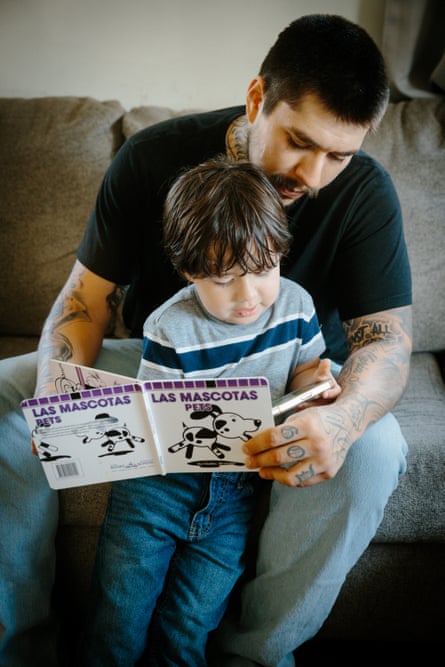
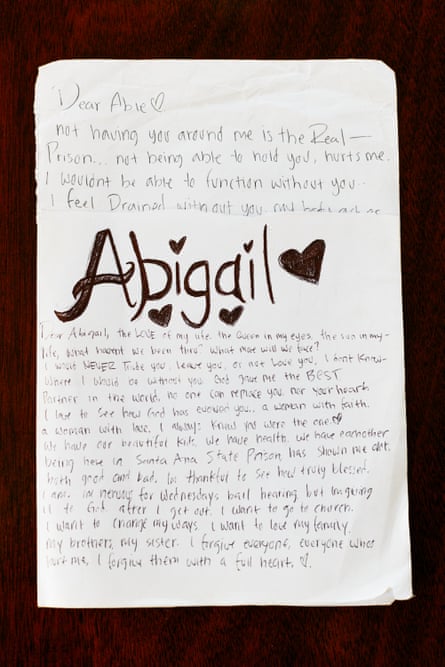
From jail, Cerna tried to assure Chavez he was OK and told her not to put his crying two-year-old son on the phone since it was only making him more upset. Privately, he feared his life was over: “I thought the government was going to throw me under the bus and bury me … They were trying to incite fear into people and make an example out of me.”
Cerna was released after a week and put on house arrest with GPS monitoring.
The stress overwhelmed his family. His infant daughter developed a full-body rash, which Chavez suspected was stress-related. Chavez struggled to eat and lost 20lbs. Cerna was hospitalized with a ruptured appendix, which, according to court records, his doctors attributed to stress. He went on disability leave and stopped working as a carpenter.
Their son was hit the hardest. He sobbed when Cerna came home from jail, then began screaming and crying any time he was separated from his father, even if Cerna was just in the bathroom, Cerna said. At night, “He’d wake up screaming with nightmares, ‘Dad! Dad!’ and I’d say, ‘Relax, I’m right here,’” Cerna said.
Chavez and Cerna said they have both experienced symptoms of post-traumatic stress disorder, including panic attacks, sometimes triggered by the sight of suspicious cars. As the case dragged into the fall, they became eager for a resolution.
A judge’s rebuke
Cerna didn’t want to risk a possible lengthy prison sentence from a felony conviction.
In December, he pleaded guilty to simple assault on an officer, a lesser misdemeanor that doesn’t require any allegations of physical contact and carries a maximum one-year sentence. The agreement said he “intentionally swung at” the border agent’s face, but did not say he punched or injured the officer.
Prosecutors argued in filings that Cerna should be jailed for eight months, citing his verbal threats during the protest and submitting footage of Cerna at one point throwing a water bottle and firecracker in the direction of officers. Cerna’s lawyer argued he should get no jail time, saying officers had used unnecessary force and violence at the protest, Cerna had not made contact with the agent, and only threw objects after he was hit in the face by a teargas canister. Cerna’s lawyer noted he had already faced significant consequences, including a brutal arrest, a week in jail and two months of home confinement.
The DoJ declined to comment.
At sentencing in March, Chavez sat with their daughter in her arms as US judge Cynthia Valenzuela announced Cerna’s fate.
Valenzuela criticized Cerna for making “violent threats”, saying his protest actions were “inappropriate” and “dangerous”. She also said he appeared to be a “hard-working, honest and respectful man” and had no criminal history. She acknowledged the trauma of his father’s deportation and violence he witnessed in his youth had influenced his actions. She said there was no evidence the agent was injured.
Then she denounced ICE for its “troubling” arrest tactics. Pinning his car, she said, was unnecessary and endangered his family and the public. She noted officers pointed assault rifles “even as he surrendered peacefully and begged them not to harm his children” and said it was concerning Mejorado showed up and interrogated Cerna without giving him a Miranda warning.
The judge noted the DHS’s promotion of the arrest video on social media, saying: “The circumstances of the arrest suggest a vindictive effort by government officials to impose extrajudicial punishment and to circumvent protections of due process to which defendant was entitled.”
She sentenced him to one year of probation and no jail time.
Outside court, Cerna and Chavez embraced and cried.