


For anyone with even the slightest interest in Hollywood, it is not entirely surprising that Anne Hathaway recently appeared on Popcast, the New York Times critics’ podcast that has become a premier destination for music promotion. After all, the actor – whose last appearance in a musical bagged her an Academy Award – is a major part of one of the best recent movies to show pop stardom on screen. No, it’s not Mother Mary, the new A24 psychodrama for which Hathaway is making the press rounds as a world-famous diva in the midst of a spiritual and sartorial crisis. I’m thinking of The Idea of You, the improbably glossy 2024 romance in which Hathaway’s 40-year-old divorcee hooks up with a much-younger singer who looks suspiciously like Harry Styles.
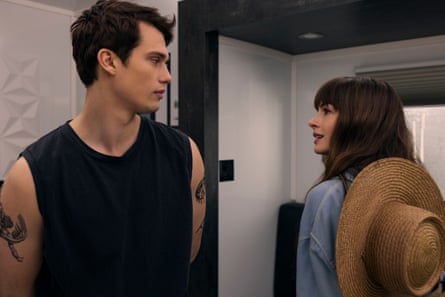
The Idea of You successfully conveyed the idea that Hayes Campbell (Nicholas Galitzine) was the breakout star of a crushable 2010s boyband with a feral fanbase called August Moon. And by “successfully conveyed”, I mean the film remixed a string of One Direction-esque iconography – the jaunty rock-lite choruses, fizzy cheerfulness and class clown antics – into actual music videos and convincingly banal bops. The bar is low; many, many films have created bespoke pop stars and/or music for alternate cultural histories, but vanishingly few transcend pastiche. To be an echo is, generally, enough.
I found myself missing the catchy yet entirely forgettable output of August Moon while watching the much more highbrow-aiming Mother Mary, which similarly tries very hard to conjure the magic of a generational pop icon by remixing the recognizable. Diva signatures abound – Mother Mary struts like Taylor Swift, stuns in goddess repose a la Beyoncé and bears the ornate hand tattoos of Ariana Grande. She shares with Lady Gaga an imperial remove, haute styling and maternal forbearance (as well as some biography – Lowery seems more than a little inspired by Gaga’s mid-career falling out with Laurieann Gibson, the creative director behind her first two albums.) She sings tracks composed by the alt-pop auteurs FKA twigs and Charli xcx, as well as production maestro Jack Antonoff. Surely, this hyper-stylish film posits, somewhere amid this swirl of iconography and signifiers and one generationally beloved movie star, you will see the vision.
I did not. That partly owes to Lowery’s writing, which tips too heavily into portentous psychobabble and leaden metaphor, but perhaps more so to the seemingly immovable fact that it is just exceedingly difficult to fictionalize pop stardom for the screen. It’s certainly not for lack of trying, nor caring. By all accounts, the pop elements of Mother Mary, meant to color a character whose relationship to fandom serves as an overarching metaphor, were made with great reverence for an artform often easily dismissed as, well, easy. On the Popcast, Hathaway waxes poetic about studying pop music like an academic, and Mother Mary certainly appears erudite – speaking nonsense, sure, but well-versed in the precise choreography, deific grace and outsized persona of an archetypical pop star. But the effect is not, as FKA twigs put it in the same interview, “total feeling” despite imperfect approximation. It is the opposite, and the latest disappointing example of a nagging paradox: pop’s power is everywhere – commanding evermore feelings, attention and fan investment – yet almost nowhere, at least convincingly, in film and TV.
Mother Mary, to be fair, sets itself the very difficult task of not only convincing us of the music’s reality but also its fictional popularity, a thing which requires ineffable star quality – that quicksilver thing that makes a certain performer pop on camera, or why, say, Harry Styles stood out in One Direction – that definitionally cannot be created, only trained. The impossibility of reverse alchemy, of creating the matter of cultural legend, is the same reason why Amazon’s splashy Daisy Jones & The Six, which employed almost as much star wattage to create an alternative Fleetwood Mac, fizzled on impact.
It helps to bank on the real thing. Though Bradley Cooper’s A Star Is Born was ultimately about a fading male rock star, it is Lady Gaga’s meta-transformation, from high camp into stripped-down singer-songwriter with glinting ambition, that powered the anthemic Shallow into a crossover hit. The imagination of an alternate, artistically compromised Brat Summer in Charli xcx’s satirical mockumentary The Moment was ultimately listless, but the film at least had some of her volatile star power to burn. That prospect of verisimilitude to the real, established thing propels our evergreen fascination with the much more successful genre of musical biopics, from Michael to Rocketman, Bohemian Rhapsody to Springsteen: Deliver Me from Nowhere. Fan or not, the question of whether Austin Butler can evoke the swagger of Elvis Presley, or if Timothée Chalamet can rasp like Bob Dylan, will almost always supersede a character invented wholesale.
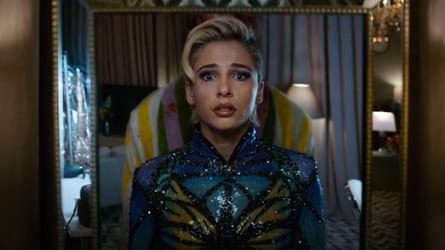
A handful of recent movies have fared better when using pop stardom as a backdrop to the action, rather than thematic engine. The horror films Trap and Smile 2, released in 2024, both staked arena shows for youth-skewing female stars as the focal point for genre conventions, built out with music videos, Drew Barrymore crossover appearances celeb cameos and original music befitting a mid-tier musician. The recessive output of Skye Riley (Naomi Scott) or Lady Raven (Saleka Shyamalan, daughter of director M Night) works, in that it appears as generic to some (say, Josh Hartnett’s girl dad / serial killer) as it is indispensable to young fans. In both, mediocrity and disposability are part of the product. Perhaps the best fictionalized pop music in recent memory is, and I cannot believe I’m saying this, Jocelyn’s (Lily-Rose Depp) World Class Sinner / I’m A Freak, the mediocre pop song from HBO’s cursed series The Idol, that is the right combination of dumb, campy, demonic and desperately catchy to realistically (and actually) go viral.
Each of these carve some vague path through the vast morass of modern celebrity; far fewer have the nerve to actually commit to a corner. Alex Russell’s criminally underseen Lurker, released last year, strategically deploys atmospheric, entrancing music, with just enough snippets of video, to pad a portrait of toxic adjacency, in which an obsessive fan wheedles his way into a singer’s entourage that got too comfortable laundering trust and envy. But it’s Vox Lux, Brady Corbet’s 2018 precursor to The Brutalist, that remains the most divisive and compelling pop star movie in recent memory for its pitch-black view of pop music as fundamentally empty, stardom a Faustian bargain; in it, a school shooting survivor becomes a star played by a sneering Natalie Portman, but her music contains no depth, nor comfort, just violence metabolized into earworms that slowly poison her. It’s an incredibly dim view – the movie, unsurprisingly, made little money – but so wildly ambitious and unnerving as to be unforgettable. (I can’t say the same for the music, which is both too low-budget, and too disdaining of actual pop, to take seriously.)
Vox Lux, at least, expressed some irreducible confidence nowhere to be found in Mother Mary’s diva-off. For all its posturing, and for Hathaway and Michaela Coel’s sincere commitment to chewing scenery, the film is surprisingly weightless – untethered from the real humiliations of modern celebrity, unwound from the pressures of a vague, abstract fandom, untied from specific history. Uninterested, on some level, in the actual gristle of pop stardom. But to be fair, vibes are easy; not even all the effort in the world could make pop magic.