






It wasn’t supposed to be like this. I was waiting for an overwhelming rush of love, but when I looked at my newborn baby what I felt was utter despair. No matter how much I smiled at her, crooned at her, fed, patted, caressed and changed her, I was absolutely numb.
I had yearned for her. Growing up in Italy, I was surrounded by images of perfect motherhood. Every rural crossroad has its tiny shrine to the Madonna and Child. I was certain by the end of my teens that I wanted to have at least one baby.
I knew almost nothing about real babies, of course. I didn’t have the kind of large nest of siblings and extended relations that many other people seemed to have in the 1960s; just one sister. My parents, both of whom had survived grim childhoods, tried for a third child but the unborn baby died, and my poor mother nearly did, too. From then on, human reproduction was associated only with tragedy.
We lived in Rome, where my father worked for the UN’s Food and Agriculture Organization. The few infants I saw in real life seemed boring or noisy. My mother abstracted herself from being interested in them. Tragically, she had lost her own mother at two years old, so she and her brother were passed as semi-orphans between two different sets of relations, neither of whom loved them. She was a gorgeous mother when I was little, pouring into me and my sister all the love she had craved as a little child, but later on it was different.
So where did this yearning to have a baby come from? I had a godmother, a woman who adores all children and who gave me a lot of the love and warmth I missed at home. It was her fourth child, born when I was in my early teens, who gave me the inkling that a baby is something wonderful. For it is no good just looking at a baby, I think. Visually, a baby can seem almost grotesque, with its bald, over-large head and stunted limbs. You must hold and smell that warm, moving bundle of flesh and vulnerability, to feel: I want this, too.
As a young feminist with access to free contraception, I could and sometimes did sleep with men out of curiosity, lust, loneliness, admiration, boredom or naivety. Only when I parted with the worst of them did I step back and wonder why I kept choosing such dreadful partners. As I reread Jane Austen, George Eliot and Anthony Trollope, I realised that what I really wanted was what they described, not in terms of money or class but in moral compass: an unequivocally good and loving man, with whom I could have a child.
I was lucky enough to find him. We got married and, it being the 1980s, could buy a tiny one-up, one-down cottage in Kentish Town, north-west London, on a single salary – mine, because he had just finished his PhD. At last, we could start a family.
But babies do not arrive to order. I had a miscarriage, which I’m pretty sure was not unconnected to what felt like being kicked in the stomach when my debut novel was savagely reviewed. I wrote a second novel, better received, and began a third, A Vicious Circle, a satire inspired by Vanity Fair. We moved into a bigger home. This time, the pregnancy stuck.
Like so many, I was both thrilled and deeply anxious. Though loving and supportive, my husband was largely absent during my pregnancy, working long hours at a startup consultancy he had recently founded with two academics. Every time I needed a medical appointment, including an amniocentesis test for suspected chromosomal abnormalities, he was abroad. I went to tedious NCT classes, but only one person in my friendship group had had children, and my relationship with my own mother in Italy was strained.
“Don’t worry, birth isn’t an illness,” my (male) GP reassured me when I told him I was worried about childbirth. I had reason to be concerned, as an asthmatic and a woman who had undiagnosed endometriosis that crippled me every three weeks. “It’s all perfectly natural.”
I felt I knew my baby intimately, just by the way she moved in my stomach. I could see outlines of her limbs, like something about to break through the surface of water, at once utterly mysterious and familiar. When a police car went past, sirens wailing, she responded with powerful kicks from long, strong legs like her dad’s and with a temper I was sure was my own. I longed to meet this new person and was certain I would love her instantly. How could I not, after a decade of yearning?
My due day came and went. Then a week, and then another week. I was enormous, and still had to beg my GP to be induced at more than 44 weeks. Only when I was wired up to a monitor and my baby was found to be showing signs of distress did the hospital finally agree to break my waters.
What followed were 20 grim hours. An induced labour does not progress like a natural one. There is an accelerated change from feeling “normal” into what feels like acute sea sickness. Hours of nausea passed. I was not dilating, so could not be given an epidural, and the agony was off the scale. All I cared about was that our child would live, and I made my husband promise that if it came to a choice between my life and our child’s, he would choose hers.
“I am not going to lose either of you,” he said, reassuringly.
In those days, University College hospital did not inspire confidence. A red-brick Victorian building, falling apart at the seams, its toilets were awash with blood and filth, and its junior doctors knackered by working 80-hour shifts. The maternity unit resounded with the animal sounds of women in labour, moaning, groaning, wailing and panting; sounds of effort and pain I soon found myself joining in with. I was finally given an epidural, but my baby was stuck. Just before midnight there were (my husband told me) 13 people in the room, performing an episiotomy and emergency forceps delivery. Suddenly, our daughter was there.
She was a fraction under 4.5kg, or 10lb. I’d lost so much blood that it felt like a car crash. My husband, his jeans soaked to the knee in gore, was besotted.
“Isn’t she wonderful?” he said. “Well done!”
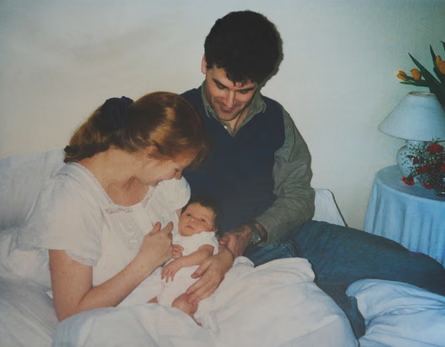
I felt absolutely nothing. It was as if the epidural that had numbed my lower half had also cut off access to emotion. All night long I lay awake in the recovery ward, waiting for the famous “glow” of new motherhood and listening to other mothers sob as the anaesthesia wore off. It reminded me of being back in a dormitory at boarding school, the place where, above all, I had learned to bury everything apart from rage.
Rage has served me quite often as a stimulant against exhaustion, and it is how I react to threat. Every woman who goes through childbirth has, I believe, been through the equivalent of war. Or, as Medea says, “I would rather stand three times with a shield in battle than give birth once.”
A great many of us have the equivalent of PTSD due to poor maternity care. My treatment, from both my GP and hospital, came at the tail-end of the 18 consecutive years of Conservative government that saw NHS funding cut to the bone. But it was also reflective of the way our culture – unlike, say, that of ancient Sparta – seems not to honour mothers. It did not help that in the early 1990s, there were more men than women in general practice, and more male obstetricians (76%). It’s not that men can’t be excellent doctors, but they might be less inclined to treat women as sheep if they understood how different women’s bodies are from the “norm”, ie men’s, and how dangerous birth still is for us. They might, when presented with a pregnancy as overdue as mine, perform a C-section.
I was ejected from hospital the next day. I’d had a big blood transfusion (which, wrongly matched, then threatened the life of my son two years later) and, as a parting gift, picked up a verruca from the filthy bathroom. I had a groin filled with what felt like a bouquet of barbed wire and could hardly walk. My husband was immensely concerned about my physical health but it did not occur to him that my mind was also reeling. Having seen how shaken he’d been by the delivery, I didn’t want to tell him, either.
Once our baby began to cry, as she did relentlessly every night, all night, and much of the day, too, it felt like a battle between my rage and hers.
Had anyone tried to take her away from me, I would have fought them like a tigress. However, protectiveness is not love. We named her Leonora after the heroine of Beethoven’s Fidelio, which in different languages means both “light” and “lion strength”, but she was still in danger. The heel-prick blood test every newborn receives revealed she had congenital hypothyroidism. About one in every 3,500 babies in the UK is born with this which, if untreated, used to be called cretinism. No longer, but in order to grow up as she should, Leonora needed daily doses of the thyroxine that her thyroid gland could not make. A baby’s brain grows 75%-80% of its total weight in the first two years of life, and the most rapid growth of all comes in its first 90 days. This meant that, despite being unwell, I had to take her every three days to Great Ormond Street hospital and allow a needle to be stuck in her tiny hand to test her blood. I felt like a monster as she shrieked each time.
The guilt and misery were overwhelming. She had, as I had guessed she would, her father’s excellent legs and my awful temper, but she seemed to hate me.
My husband had gone back to work after half a day of paternity leave and, though he did all the cooking and laundry, he was also chronically sleep-deprived. I silently blamed myself for it all, and the depression that I have battled with my entire adult life became increasingly insistent. My GP seemed more concerned that I should start doing pelvic floor exercises and my health visitor that my baby should put on weight. Nobody asked how I was feeling, so I lied to everyone that I had never been happier and carried my rage like a flaming torch into a lightless place.
My parents flew over from Italy for a brief visit but seemed almost as bewildered as I was. My father wanted to throw her up in the air as he had done me, because he thought the startle response charming. My mother has always been fearful of discussing depression – so often when I was growing up she would nestle into me and say, “I wish you were my mother.” My mother-in-law, marvellously, had immediately offered to donate blood on hearing I needed a transfusion but was incompatible, and believed “the blues” should not be discussed. I was visited by close friends but, again, how could they understand without having been through birth, too?
As many as one in three new mothers struggle to bond with their newborn, according to a 2016 study by the NCT. In those pre-internet days, I had no idea about this. Guilt, shame, alienation and depression run counter to the accepted norms of motherhood, and so, of course, we are disincentivised to speak about it, even though this is particularly common to those who have experienced a difficult labour and birth.
There was no respite. I was feverish and ill, physically and mentally. I got mastitis, which meant breastfeeding felt like having a red-hot needle thrust into my nipples, and I needed three courses of antibiotics, which upset my baby’s digestion. The thyroxine tablets that Leonora would have to take every day of her life gave her body and brain what she needed to grow normally, but I was convinced she was brain-damaged by the long labour, and that she would never improve. In utter exhaustion I repeatedly considered killing myself. Only the knowledge of what my own mother had suffered from growing up motherless stopped me. (When I see news reports now telling me suicide is the leading cause of death in the postnatal period, and that maternal death rates from suicide are 74% higher than in 2019, I despair.)
But then, seven weeks after the birth, something shifted.
My husband often claimed that Leonora was smiling, but all I saw was a faint goblin grimace, probably caused by wind – though to me it seemed more like mockery. One day, however, her vague blue eyes seemed suddenly to focus.
No sooner did this happen than her mouth, usually downturned or howling, began to curve upwards. She made odd, squeaky sounds, then her whole face blossomed into an enormous and unmistakable smile. She seemed not only to recognise me, but to greet me with unconditional love and delight.
People talk about feeling “seen” and indeed she seemed to see not just my face but my deepest self, and to find it delightful. I knew, logically, a baby’s smiles are a kind of evolutionary trick, a way of ensuring it survives – yet it was a joy so piercing, it almost felt like pain.
“Oh!” I exclaimed. “It’s you. It’s you.”
Of course there were still many howls to come, and even more broken nights. But that first smile changed me for ever. I became a different person. My relationship with my mother, which had been filled with hurt and difficulties, became easier. I felt compassion for her that deepened once I really understood her bereavement at two meant a part of her had remained frozen for ever. I had at least had my lovely godmother; she had not.
I loved literature, but nothing I read had prepared me for life after birth. What came after marriage was glossed over by the Victorian fiction I adored: Jane Eyre’s Mr Rochester has recovered his sight enough to see the child she puts in his arms and, unlike her author, she does not die a pregnancy-related death. Even more modern authors, from Fay Weldon to AS Byatt, swerved the subject. At the time I was writing A Vicious Circle (1996), five years before Rachel Cusk’s A Life’s Work (2001), there was zero about how devastating childbirth could be. I was determined to give my experiences to one of my two heroines and was duly castigated on publication by Peter Kemp in the Sunday Times for including “revolting details about childbirth”. But I could have added so much more, because I lied in that book: I redeemed one of my heroines by having her immediately love her daughter.
Many things have altered for the better since my first experience of motherhood. Under Labour, UCH was rebuilt as a shining new hospital, my GP practice was filled with wonderful young and predominantly women doctors – and we had a son, Will, whose birth was very different from his sister’s, and with whom, to my relief, I was able to bond instantly. For although having a baby brought me unimagined misery, the life-changing love and joy and courage of motherhood are real, too, and we do not talk enough about this, either.
My daughter, Leon, grew up to be a novelist herself, and as healthy, loving, beautiful and brilliant as I could possibly have wished. I have no more need of a fire in the darkness. I have light.