






Some years ago, the Guardian decided to boost its Cannes coverage by having a video crew accompany its regular festival reporters. At the meeting prior to the festival, I explained why this bright idea wouldn’t work. Cannes was a fortress and it wasn’t going to let us shoot anywhere. The security was too tight, the bureaucracy too byzantine. It would be a colossal waste of time and money. You couldn’t just run around Cannes pointing a camera at people.
It turned out I was wrong. Cannes didn’t care. It let us shoot everywhere. We shot on the street, on the beach and on the roof of Le Palais des Festivals. We dragged a sand-smeared rubber dinghy into the five-star Carlton hotel and asked famous actors to sit in it for an interview. We filmed on the carousel in the park and in the pavilions by the sea. The only resistance we encountered came from the steward of a billionaire’s yacht. The steward was perfectly happy to allow us free run of the deck, but he wanted his palms greased with a few hundred euros.
The point of this story is that Cannes will let in anyone, figuring that all publicity is good publicity. It’s an open-air movie set and a reality show. It’s a reflective hall of mirrors and a citadel of self-promotion. Before the big evening premiere, viewers are treated to a lengthy live feed of the red carpet arrivals outside. When the lights eventually go down, some of these people hiss and boo. It’s the worst thing that could happen, just when they were enjoying themselves. They would rather watch the guests at their backs than the new film on the screen.
Good news for the rubberneckers: there’s a fresh distraction in town – a canny festival sidebar that might yet take centre-stage. Alongside the usual VIP dignitaries, this year’s event will host season four of The White Lotus, reportedly beating out rival bids from Norway, Ireland and Germany. Mike White’s boutique HBO series has set up shop in the posh Hotel Martinez (now doubling as the White Lotus Cannes) and features the sort of ensemble star cast (Helena Bonham Carter, Steve Coogan, Vincent Cassel, Heather Graham) that wouldn’t look out of place in the main competition. The series shoots throughout the festival, just like we used to do. I’m seeing it as part of the same noble tradition.
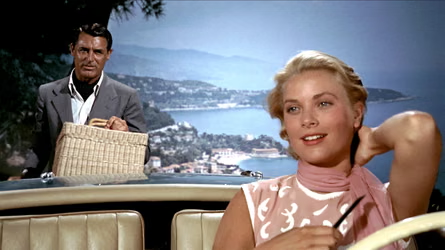
The Cannes film festival loves films, and it loves films about films. But what Cannes loves more than anything seems to be films about Cannes. Critics like to joke that there are a couple of surefire ways to have your picture accepted: namecheck the event or use the Côte d’Azur as your backdrop.
The ghastly Grace of Monaco swung by for a lengthy Cannes visit in 2014 and was duly rewarded with the opening-night slot. Rocketman, the Elton John biopic, wrapped up with a reprise of the video for I’m Still Standing, shot on the beach by the Carlton. Cleverest of all, perhaps, was last year’s Nouvelle Vague, which featured an extended sequence in which the young Jean-Luc Godard (ably impersonated by Guillaume Marbeck) took an illicit road trip to the festival. Seated for the premiere at the Grand Theatre Lumiere, the guests watched Godard sit down inside the same main theatre. It made for a great meta moment, a disorientating walk around Escher’s staircase.
The film-maker Mark Cousins likens Cannes to a church. It is about “the rituals, the grandeur, the massing of the hordes. The climbing of the steps like Santiago de Compostela.” That’s undeniably true in so far as the selection itself is concerned, with only about 2% of submissions deemed worthy of inclusion. Elsewhere, sacred rules can be bent and cherished friends waved through. The organisers always bar outside film crews from the red carpet premieres, but made an honourable exception in 2007 for Mr Bean’s Holiday, which featured slapstick antics outside and inside the palais. It transpired that the festival’s president between 2001 and 2014, Gilles Jacob, was a big fan of Rowan Atkinson.
Mr Bean’s Holiday, incidentally, punctured the pomp and pretensions of the festival. So, too, in its way, did the French sitcom Call My Agent, which once sent Juliette Binoche scurrying through the backstage corridors, riding up and down in the service lift, trying and failing to find her way to the stage. Binoche later said that this sequence was prompted by the time she arrived late to pick up an award and found herself lost in the palais, stranded behind a row of locked doors. Cannes is confusing, even for those who know it well, and the line between what’s real and what’s fake becomes porous at best.
How will The White Lotus cover Cannes? Surely the script writes itself. It’s the perfect site for satire, a vibrant, dirty tide pool of the haves and have-nots; so what if these waters have been dived and dredged beforehand? White’s plan is to install the festival as a living, breathing side attraction, folding his stars alongside other stars and juggling scripted private drama with public events. That’s a neat idea, but it’s also as old as the hills. Brian De Palma’s Femme Fatale used the 2001 festival as its backdrop, while Michael Ritchie’s An Almost Perfect Affair piggybacked off the 1978 edition. Bo Derek took the lead in 2000’s Murder at the Cannes Film Festival, optimistically cast as the most famous star in the world. Unfortunately, she dies in her seat during the opening ceremony.
The best film at Cannes ideally wins the Palme d’Or. But the best films about Cannes generally throw bricks from the wings. They’re the outsiders, the opportunists, the equivalent of those smash-and-grab robbers who stole $130m worth of gems from the Carlton in 2013.
No one would ever confuse the director David Winters with Bergman or Tarkovsky, and I’m guessing he might have been offended if they had. Nonetheless, The Last Horror Film – his postmodern 1982 slasher flick – remains the ultimate piece of guerilla Cannes film-making, shot on the fly and framing the celebrity circus as a tawdry circle of hell. Midway through the movie, the imperilled scream queen is chased up the Croisette by a crazed killer. The paparazzi go wild. The film fans are agog. “It’s a publicity stunt,” they exclaim. “What a fabulous entrance.”
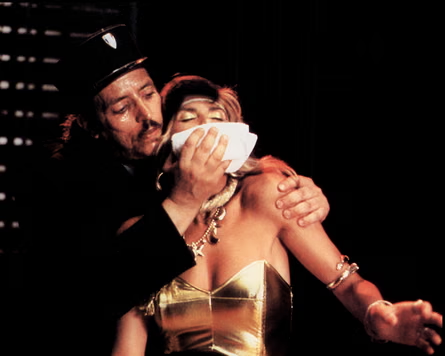
It’s nice to think of the Guardian’s video team as the iron-age ancestors of this year’s White Lotus production, lugging our hefty camera between the roof and the beach. Annoyingly, though, it’s The Last Horror Film. It’s cheap, but it’s clever; it’s illicit and inventive. Crucially, too, it already has The White Lotus beat as satire, given that White’s show will be made with Cannes’ full approval, while Winters’ B-movie was emphatically not. Shot without a permit, ogling movie stars from afar, The Last Horror Film might be the one Cannes production the festival couldn’t tame. The city didn’t like it and refused to give it houseroom. So it went its own way and opened the Sitges film festival instead.