









Your manager has fallen out with the sporting director and results have gone awry, so you replace him. Easily done, it happens. But then it turns out that the new manager could not be more ill-suited to the squad, results go awry and so you replace him.
A bad leader would hesitate and hope things worked out, but you are ruthless and decisive and turn to a manager who was once a youth player at the club and has some anecdotes about the old days. But it turns out some people think his methods are old‑fashioned and results go awry, so you replace him.
And this time you pull a masterstroke. You get in a bloke who saved a team in not dissimilar circumstances last season, who takes 15 points from his first nine league games in charge, lifting you six clear of the relegation zone. If you beat Newcastle at home on Sunday you’ll be safe. You are a genius, your recruitment skills unmatched.
And of course you mean the blind trust you placed the club in to comply with Uefa relegations so you could go on a morale‑boosting run to the Europa League semi-final. Or maybe you just rolled the dice often enough that eventually the right number came up.
That’s Nottingham Forest, but something similar applies to Tottenham. Thomas Frank wilted in the job. Igor Tudor was such a bad fit he lasted 44 days, the established benchmark for a manager unsuited to a role. Tottenham fell into the bottom three after defeat by Sunderland in Roberto De Zerbi’s first game in charge. They conceded an injury-time equaliser against Brighton. An implausibly long injury list has somehow got even longer.
The implosion might easily have continued. But Spurs then beat Wolves and Aston Villa. It’s true that the latter, resting players before the second leg of their Europa League semi-final, were atrocious but, still, there was greater spirit and, most significant, clear signs of De Zerbi football as the Villa press was repeatedly baited. Watching Tottenham over the past four games has been like watching a time-lapse video of a plant’s growth: what normally happens incrementally behind the scenes in pre-season sped up and on public view.

But is the recent improvement in Forest’s and Spurs’ form really down to their new managers? In Soccernomics, Simon Kuper and Stefan Szymanski cite the theory of the Finnish economist Marko Terviö that in markets for very talented individuals in which ability is only revealed on the job, the incentives for companies to find the very best are limited because once that ability is revealed the individual will simply sell himself to the highest bidder. As they point out, this sounds very like the market for football managers.
They go on to argue that managers don’t actually matter all that much – an idea that gained prominence earlier this year when the Chelsea director Daniel Finkelstein apparently said something similar to a fans’ protest group when they asked why Chelsea had not pursued Luis Enrique. Separate work done by Liverpool’s former director of research, Ian Graham, and the Institute for Economic Affairs reaches a similar conclusion.
The biggest single factor by far in determining performance is wage spending. That shouldn’t come as a huge surprise: of course the club with the greatest revenues will be near the top, and nobody would expect a club operating on a League Two budget to qualify for the Champions League.
But if a manager can take the side with the second-highest wage bill and make them champions, he has added value. If he can take the side with the 17th-highest wage bill to the verge of Champions League qualification, as Andoni Iraola has done with Bournemouth, he (or the recruitment department) is adding miracles.
The question is how much of the variance that is not down to wages is down to the manager. There, frankly, the data is inconclusive, but it could be argued that any variance attributable to the manager is worth investing in. This bloke will make everybody 2% better but this one 5% better? That could be worth two or three places in the table, which does seem pretty significant. (And if Chelsea really don’t think the manager makes much difference, why did they sack Liam Rosenior after five successive Premier League defeats? The manager clearly makes enough difference to make it worth striking at the mood of negativity that had developed.)
Multiple studies suggest the new manager bounce does not really exist, yet does anybody at Forest think they would be this close to safety under Sean Dyche? Does anybody at Spurs think the situation would have improved this much under Tudor?
One of the issues of data in football, arguably one of the purposes, is to strip out emotion – but emotion matters. It may be true, as Szymanski and Kuper say, that two seasons is insufficient to allow for the vagaries of luck (another study calculated that for a league to be “fair” in the sense that the form of opponents was not statistically significant, a season would have to last 35 years).
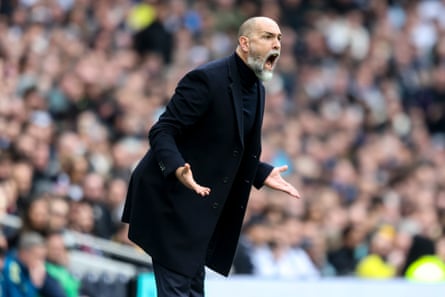
But it’s also true that over the span of two years circumstances may have changed sufficiently for the right manager to have become the wrong manager. Arne Slot’s calmness is a boon when results are going well and everybody is still exhausted from the volubility of Jürgen Klopp, but less so when performances decline and there is a need for reinvigoration. It’s horses for courses but the course keeps on changing.
Equally, poor results can quickly lead to a negative cycle, a manager doubting himself, feeling beleaguered and making poor decisions as a result. Once that happens, once, as one club owner put it, the light goes out in their eyes, the only solution is termination. Waiting for a statistically significant sample size is not an option.
Which, in some ways, is an extension of Terviö’s point. The market in managers is inefficient, perhaps necessarily so, because everything changes all the time. The multiple interlocking contingencies of football make it resistant to analysis.
Or perhaps we just create post‑hoc narratives to fit the facts, and Vítor Pereira and De Zerbi aren’t that much different to their predecessors after all.