





Tim Miller is good at finding missing people – or rather, their bodies. Four years ago, a stranger called him and left a rambling message claiming that he had important information about an unsolved murder case.
Miller, who lives in Texas and runs a non-profit search-and-recovery organization called EquuSearch, did not treat the message as a high priority. The caller sounded as if he might have been drunk or on drugs. Although tips are vital to EquuSearch’s work, the tip line brings a certain number of hoaxes, cranks and innuendo. Some of the people who leave messages, Miller told me, “probably ought to get their medication checked”.
Miller’s teenage daughter, Laura, disappeared in League City, Texas, in 1984 and was found murdered two years later. His zealous efforts to find out what happened to her, and his frustration with what he viewed as an inadequate police investigation, led him to develop a certain expertise in locating people or their remains. He founded EquuSearch, in 2000, as an outgrowth of that work.
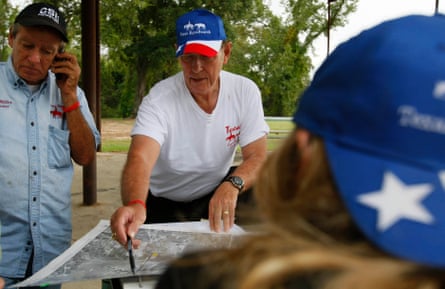
EquuSearch – so named because its volunteers sometimes conduct searches by horseback – has an office on a sun-baked road on Texas’s gulf coast, about 10 miles (16km) from the bayous, beaches and oil rigs of Galveston Bay. On days when a search is under way, a flurry of people may come and go with ATVs, boats, horses or backhoes in tow.
Laura was one of about 30 women and girls who disappeared or died in the area between the 1970s and early 2000s, the victims of what law enforcement agencies believe was a grim confluence of overlapping serial killers and one-time acts of violence. Despite the notoriety of these crimes – which have been the subject of years of media coverage, including a 2022 Netflix documentary – many of the cases remain unsolved.
When families or law enforcement agencies ask for EquuSearch’s assistance, it is often for situations that are urgent but, unfortunately, not unusual: someone suffering a mental health crisis can’t be found; a relative with Alzheimer’s has wandered off; a friend went fishing, hiking or boating, and disappeared.
Other times the cases are more sinister. In 2020, EquuSearch helped find the remains of a soldier murdered at Fort Hood, Vanessa Guillén, buried in a shallow grave. In 2024, EquuSearch found the remains of a woman who had been missing since 1999, Kimberly Langwell, hidden under a bedroom in her ex-boyfriend’s house. Miller and police had noticed an odd area of tilework flooring – then realized that it sounded hollow.
Those are the kinds of details that Miller listens for when strangers call in with tips. Nothing in the rambling message he got four years ago, however, made him curious enough to immediately respond. But the caller telephoned again the next day. After the third call, Miller called him back – wary, but open to hearing what he had to say.
Miller had little idea that this call would start a cascade of events that has culminated, this spring, in the identification of a possible serial killer and the arrest of an alleged accomplice; the possible resolution of some of Texas’s most haunting unsolved murders; and a small measure of justice for families who have lived with decades of grief.
When they finally spoke, Miller apologized for having been busy. As he recalls it, the man reiterated that he had information about a case.
“Which case?” Miller asked.
“Your daughter,” the man said.
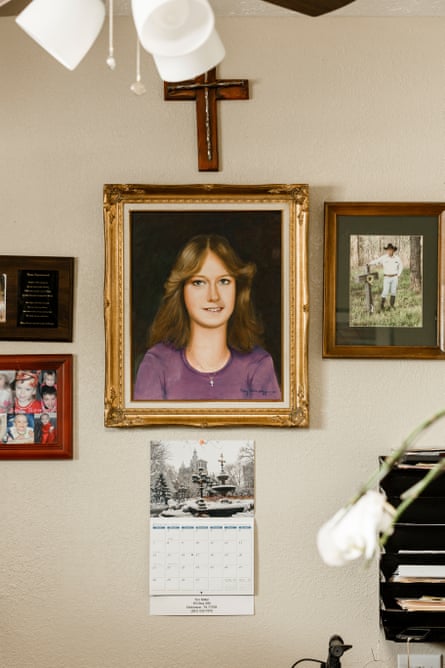
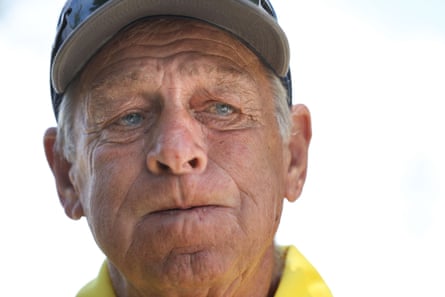
Miller has blue eyes and a face weather-beaten by years of digging holes under the sun. He lives on a small ranch in Santa Fe, Texas. I first met him in 2018, when I visited the area to write a long piece about his story and the larger saga of what had come to be known as “the killing fields”.
At the time, Miller strongly believed he knew who killed his daughter. But proving it remained elusive. Miller, then 71, also had a complicated relationship with local law enforcement agencies. Earlier in his decades-long hunt for his daughter’s killer, he had crossed the line into vigilantism – hounding suspects and even, by his own admission, confronting one at gunpoint. He also had a tendency to publicly accuse law enforcement agencies of being derelict in their duties. He still believes some of them deserve embarrassment.
“I dedicated my damn life to this shit,” he told me recently. “And I’m very disappointed in the system.”
Today, Miller is almost 80, and is retired from his former day job as a construction contractor. Yet he remains relentlessly devoted to the volunteer detective work that EquuSearch provides, free of charge, to those who ask its help. He is also, in an odd and steely way, optimistic. Optimism is what you have left when the worst conceivable thing has already happened.
In September 1984, Miller and his then wife, Jan, moved to League City with their children. The phone lines in their house had not been set up yet, so that evening their 16-year-old daughter, Laura, went to call her boyfriend at a gas station payphone down the road. She did not return.
Laura had a history of seizures as well as depression and anxiety; her self-esteem had never fully recovered after her solo at a school music recital was derailed by a seizure, and she had taken to hanging out with a druggy crowd. For these reasons the League City police department treated her as a runaway or suicide, according to Miller, despite his insistence that she might have been attacked or abducted.
The Millers’ corner of south-east Texas – toward Louisiana, in the coastal plain between the urban sprawl of Houston and the island of Galveston – was then more rural. The I-45 freeway connecting Houston to Galveston ran through a series of small towns surrounded by undeveloped land.
The area seemed to be a magnet for serial violence. In the early 1970s, nearly a dozen adolescent and teenage girls disappeared in Galveston and the greater Houston area; many were later found killed. In the late 1970s, the serial killer Dean Corll, working with two teenage accomplices, abducted, tortured and murdered at least 29 boys and men.
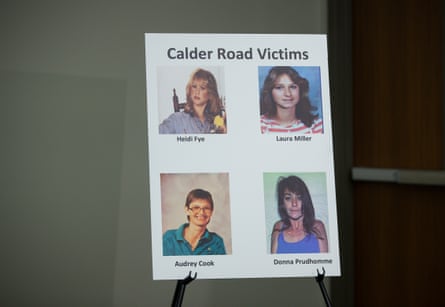
And about a year before Laura disappeared, a 25-year-old waitress, Heide Fye, had also gone missing in League City. (Some sources spell her name “Heidi”.) Five months later, a dog dragged a human skull from an abandoned oilfield. The rest of Fye’s body was found there. She appeared to have been beaten to death with a blunt instrument.
Fye had disappeared from the same gas station as Laura. When Miller raised the connection to police, they were, he said, dismissive.
Two years later, in 1986, some boys riding dirt bikes smelled something strange near the same oilfield, and contacted police.
Robert Valentine, 73, was a League City police officer at the time and one of the first people on the scene. He still vividly remembers it. “If you’ve ever smelled the decomposition of a human being, it’s very distinct,” he told me. “When I exited the car, there was no doubt in my mind what it was.”
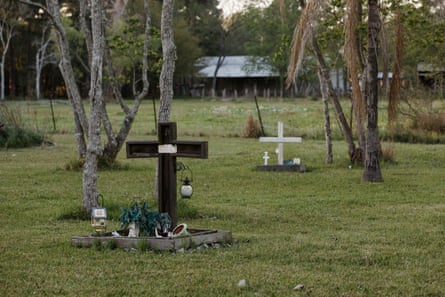
In the field, police saw the body of a young woman killed by a possible gunshot wound. They could not identify her and named her Jane Doe. Nearby they also found Laura Miller. She had been dead much longer, and her cause of death could not be determined. A men’s shirt was found at the scene, though police later lost it.
Valentine believes that Miller’s sense that his daughter’s case was mishandled is accurate. At the time the local police department was much smaller, less professional, and dominated by, he said, “a good old boy system”. The Millers lived in a neighborhood that police viewed as being on the wrong side of the tracks. Local law enforcement agencies rarely collaborated with each other on investigations, and were hostile about sharing information.
When the bodies were found, Valentine said, the department declined to immediately send criminal investigators to the scene, instead leaving the crime scene largely unattended.
“That just baffled me,” Valentine said. “Are you kidding? We have the remains of two people and you’re not coming out to the scene?”
A local man eventually offered to guard the scene in a lawn chair. “The area wasn’t roped off, wasn’t taped off,” Valentine said. “So I have no idea what happened that night.”
(Noting that these crimes remain active and ongoing investigations, the League City police department declined to comment.)
Valentine was so concerned that he took to going out at night, in a darkened vehicle, with night-vision equipment, to watch the crime scene. An officer who lived nearby, he said, eventually told him to stop.
Miller’s life had been marked by tragedy even before Laura died. He and his brother were abandoned by their parents at a young age and raised, he has said, by abusive relatives. One of his children died as an infant, and his brother killed himself about a year before Laura’s disappearance.
As months, then years, went by with no suspect named in the deaths of Heide Fye, Laura Miller or Jane Doe, he undertook his own mission to find the killer. Like the officer who found Laura and Jane Doe in the oilfield, he took to conducting nocturnal stakeouts. He drank heavily, became separated from Jan, and at one point checked himself into a psychiatric ward for 10 days. His obsession with finding Laura’s killer also strained his relationship with his surviving daughter.
Miller was debilitated by grief, but he was also furious. He believed that if police had more diligently searched the scene when Fye’s body was found, they would have found Laura’s. And if they had found Laura’s body earlier, before physical evidence deteriorated, they might have been able to stop the killer before he got to Jane Doe.
He was also suspicious of a former neighbor. A roofing installer and bar fly, Clyde Hedrick was a fixture of local honky-tonks. He loved dancing and chatting up women. Before years of hard living and an attack of jaw cancer later caught up to him, he was considered handsome.
Hedrick had once served two years in prison for attempted second-degree arson. But Miller also learned something else interesting: in July 1984, only a couple months before Laura disappeared, Hedrick had left the Texas Moon, a local bar, with a 29-year-old woman, Ellen Beason, who was later found dead. Beason had drowned while skinny-dipping, Hedrick told police, and he had panicked and hidden her body. He was convicted of “abusing a corpse”, for concealing her remains, and was sentenced to a year in jail.
Hedrick’s story seemed almost outrageously suspicious, but the medical examiner had not found any signs of foul play on Beason’s body, and police struggled to find any actionable evidence contradicting his account.
That did not stop Miller from pursuing a one-man investigation and vendetta. In 1988, he claimed, he committed Dickinson, Texas’s, first-ever “drive-by shooting”: shortly before a tropical storm he drove to Hedrick’s house, while he was out, and blasted holes in his roof with a shotgun. “It rained for three days, and all his insulation got wet and all the sheetrock caved in.”
Then, in 1991, it happened again. People riding horses near the oilfield discovered the body of a fourth woman. She appeared to have been beaten to death. Like Jane Doe, she could not be identified. Police named her Janet Doe.
Everything shifted. Rather than Hedrick, the League City police and the FBI came to suspect that the killer was a rancher and retired Nasa engineer named Robert Abel. Abel owned a horse-riding attraction, Stardust Trailrides, that abutted the oilfield; he bore an uncanny resemblance to an FBI profile describing the personality of the killer; and he had a fraught romantic history, with two ex-wives alleging a raging temper beneath his gentle and shy exterior.
For his part, Miller became so convinced that Abel was the killer, he has said, that he once confronted him outside his home, put a gun to his head, and demanded – fruitlessly – that he confess. After an exhaustive investigation, police cleared Abel. Miller apologized and withdrew his accusation. (Abel was struck and killed by a train in 2005, in what may have been a suicide.)
Yet the small towns of the coastal plain, riven by fear and panic, could not seem to find relief. In 1997, 12-year-old Laura Smither disappeared while jogging in Friendswood. The same year, 17-year-old Jessica Cain disappeared while leaving a restaurant in Clear Lake City. People were unsure whether the oilfield killer had returned, or another, different, killer was stalking the area. According to Texas Monthly, one school district gave parents a kit to collect their children’s fingerprints and hair in case they ever needed to be identified.
Miller founded EquuSearch in 2000 as a way to channel his grief and anger more productively, by aiding other families who needed help. “Whenever I come home from a search, I love to go out to my barn at night with my horses. I bring them treats. I pet on them and brush them and talk to them,” he told Orlando magazine in 2009. “I’ll get a 12-pack of beer … And I’ll put some music on the stereo out in the barn, and it’s normally some kind of sad and mellow stuff. And I’ll drink all my beer and I’ll spend a lot of time by myself with my horses. Will I cry out there? Yes.”
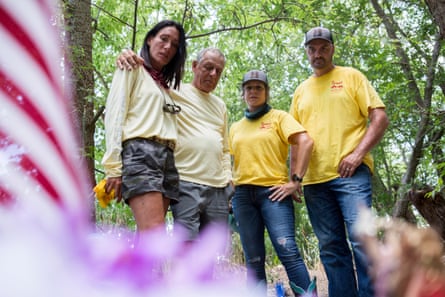
He sought counsel from a Christian pastor and later quit drinking. Yet he hadn’t given up on his daughter’s case.
In 2012, at Miller’s urging, the FBI and the Galveston county sheriff’s office exhumed and re-examined Beason’s body. This time a forensic anthropologist found a hairline fracture in her skull caused by blunt-force trauma. Her death was ruled a homicide – and Hedrick, who continued to deny any guilt, was rearrested.
A jury determined that Hedrick had been responsible for Beason’s death, but could not say whether he had deliberately killed her. He was sentenced to 20 years in prison for manslaughter, with parole in the event of good behavior.
In 2018, when I first wrote about the killing fields, Hedrick sent me a handwritten letter from prison vehemently denying that he was responsible for the death of Beason, or anyone else. He accused Miller of ruining his life, and described himself as one in a series of men whom Miller had accused of being his daughter’s killer.
“I had no contact with [the] Miller girl at all anytime, so help me God,” he wrote. “I didn’t do anything to anyone.”
In 2019, the League City police department made a seismic announcement. After more than three decades, using new breakthroughs in genealogical and DNA research, they had discovered the identities of Jane and Janet Doe, the two women found in the oilfield near Heide Fye and Laura Miller.
Jane Doe was Audrey Lee Cook, a motorcycle enthusiast from Tennessee who had moved to the Houston area with a girlfriend and found work as a mechanic – until her occasional letters home suddenly ceased, according to ABC13, around Christmas of 1985. Cook’s mother died without ever knowing what happened to her, and an aunt had spent years looking for her without success. Cook had been around 30 years old when she died.
“She was enjoying life. Then, someone took that joy from her,” her aunt, Shirley Love, told ABC13. “They took her from us.”
Janet Doe was Donna Gonsoulin Prudhomme, a woman who was last seen in 1991 and was around 31 when she died. Prudhomme had grown up in a big Cajun family in Port Arthur, Texas, and moved to the Houston area. While dealing with some personal problems, she had dropped off her two sons to live with their grandparents, temporarily, in 1989.
After she disappeared, her sister, Dianne Gonsoulin, spent years grappling with two cruel possibilities: one, that something horrible had happened to her gumbo-cooking, crab-fishing, paper-towel-roll-singing sister; or two, that she had abandoned her sons, something that Dianne found even more unthinkable than her sister’s death.
“I just keep trying, when I can, to give Donna a voice,” Gonsoulin told me. “I can’t bring her back, and I can’t change what happened to her, but I can still love who she was and honor the good stuff and laugh about things she used to do.”
In 2021, after eight years of his 20-year sentence, Hedrick was paroled from prison to a halfway house. Miller lobbied the state to keep him under close supervision. In 2022, he also won a $24m wrongful death lawsuit against Hedrick.
Miller won the lawsuit by default, after Hedrick failed to contest it. In the view of law enforcement agencies, there was still no concrete evidence that Hedrick was guilty of murder, let alone multiple murders.
But Miller and Dianne Gonsoulin did learn something startling, she said. When Gonsoulin showed a picture of Hedrick to one of Donna’s now adult sons, she said, he reacted as if he had been jolted. Her sister may have known Hedrick, she said – and on one occasion Hedrick even drove her to visit her children at their grandparents’ house.
“He said: ‘Dianne, that’s him. That is him. That’s who was with mama. I know his hair, his eyes, his clothes, his shoes.’”
The caller, four years ago, who claimed he had important information was a grizzled man in his late 50s from Bacliff, near League City, named James Elmore.
Soon after they spoke, Miller picked him up in his truck and they went on a drive. According to Miller, Elmore told him that he wanted to “come clean” about some old memories. He had been friends with Hedrick for years, he said. He had seen him do things. He had helped him dump stuff.
As they drove, Miller told me, Elmore pointed out pertinent landmarks, including Hedrick’s old house and the oilfield. Miller was still skeptical about Elmore’s credibility. The oilfield, after all, was well known to locals and immortalized in countless articles, newscasts and crime documentaries. He had the impression that Elmore – who had a lengthy rap sheet of drug- and violence-related charges – smoked a lot of pot.
Then Elmore asked to drive to a cemetery a few blocks from the Millers’ old house. Miller felt unsettled. Laura used to walk to the cemetery and sit near a bayou there, something that far fewer people knew.
Elmore, he said, added something chilling. He pointed at a copse of trees and said: “See them woods right there? That’s where Clyde used to hide and watch Laura.”
In the four years that followed, Miller met with Elmore at least 30 times, he estimates, as he tried to pry more information out of him and persuade him to speak to the authorities. Elmore, who was hoping for immunity, dithered. Miller is uncertain whether Elmore came forward because of an actual crisis of conscience; he suspects that the real motivation was a longstanding $25,000 award for information on Laura’s killer.
After countless meetings, Miller said, Elmore finally told him what had happened to Laura. Hedrick had raped her, killed her with an intentional cocaine overdose, then covered her body with a shirt. He had then enlisted Elmore to help move her body. Elmore also, Miller said, hinted at information implicating Hedrick in other killings.
As Elmore related the graphic description of Laura’s death, Miller worked to hold his composure and appear unfazed, though he said that there were times after speaking with Elmore that he would drive behind a convenience store and “just sob”.
Miller contacted Corey Williams, a detective with the Hitchcock police department who had expressed interest in revisiting the case against Hedrick.
Hitchcock is “the smallest, poorest city in our damn county”, Miller said, and the police department does not have the resources of others in the area. Yet Williams, a 38-year-old black officer who grew up in New Orleans and moved to Texas after Hurricane Katrina, seemed moved by the tragedy of the killing fields, Miller said, and visited the oilfield many times to sit there and try to reconstruct what happened decades ago. (Williams declined to comment.)
Williams and officers from other law enforcement agencies began working with prosecutors at the Galveston district attorney’s office to seek a grand jury indictment against Hedrick for the deaths of Miller, Cook, Fye and Prudhomme. Elmore eventually agreed to talk to Williams. After interviewing him, Williams went to speak to Hedrick, who was at a Houston hospital undergoing treatment for chronic medical conditions that caused him breathing problems.
On 21 March, about a day after Williams confronted him, hospital workers found Hedrick dead. According to Ken Cusick, the Galveston district attorney, Hedrick killed himself.
Miller does not think that Hedrick, who was 72, was afraid to go back to prison.
“The whole deal with serial killers – it’s about control,” he said. “And I believe in his very last breath, because of his control shit, he probably put a big smile on his face, like, what are you guys gonna do about me now?”
Elmore was indicted by a grand jury, in late March, for the manslaughter of Laura Miller and for tampering with evidence related to the deaths of Laura Miller and Audrey Cook. His trial is scheduled for August, and his combined bail has been set at $4.5m. The indictment accuses Elmore of having “recklessly cause[d] the death of an individual … by preparing a vial of cocaine for Clyde Hedrick to administer to Laura Miller.”
Noting that the case is ongoing, Elmore’s attorney declined to comment.
On 16 April, police executed search warrants at property Elmore owns that once belonged, according to warrants, to Hedrick. Police were searching for human remains. They did not find any, though police allegedly found evidence that led them to additionally charge Elmore for possession of materials depicting sexual assault and child sexual abuse, according to court documents.
Elmore was “running buddies” with Hedrick and a third man, now deceased, for years, Miller said. He thinks Elmore holds crucial information. “I wouldn’t go along with a plea bargain where they slap his hand and put him on probation,” Miller said. “But if he’d lead us to more bodies, I’d go along with a plea bargain.”
Miller believes that Hedrick was guilty of at least five homicides: the four oilfield murders; the killing of Ellen Beason; and the death of Angela Ramsey, a 16-year-old girl who disappeared from a motel in Deland, Florida, in 1977, during a period when Hedrick was in Deland. Before his legal problems started, Hedrick also traveled often for work around Texas, Louisiana and Oklahoma.
After decades of pain and uncertainty, this saga could mean legal closure to some – if not all – of the lingering mysteries of the Texas killing fields. Some cases remain unsolved. Others have been solved but found to be unrelated. (In 2022, the serial killer William Reece pleaded guilty to the 1997 murders of Laura Smither and Jessica Cain.)
In 2018, Miller told me that “closure” was a myth. He has since softened his stance. “I feel a little bit of comfort now,” he said, “knowing everything wasn’t in vain.” Nonetheless, he is disappointed that the charges against Elmore only name Laura and Audrey Cook. The other victims’ families may have to wait longer for justice.
Miller is used to waiting. He has worked with a grief counselor since 1997. His relationship with his fiancee, Rilene, 75, also helps keep him grounded. “God put somebody very special in my life,” he said of her, “and I think he did it at the right time.”
Despite some neck and back surgeries in recent years, he has not stopped indulging the one hobby that, he finds, provides complete distraction: drag racing. “When you’re in that car, at the starting line,” he said, “there’s only one thing you better have on your mind. And that’s to get from point A to point B and don’t crash that thing.”
Nor does he plan to step back from his work finding missing people. “Just because we got an arrest on Laura doesn’t mean I’m walking away from EquuSearch,” he said. “We got a lot more girls to find, and a lot more families to help.”