



惯性聚合 高效追踪和阅读你感兴趣的博客、新闻、科技资讯
阅读原文 在惯性聚合中打开

推荐订阅源

Google DeepMind News
L
LangChain Blog
H
Help Net Security
博客园_首页
T
Tailwind CSS Blog
Microsoft Security Blog
T
The Blog of Author Tim Ferriss
雷峰网
雷峰网
Recent Announcements
D
DataBreaches.Net
U
Unit 42
Vercel News
Vercel News
I
InfoQ
Martin Fowler
Martin Fowler
Microsoft Azure Blog
Apple Machine Learning Research
S
SegmentFault 最新的问题
Jina AI
Jina AI
博客园 - 叶小钗
博客园 - 【当耐特】
罗磊的独立博客
OSCHINA 社区最新新闻
OSCHINA 社区最新新闻
月光博客
月光博客
Last Week in AI
Last Week in AI

The Guardian

Rory McIlroy surges into six-shot Masters lead with stunning second-round flourish ‘That’ll be the end’: actor Sam Neill joins fight to stop controversial goldmine near his New Zealand vineyard Roberto De Zerbi targets ‘Ange-ball’ revival to save Spurs from relegation Bath hit back to reach semi-final after stunning Northampton in 11-try epic Secret Garden to Outcome: the week in rave reviews Zebras, wealth and power: Hungary’s election tests Orbán’s grip on power ‘TikTok effect’ brings sellout crowds and younger fans to Grand National meeting The war over Omagh’s gold: the £21bn mine plan tearing a community apart Britain’s shadow workforce is paid as little as 65p an hour. Who cares for the carers? From You, Me & Tuscany to Euphoria: your complete entertainment guide to the week ahead Six great reads: the man who let snakes bite him, masked heavy metal and the brutal reality for foreign students in the UK American Classic review – I defy you not to fall in love with Kevin Kline and Laura Linney’s tender comedy Cuba’s doctors were a lifeline for the world. Now the Caribbean is shamefully complicit in the US drive to expel them An environmental disaster in Moldova has Russia’s fingerprints all over it RMIT drops misconduct case against student who accused university of being ‘complicit in Gaza genocide’ Ichiro Suzuki statue unveiling goes awry as bronze bat snaps during ceremony Survivors of Epstein’s abuse accuse Melania Trump of ‘shifting burden’ on to victims European football: Real Madrid held at home by Girona to extend winless run Arne Slot insists he is ‘aligned’ with Liverpool board and fans as squad is rebuilt Kamala Harris ‘thinking about’ running for president again in 2028 JD Vance warns Iran against trying to ‘play’ the US in peace talks West Ham double up twice to thrash Wolves and put Spurs in relegation zone Trump administration releases new renderings of so-called ‘Arc de Trump’ Crispin Odey drops £79m libel claim against FT over sexual misconduct allegations Bafta apologises for events surrounding John Davidson’s Tourette’s outburst Cocktail of the week: Bar Shrimp’s la rosita – recipe New drug may extend survival in aggressive ovarian cancer, trial shows One dead and 27 injured after bus with British passengers crashes in Canary Islands Pope adds to Smith’s mass of Surrey runs with England woes a world away OpenAI CEO Sam Altman’s home targeted with molotov cocktail
‘Chock full of incredible animals’: marine expedition unc...
https://www.theguardian.com/profile/jonathanwatts · 2026-06-26 · via The Guardian

A marine biology expedition in international waters off the coast of Brazil has discovered 31 new species in just two weeks.

The researchers believe the speed at which the species were found and identified may be a record, in part because of the cutting-edge tech designed and built by the science and engineering team. For the first time on board a ship, the researchers were able to observe the living 3D cellular structure of microbial life thanks to a new technological breakthrough nicknamed the Squid.

Two dozen international experts, from the US, Australia, Brazil and Japan, carried out the survey onboard the Falkor (too), a research vessel operated by the Schmidt Ocean Institute with support from the University of Western Australia and several other institutions.

Setting out from Salvador, Bahia, their focus was on the ocean midwater – the area between the seafloor and the sunlit layer closer to the surface. The researchers said this was the largest habitat on Earth, encompassing 90% of the living space on our planet, and also one of the least explored.
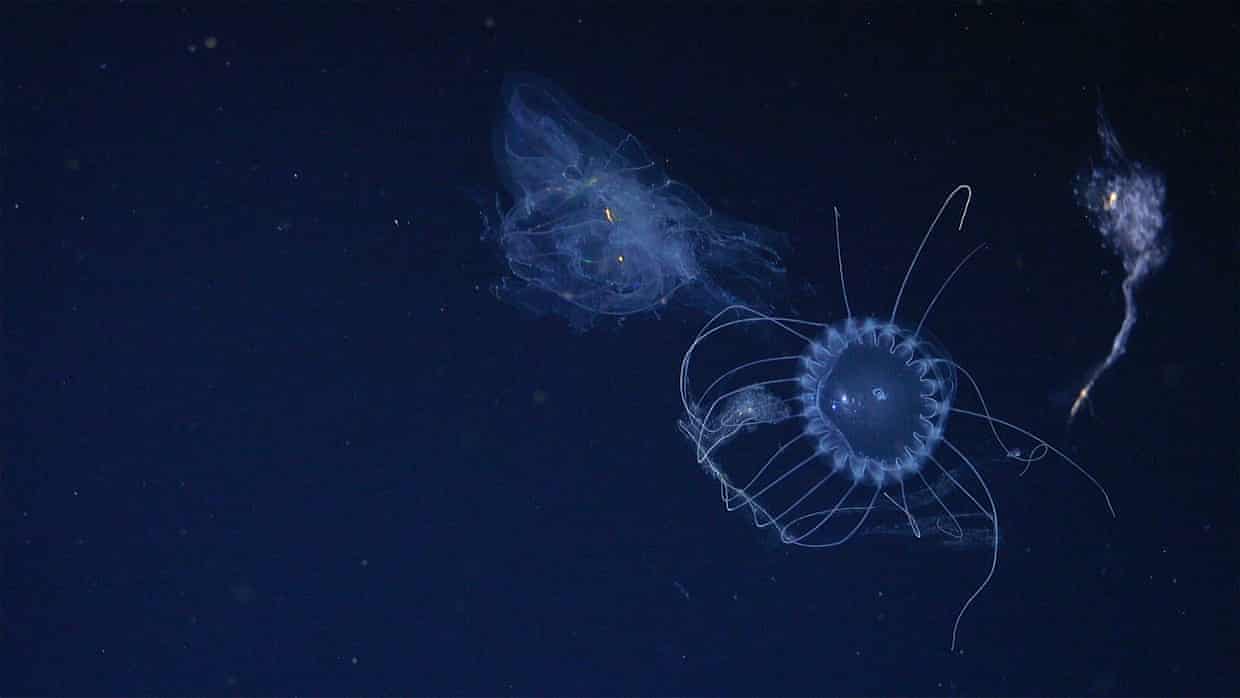
Darkish underwater image of jellyfish catching prey
A Solmissus, or dinner plate jellyfish, preys upon a ctenophore, commonly known as a comb jelly. Photograph: ROV SuBastian/Schmidt Ocean Institute

Among the new discoveries were an amphipod, a type of crustacean related to crabs and lobsters; a fast-moving gossamer worm; nine jellyfish; seven siphonophores, colonial organisms related to jellyfish and corals; seven comb jellies or ctenophores, famous for the glittering cilia they use to swim; four larvaceans, tadpole-like creatures that live in mucus houses and are more closely related to humans than invertebrates; and two giant rhizarians, single-celled organisms visible to the naked eye.
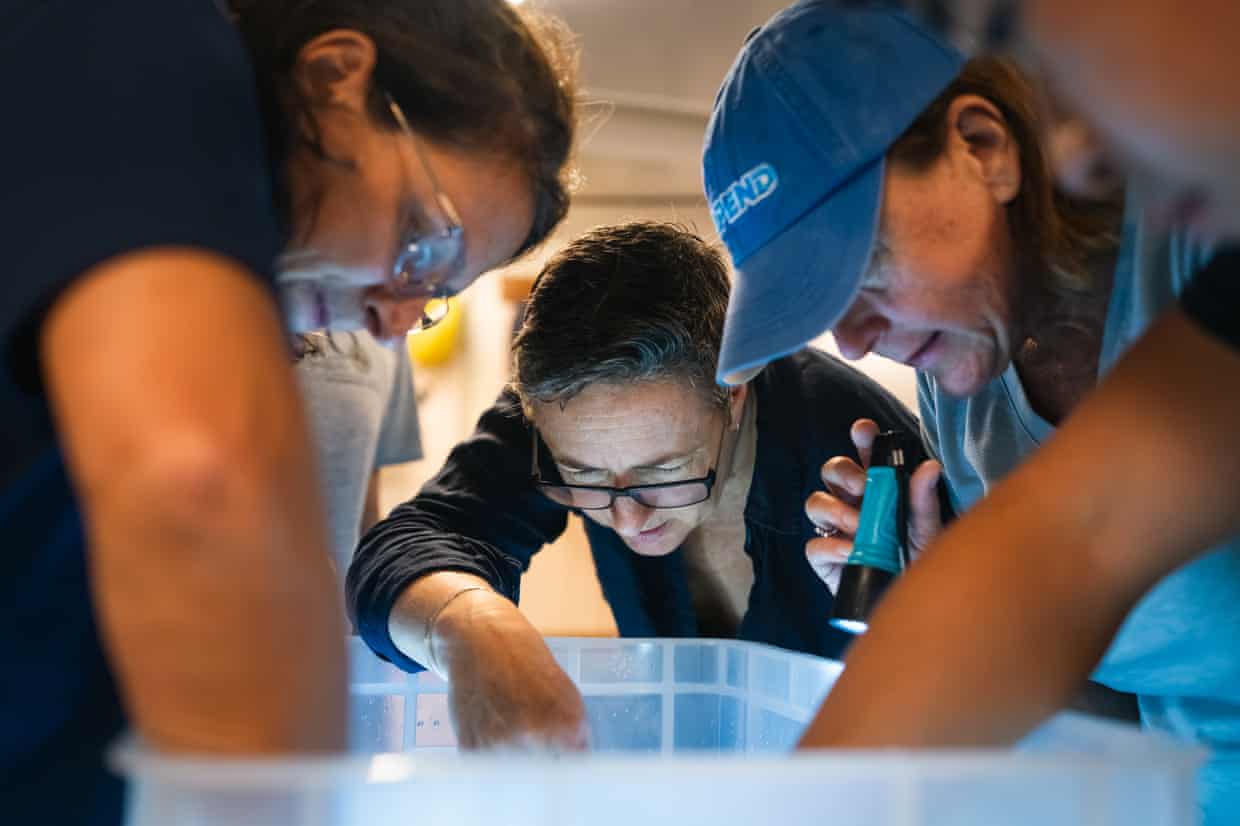
Three people bent over with arms in large plastic tank
Dr Karen Osborn, centre, with other researchers in the wet lab onboard Falkor (too), gathering tiny translucent animals from a large container for further study. Photograph: Alex Ingle/Schmidt Ocean Institute

“It was pretty exciting,” said the expedition’s chief scientist, Dr Karen Osborn of the Smithsonian National Museum of Natural History. “The midwater is chock full of incredible animals that we don’t know much about. And this was an area that hadn’t been explored before so there were more opportunities to find new species. This must be close to a record for discoveries of new animals in a short space of time.”
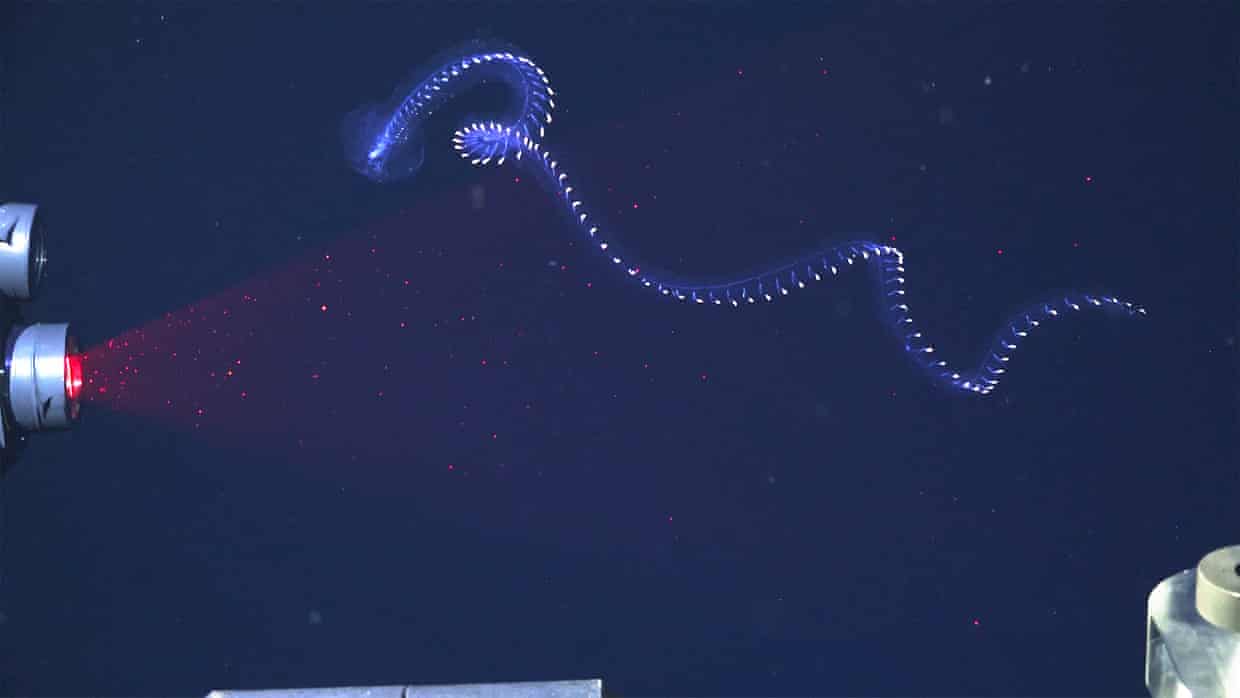
Curly wormlike creature with dots lit up along the length of its body and laser emitting red light
One of the seven new species of siphonophores that were discovered during the fortnight-long expedition, which used lasers to scan the microscopic details of the creatures it found. Photograph: ROV SuBastian/Schmidt Ocean Institute

One of the technological breakthroughs was the onboard use of a spinning wheel confocal microscope, nicknamed the Squid, which uses lasers to scan microscopic details of how organisms are put together. “That opens up a whole new world of exploring. We could see cells interacting with each other, exchanging material and building skeletons. And we could do that live on the ship, when usually it takes a couple of weeks of staining and mounting to see anything,” Osborne said.

The researchers also used prototype imaging systems, genetic analysis, and assembled a team of taxonomic experts for rapid identification of species.
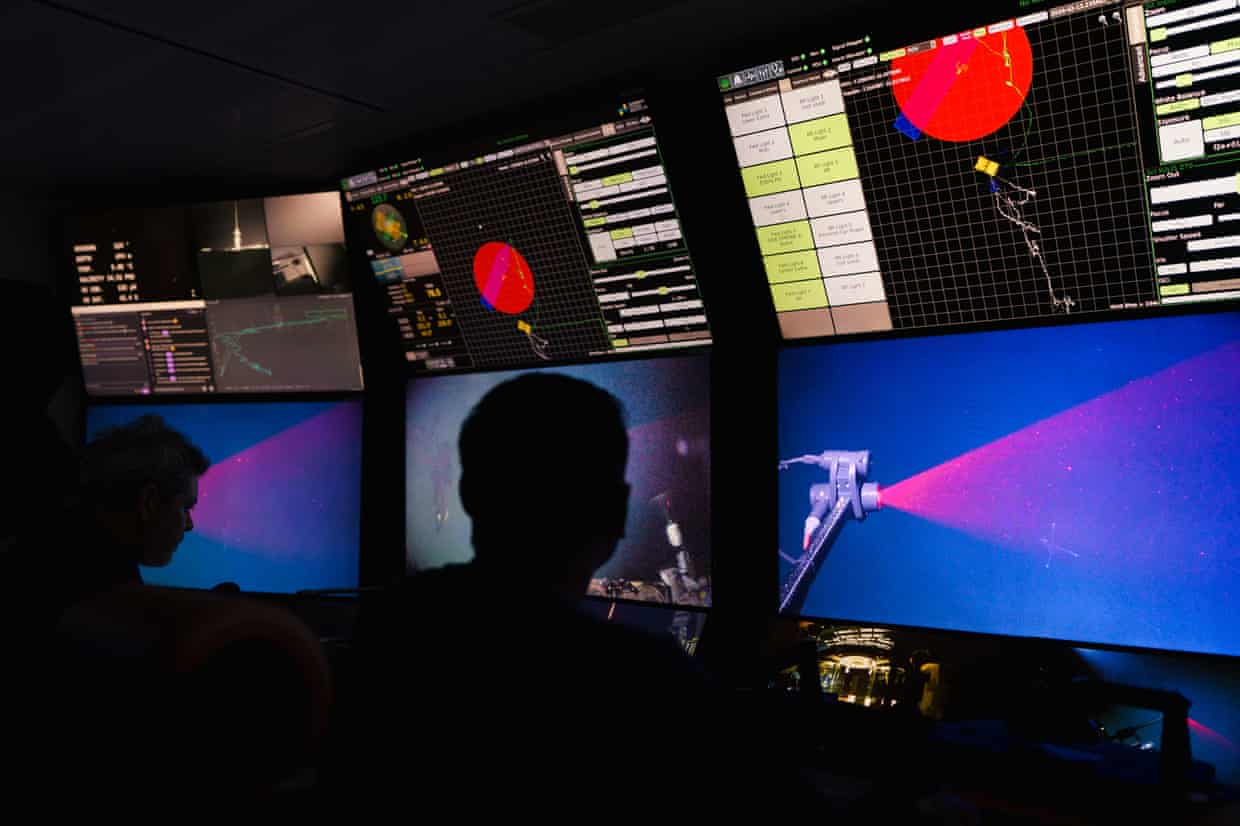
Silhouette of two people sat in front of multiple screens showing underwater images
Inside the mission control room of Falkor (too). The team utilises cutting-edge technology both deep underwater and on the ship, including specialised microscopes – such as the Squid – DNA sampling, stable isotope analysis, and multiple imaging systems. Photograph: Alex Ingle/Schmidt Ocean Institute

The findings contribute to human understanding of the distribution of life in the oceans. “I think about it as a layer cake. It is common to find the same thing at similar depths in distance locations such as Japan and California,” Osborn explained.

Closeup of yellow and blue squid with eye stalks protruding
A juvenile glass squid, collected at a depth of 779 metres and then photographed onboard the Falkor (too). Photograph: Emily Clark/MBARI/Schmidt Ocean Institute

But there is also a huge vertical movement at night when creatures that have been hiding in the depths during the day go closer to the surface to eat under the cover of darkness. This has considerable influence on the drawdown of carbon by the oceans.

The expedition coincided with the unveiling of plans by the Trump administration to dismantle one of the world’s most important deep-sea observation systems – the $368m (£278m) Ocean Observatories Initiative, which uses more than 900 instruments to collect data on ocean health, including current patterns, climate variability and marine biodiversity.

Osborne said the latest expedition confirmed for her the importance of scientific collaboration and learning more about the ocean. “I think we should be doing this so much more. We need to bring together teams with a common goal to try out new ways of looking at things,” she said.

“What humanity has found so far is just the tip of the iceberg. There is an immense amount of life out there solving life’s challenges in unusual ways. Imagine what we can learn from them as we understand them better.”