
惯性聚合 高效追踪和阅读你感兴趣的博客、新闻、科技资讯
阅读原文 在惯性聚合中打开

推荐订阅源

博客园 - 叶小钗
MyScale Blog
MyScale Blog
博客园 - 【当耐特】
I
InfoQ
腾讯CDC
aimingoo的专栏
aimingoo的专栏
L
LangChain Blog
人人都是产品经理
人人都是产品经理
D
DataBreaches.Net
freeCodeCamp Programming Tutorials: Python, JavaScript, Git & More
Engineering at Meta
Engineering at Meta
A
About on SuperTechFans
Google DeepMind News
Vercel News
Vercel News
C
Check Point Blog
B
Blog RSS Feed
Cyber Security Advisories - MS-ISAC
美团技术团队
Stack Overflow Blog
Stack Overflow Blog
Y
Y Combinator Blog
D
Docker
MongoDB | Blog
MongoDB | Blog
量子位
博客园_首页

The Guardian

Rory McIlroy surges into six-shot Masters lead with stunning second-round flourish ‘That’ll be the end’: actor Sam Neill joins fight to stop controversial goldmine near his New Zealand vineyard Roberto De Zerbi targets ‘Ange-ball’ revival to save Spurs from relegation Bath hit back to reach semi-final after stunning Northampton in 11-try epic Secret Garden to Outcome: the week in rave reviews Zebras, wealth and power: Hungary’s election tests Orbán’s grip on power ‘TikTok effect’ brings sellout crowds and younger fans to Grand National meeting The war over Omagh’s gold: the £21bn mine plan tearing a community apart Britain’s shadow workforce is paid as little as 65p an hour. Who cares for the carers? From You, Me & Tuscany to Euphoria: your complete entertainment guide to the week ahead Six great reads: the man who let snakes bite him, masked heavy metal and the brutal reality for foreign students in the UK American Classic review – I defy you not to fall in love with Kevin Kline and Laura Linney’s tender comedy Cuba’s doctors were a lifeline for the world. Now the Caribbean is shamefully complicit in the US drive to expel them An environmental disaster in Moldova has Russia’s fingerprints all over it RMIT drops misconduct case against student who accused university of being ‘complicit in Gaza genocide’ Ichiro Suzuki statue unveiling goes awry as bronze bat snaps during ceremony Survivors of Epstein’s abuse accuse Melania Trump of ‘shifting burden’ on to victims European football: Real Madrid held at home by Girona to extend winless run Arne Slot insists he is ‘aligned’ with Liverpool board and fans as squad is rebuilt Kamala Harris ‘thinking about’ running for president again in 2028 JD Vance warns Iran against trying to ‘play’ the US in peace talks West Ham double up twice to thrash Wolves and put Spurs in relegation zone Trump administration releases new renderings of so-called ‘Arc de Trump’ Crispin Odey drops £79m libel claim against FT over sexual misconduct allegations Bafta apologises for events surrounding John Davidson’s Tourette’s outburst Cocktail of the week: Bar Shrimp’s la rosita – recipe New drug may extend survival in aggressive ovarian cancer, trial shows One dead and 27 injured after bus with British passengers crashes in Canary Islands Pope adds to Smith’s mass of Surrey runs with England woes a world away OpenAI CEO Sam Altman’s home targeted with molotov cocktail
Choughs reappear at Tintagel Castle in Cornwall after dec...
Steven Morri · 2026-05-14 · via The Guardian

Decades after disappearing from the jagged cliffs around Tintagel Castle on the coast of north Cornwall, a bird with legendary connections to the area has returned.

The custodian of Tintagel, English Heritage, and local ornithologists have declared that choughs – charismatic corvids with red beaks and feet – are back.

Choughs are considered Cornwall’s “national bird” and feature in its coat of arms but vanished as a resident from the far south-west of the UK in the early 1970s, largely because of the decline of their grazed clifftop habitat.

Their disappearance was keenly felt across Cornwall but particularly, perhaps, in and around Tintagel because of the bird’s connections to the legend of King Arthur.

The once and future king is said to have been conceived at Tintagel and his spirit is said to live on in the shape of a chough, the red feet and beak representing his bloody end.

Since the turn of this century, choughs have staged a comeback in Cornwall and English Heritage announced on Thursday that they had made it back to Tintagel.
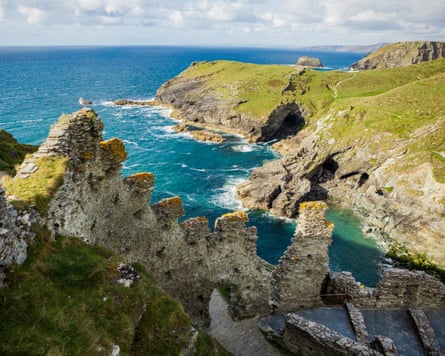
The remains of the castle on a rocky headland.
The remains of the castle on a rocky headland on the north Cornish coast. Photograph: Nigel Wallace-Iles

Win Scutt, an English Heritage curator, said: “People have told stories for centuries about choughs at Tintagel, so to see them here again, a place so bound up with the legend of Arthur, feels extraordinary. It’s a rare moment where nature and myth seem to meet.”

Speaking to the Guardian as he clambered the cliffs around the castle, which is built half on the mainland, half on a headland projecting into the waves, Scutt said: “They’re on the coat of arms with a fisherman and a tin miner, so they’re very much tied in with Cornish identity.”

Christina Hazel, a visitor assistant at Tintagel, said she was mesmerised by the choughs when they reappeared. “They’re fascinating and magical to watch. We started with one male and now have three birds that visit.”

Choughs have been seen from time to time at Tintagel since September 2024 but their return has not been widely publicised to give them time and space to settle. Hazel said: “It’s wonderful to see them back on our coastline.”

Hilary Mitchell, of Cornwall Birds, said: “They have been recorded on the cliffs and in the castle itself. Some people have been lucky enough to have the choughs visit their gardens. A pair has become established and up to four seen together. It’s a historic moment, especially given the choughs’ connection to the King Arthur legend.”

Mitchell said the Cornish chough population revival came after a pair arrived from Ireland on the Lizard peninsula in south Cornwall in 2001.

“The Tintagel birds are our furthest north and east and we hope in time they will spread further along the coast into north Devon and Somerset and ultimately join up with the population in south Wales,” she said. “Historically, choughs would have been found along much of the length of the South West Coast Path and it would be wonderful if that could be the case again.”

The RSPB describes choughs as master flyers” and highlights that as well as suffering through loss of habitat, they were persecuted throughout medieval times, as folklore told they were fire raisers and got their red legs and bill from paddling in the blood of Thomas Becket after his murder in the 12th century.