Financial stability risks are rising as AI fuels cyber-at...
Graeme Wearden·2026-05-07·via The Guardian
IMF warns AI tools such as Mythos threaten financial stability
Newsflash: The International Monetary Fund is warning that financial stability risks are rising as artificial intelligence fuels cyber-attacks.
In a new blogpost, just published, the IMF singles out ClaudeMythos as an example of how quickly risks are increasing.
The Fund is calling for “resilience, supervision, and international coordination” to safeguard global financial markets, and protect them against attackers with new AI tools.
It warns that AI tools such as Mythos can “dramatically” cut the time and cost needed to identify and exploit vulnerabilities, which raises the risk of weaknesses in key systems being discovered and exploited.
IMF experts TobiasAdrian, TamasGaidosch and RangacharyRavikumar write:
Mythos could find and exploit vulnerabilities in every major operating system and web browser—even when used by non-experts.
This foreshadows how fast‑moving, AI‑driven cyber risks could destabilize the financial system if not managed carefully, and why authorities must focus on building resilience through supervision and coordination—rather than treating these developments as purely technical or operational issues.
AI firm Anthropic announced the existence of Mythos on 7 April but said it would not be released publicly because of its ability to identify unknown flaws in IT systems, which could be exploited by hackers.
But on 22 April Anthropic confirmed it is investigating a report that unauthorised users have gained access to Mythos
The IMF says “The Mythos episode” highlights the governance challenges surrounding AI, explaining:
Cyber risk does not respect borders. As AI capabilities spread across countries, inconsistent oversight could weaken a globally interconnected system.
The Fund is also concerned that emerging and developing economies may be disproportionately exposed to attackers targeting regions with weaker defenses
The International Monetary Fund has warned that AI services such as Claude Mythos could threaten financial stability. In a new blogpost, the IMF says “Mythos could find and exploit vulnerabilities in every major operating system and web browser—even when used by non-experts”.
Oil has hit its lowest level in over two weeks, on hope that the US and Iran are inching towards a peace agreement. Brent crude is trading around $98 a barrel, having dropped as low as $96.03 a barrel this morning.
The Middle East conflict has helped to push up profits at Shell. The energy giant reported better than expected profits of $6.9bn (£5bn) for the first quarter of 2026, angering climate campaigners.
Britain’s FTSE 100 share index has closed down 1.55%, wiping out around three quarters of yesterday’s rally.
The blue-chip share index has dropped by 162 points to finish at 10,276 points.
Top fallers included Centrica (-5.15%), which said this morning that earnings in its British Gas operations will be towards the lower end of guidance, and weapons maker BAESystems (-4.7%).
The IMF’s AI cybercrime warning comes as new research finds recent AI systems can independently copy themselves on to other computers….
In Berlin, German chancellor Friedrich Merz has blasted Italy’s UniCredit over its takeover approach for Commerzbank.
Merz told an industry conference that Germany rejects hostile and aggressive takeovers in the banking sector, saying:
Merz pointed to a recent decision by German financial regulator Bafin ordering UniCredit to stop publishing “misleading advertisements” in connection with its bid to take over Commerzbank, declaring:
“That’s not how you treat institutions such as a bank in Germany, Commerzbank. That destroys trust rather fosters new trust.”
UniCredit launched its €35bn takeover offer for Commerzbank in March, despite fierce opposition from Germany’s government.
Whirlpool shares slide after 'recession-level industry decline' warning
Back in the markets, shares in electrical goods maker Whirlpool have plunged more than 10% after it blamed a “recession-level industry decline” for a drop in sales and profits.
Whirlpool reported a 9.6% drop in net sales in the first quarter of this year, and a net loss of $85m, down from a profit of $71m in the first three months of 2025.
The company, which makes dishwashers, washing machines, ovens and fridges, told investors:
War in Iran resulted in recession-level industry decline in the U.S. as consumer confidence collapsed in late February and March.
Chairman and CEO Marc Bitzer says Whirlpool “acted decisively to address pricing and costs” in the face of a rapid deterioration in macroeconomic conditions.
Shares in Whirlpool have dropped by around 13% to $47.66.
In its new blogpost, the IMF cites three ways that AI‑enabled cyber tools threaten financial stability:
Risks are systemic. Attacks become more dangerous when discovery and exploitation scale rapidly, with implications for financial stability.
Risks cut across sectors. The financial sector shares digital foundations with energy, telecommunications, and public services. That means AI‑assisted attacks can propagate across sectors that rely on the same infrastructure.
AI may further concentrate risk and failures with one vulnerability rippling across many institutions. Reliance on a small number of software platforms, cloud providers, or AI models increases the impact of any single exploited weakness.
IMF warns AI tools such as Mythos threaten financial stability
Newsflash: The International Monetary Fund is warning that financial stability risks are rising as artificial intelligence fuels cyber-attacks.
In a new blogpost, just published, the IMF singles out ClaudeMythos as an example of how quickly risks are increasing.
The Fund is calling for “resilience, supervision, and international coordination” to safeguard global financial markets, and protect them against attackers with new AI tools.
It warns that AI tools such as Mythos can “dramatically” cut the time and cost needed to identify and exploit vulnerabilities, which raises the risk of weaknesses in key systems being discovered and exploited.
IMF experts TobiasAdrian, TamasGaidosch and RangacharyRavikumar write:
Mythos could find and exploit vulnerabilities in every major operating system and web browser—even when used by non-experts.
This foreshadows how fast‑moving, AI‑driven cyber risks could destabilize the financial system if not managed carefully, and why authorities must focus on building resilience through supervision and coordination—rather than treating these developments as purely technical or operational issues.
AI firm Anthropic announced the existence of Mythos on 7 April but said it would not be released publicly because of its ability to identify unknown flaws in IT systems, which could be exploited by hackers.
But on 22 April Anthropic confirmed it is investigating a report that unauthorised users have gained access to Mythos
The IMF says “The Mythos episode” highlights the governance challenges surrounding AI, explaining:
Cyber risk does not respect borders. As AI capabilities spread across countries, inconsistent oversight could weaken a globally interconnected system.
The Fund is also concerned that emerging and developing economies may be disproportionately exposed to attackers targeting regions with weaker defenses
US stock market hits new highs
Zing! The US stock market has hit new record highs at the start of trading in New York.
With the oil price falling, hopes of a US-Iran peace agreement are spurring shares higher.
The S&P 500 share index has reached a new peak of 7,376 points, while the tech-focused NasdaqComposite also hit a new high.
Oil price hits two-week low on Iran deal optimism
Brent crude has now sunk to its lowest level in over two weeks.
The benchmark oil measure is now down 5% today at $96.19 a barrel, its lowest level since 21 April.
Investors appear to remain hopeful that Iran might give a positive reaction to the peace deal proposed by the US yesterday, after US President Donald Trump predicted that the war in Iran will be “over quickly”.
Fawad Razaqzada, market analyst at Forex.com, explains:
The latest developments surrounding Iran have kept investors focused firmly on the risk-on trade.
Reports indicate Tehran is reviewing a US proposal that could eventually lead to the reopening of the Strait of Hormuz, while broader nuclear discussions may be delayed until later stages. At the same time, President Donald Trump has continued to strike a relatively optimistic tone, suggesting a deal could potentially be reached within a week ahead of the upcoming summit with Chinese President Xi Jinping on May 14-15.
The number of Americans filing new claims for jobless support has risen, but remains low.
Last week there were 200,000 new ‘initial claims’ for unemployment insurance, up from 190,000 in the previous week.
Oil is dropping closer to a two-week low, as Iran continues to ponder the US’s latest peace proposal.
Brent crude is now down more than 3% to just over $98 a barrel, near the lows seen yesterday after Tehran said the strait of Hormuz could reopen under new procedures.
There don’t appear to be any major breakthroughs yet, but key mediator Pakistan remains optimistic.
The Pakistani foreign ministry spokesperson, Tahir Andrabi, would not disclose details of the ongoing diplomatic efforts but said a deal could be reached soon.
He told a news briefing:
“What I can tell you and this is what I have stated before that we remain positive, we remain optimist, and we hope the settlement will be soon rather than later.”
Our Middle East crisis liveblog has the latest developments:
Sterling is having a calm election day.
The pound has gained 0.15% against the US dollar, which is generally weaker amid hopes of a US-Iran peace breakthrough.
The UK currency could be more volatile tomorrow as local election results from England, Scotland and Wales are announced.
There are forecasts that the Labour Party could lose as 1,800 council seats, or 75% of the seats it is defending. The worse the result, the greater the pressure on prime minister Keir Starmer – potentially creating fresh political instability.
Malaysia has joined the ranks of central banks leaving interest rates on hold while it assesses the impact of the Iran war.
Unike Norway, which hiked borrowing costs today (see earlier post), the BankofMalaysia left its Overnight Policy Rate unchanged at 2.75%.
It also warned that sharp increases in energy and commodity prices from the Middle East crisis, and supply chain disruptions, are beginning to hurt global growth momentum, adding:
Downside risks to global growth remain elevated stemming from the uncertainties surrounding the length and severity of the conflict, tighter global financial conditions and concerns over valuations in financial markets.
“Today’s figures show sentiment in the sector has fallen significantly as the industry braces for the impact of the Middle East conflict. Mobilisation is slowing as UK construction faced cost pressures on slim margins further challenged by the weakening economic backdrop.
“Pipelines are currently strong, particularly for large infrastructure projects including defence, healthcare and data centres. There are however some significant challenges around reassessing the viability of projects and extending mobilisation start dates, as oil price increases hit the supply chain, increasing material and fuel costs.
“With the increased volume of infrastructure projects committed to in prior years, outputs remain strong. However, local elections this week could cause further uncertainty among contractors around where future infrastructure spending will be focused. Uncertainty around planning decisions and concerns around new work to replace completed projects in April could create a shrinkage in the pipeline in the future that will create further instability for the industry. There is a significant risk that some planned projects will become unviable in the current economic climate, particularly for long-term fixed price projects, so we may see some large infrastructure projects put on hold.
Barclays' AGM disrupted
Pro-Palestinian and climate protesters have interrupted the opening minutes of Barclays’ annual general meeting in Westminster, London, PA Media report.
The disruption broke out as chairman NigelHiggins delivered his opening remarks, with several protesters standing up holding Palestinian flags and shouting “Free free Palestine”, “Everyone here is profiting from genocide” and “Barclays bank, you can’t hide, you’re supporting genocide”.
MrHiggins responded that the board had “heard your point” and would take questions on the topic during a later Q+A section.
Security staff escorted, and in some cases carried, the protesters out of the meeting room as they continued shouting.
A few minutes later, climate protesters rose from their seats at the AGM and started singing: “Stop, in the name of love, before you break this Earth.”
One shouted:
“This bank is financing the climate and nature crisis that we have to stop. Softly-softly, slowly-slowly is not good enough. You are endangering life on Earth.”
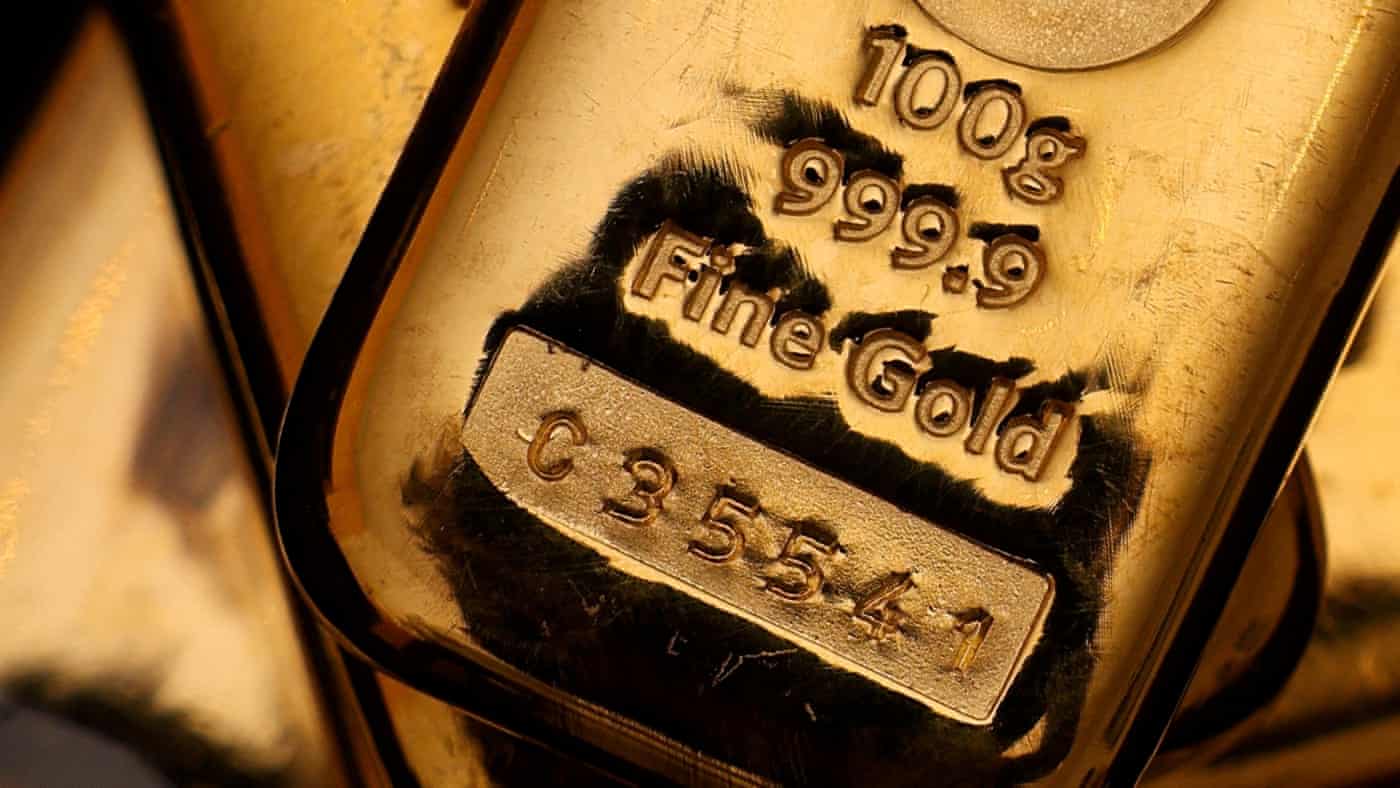
A bar of gold bullion. Photograph: Hiba Kola/Reuters
China’s central bank loaded up on gold for an 18th straight month in April, Reuters reports.
They cite data from the People’s Bank of China which shows that China’s gold reserves rose to 74.64m fine troy ounces at the end of April, up from 74.38m at the end of March.
The total value of China’s gold mountain has risen too – to $344.17bn, up from $342.76bn a month earlier. The gold price stabilised in April after falling by 11.5% in March.