





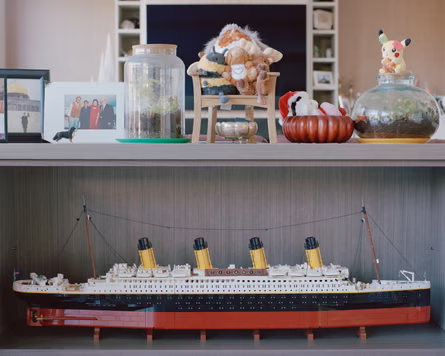
Walking into Christine Dawood’s kitchen, it’s impossible not to be drawn to the model Titanic in the centre of the room. Sitting in its own glass-fronted cabinet, the Lego ship is almost 1.5 metres long, constructed of 9,090 of the iconic plastic bricks. Dawood’s 19-year-old son Suleman spent almost two weeks building it. “People are always a bit shocked to see it,” she admits. “But what was I going to do? Break it up? Hide it away? Suleman put all those hours in. He’d been fascinated with the Titanic since we went to a huge exhibition when we lived in Singapore.“
I went to that same exhibition when it came to London, and remember marvelling at the china dinner plates that had survived intact; the unused lifejackets that had failed to save someone; the sheet music belonging to the orchestra who had supposedly bravely played even as the ship went down. Instead of a ticket, you were given a replica boarding pass with a real passenger’s name on it. At the end, you could find out who survived and who didn’t.
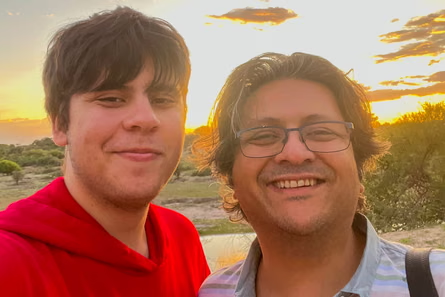
On 18 June 2023, Suleman Dawood died alongside his 48-year-old father, Shahzada, and three other men in the Titan submersible as it attempted to dive to the Titanic. They were 500 metres above the wreck when the submersible imploded. It was a horrifying tragedy that made headlines around the world.
“The Titanic was claiming another five people, right?” Dawood says. “And the age of my son was a huge thing. Another reason why the press latched on to this, I think. If it had been five grown men, it might not have been as juicy.”
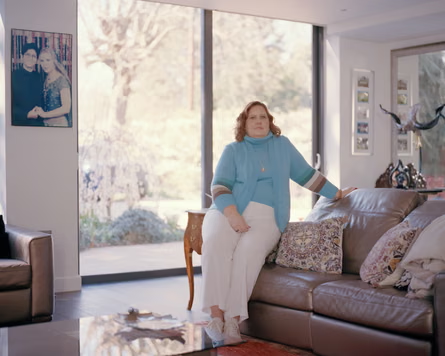
We’re in the family home in Surrey where she lives with her 20-year-old daughter. Dawood is understandably protective of her. “I don’t want her to be known as that girl who lost her father and brother on the Titan,” she tells me. “She’s just starting her life and I prefer to leave her out. But she understands I do want to talk now.” Floor-to-ceiling windows take up an entire side of the room. She needs that sense of light and space, Dawood tells me, after growing up in the mountains of Bavaria. On the walls hang richly coloured Pakistani art, mostly gifts from her in-laws, to whom she remains extremely close. “I love this house still,” she tells me. “Even though they are not here any more.” Dawood, a trained psychologist, is speaking in detail for the first time; she has also written a book telling her story.
A media frenzy broke out with the news that the Titan was missing. Rumours spread. Was the sub trapped in the wreck itself? Or floating adrift in the North Atlantic? Reports circulated that the stricken craft had just four days of oxygen. A countdown began; social media was gripped by the fate of the little sub. And as details emerged about the men onboard, word spread that Dawood should have been on the submersible herself, but had given the ticket to her son.
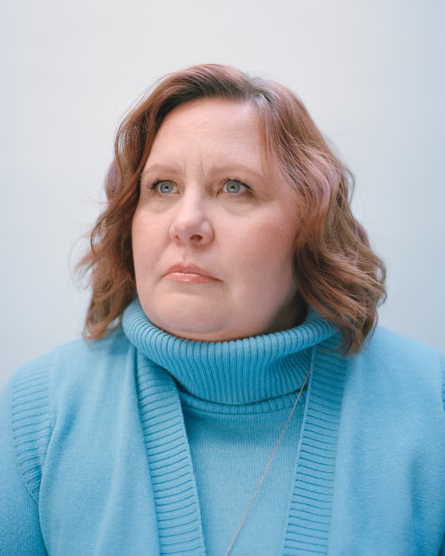
Almost three years on, she holds close the advice she was given when she came ashore after the four-day search. “It was one of the Canadian Coast Guards,” she remembers. “A very experienced woman with blond hair – I forget her name – gave me the best advice I’ve ever gotten: ‘Hindsight won’t help you, so don’t fall into that trap. Just because you know it now … you didn’t know it before.’ I’ve always remembered her telling me that. Suleman wanted to go and I was happy to give up the seat. I was happy for him to make memories with his father. I can’t change that.”
During the 2020 lockdown, Dawood came across an advert for “a once-in-a-lifetime opportunity to dive to the Titanic”. The family had recently bought a puppy, a bernese mountain dog called Stig, who is Dawood’s constant companion as we talk. “I was scrolling through my Instagram,” she recalls, “lots of puppy pictures and that type of thing, when a photo of a submersible popped up right next to the Titanic. I couldn’t believe it and I called Quintessentially, our personal travel agency. They called themselves lifestyle managers, in fact, and we paid them a pretty big yearly membership. We’d had incredible trips organised by them, to Antarctica and Greenland. So when they came back to me and said this was doable, we were excited.”
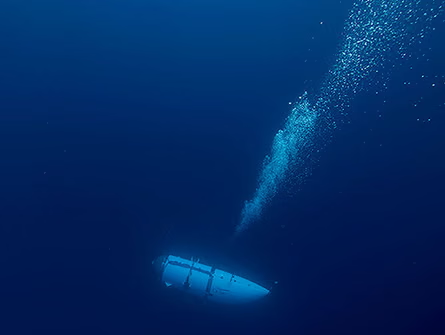
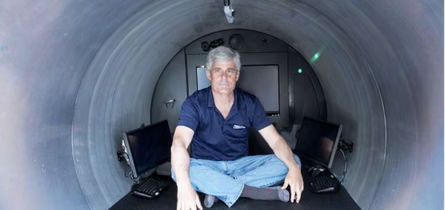
OceanGate, founded by CEO Stockton Rush in 2009, was indeed promoting tourist dives to the famous wreck. The American’s mission was to democratise the deep ocean. In 2013, Rush began work on the Titan, a submersible he was convinced would be as indestructible as its namesake was claimed to be. The experimental construction flew in the face of tried-and-tested submersible design. The carbon fibre hull and cylindrical shape replaced the conventional but proven structures of titanium or high-strength steel spheres known to withstand the pressures of the deep.
Initially, Dawood suggested they try a shallow dive, to get used to the feeling of being locked inside the 6.7-metre-long submersible. But Shahzada was adamant: he wanted to go straight to the Titanic. “If I’m doing a dive, I want to do it properly,” he told her. “That was what made him successful in business,” she says. “You have a clear goal, and you go for it. But he wasn’t an adrenaline-seeker. If I’d have suggested going bungee jumping, it would have been, ‘No way!’ He wouldn’t do like [Jeff] Bezos did, and go up in a rocket, because you need to be physically fit, to train. He wouldn’t have done that. On paper, this dive looked comfortable. You just sit there, right? He didn’t have to be physically fit. It was possible, convenient. We always were the glampers of the explorers.”
The world was slow to emerge from Covid restrictions, so Dawood added the trip to the family bucket list and for the next two years, she didn’t follow the progress of the OceanGate expeditions. Life became busy again with work and school. They went on a Mediterranean cruise with her in-laws from Pakistan after having not seen them for so long. In September 2022, Suleman started a new chapter of his life, studying business at the University of Strathclyde.
Dreams of exploring the deep ocean had been forgotten until late 2022, when Quintessentially called to ask if they were still interested in visiting the Titanic. “It was a shitload of money,” admits Dawood – “$500,000 for two seats! The kind of money I’d expect a house for.” She laughs slightly, shaking her head at the cost now. But the family could afford it – Shahzada was from one of Pakistan’s wealthiest families – and began planning to join OceanGate’s 2023 expedition. “Whatever due diligence I did,” she tells me, “I didn’t find a single civilian submersible accident. That was good enough for me. I hardly knew OceanGate, so my trust was based in Quintessentially.”
In a statement, Quintessentially said that the services they provide to members are confidential, but clarified that they never had a commercial relationship with OceanGate, promoted any of their expeditions or recommended them to members. They said that they “will continue to be supportive to the Dawood family”.
In February 2023, Rush and his wife Wendy, OceanGate’s director of communications, flew from Seattle to London to meet the Dawoods. In a cafe on the South Bank, Rush set about reassuring them that the trip would be worth every cent. He boasted about how unique the Titan was. No other submersible could take as many as five people to the deep ocean, he told them. He’d already made dreams come true by taking it to the Titanic 13 times. He described the strange ocean creatures and the flashes of blue, green and eerie white bioluminescence they would see floating past the large viewing port – “the largest on planet Earth”, as he liked to call it – and, finally, how they would arrive at the wreck itself. They’d glide towards the iconic bow encrusted with rusticles, the micro-organisms slowly eating through the great ship’s skeleton.
“We had never even been snorkelling,” says Dawood. “And Shahzada got so wrapped up in Rush’s stories. But Wendy was very quiet. Then the conversation went to communication between the sub and the ship. And Stockton says, ‘Yeah, sometimes we lose contact.’ I noticed Wendy’s whole body go rigid. ‘We don’t like it when that happens,’ she said to him. ‘If you don’t tell us where you are, we worry.’ I felt the dynamic between them; she couldn’t get through to him. I think she saw the risks; she saw the potential that there was something not quite right. He just ignored her.”
There was a lot that Rush had simply ignored – things that Dawood would only find out after the tragedy. He had failed to tell them about the many aborted dives and hundreds of technical issues that had plagued the Titan during its two short seasons in the North Atlantic. Or that in July 2022, while ascending, passengers had heard an explosive noise that shook the submersible, which Rush had never investigated. Or that the sub was operating under the radar, that he had refused to have it inspected or classified by any maritime authority, claiming that the safety process was too slow and “stifled innovation”. The Titan was not, in fact, registered to carry passengers at all. As the couples shook hands, the Rushes neglected to mention that for the past six months, the Titan had been sitting in a car park in St John’s, uncovered and unwatched, exposed to the icy conditions of the Newfoundland winter.
On 14 June, the family set off with a mixture of nervous excitement. “We’d all been so busy,” Dawood remembers. “And this was the start of a family adventure, that’s how we saw it.” They missed their connecting flight to St John’s, so by the time they arrived they had to jump straight aboard the Polar Prince, a ship that would take them 400 miles south-east across the North Atlantic to Titanic waters. Unbeknown to Dawood, funds were running low and the Polar Prince was all Rush could afford. An old ice breaker, the ship was not originally designed to carry passengers and its spoon-shaped hull pitched and rolled continually. In 2021 and 2022, OceanGate had hired a modern ship, the Horizon Arctic, which had transported the Titan on deck. It was impossible to carry the sub onboard the Polar Prince, so it was towed behind on a platform, buffeted and pounded by the waves. “This was the roughest we’d ever travelled,” Dawood admits. “I’m almost 50 and you put me in a bunk bed with scratchy bed sheets! Cruise ships have very nice stabilisers, and you pay $500,000 for this?” But she laughs and tells me how they joked about it.
That month, Newfoundland had been enjoying unusually warm weather. A sea fog rolled gently along the rocky coast and a few icebergs lingered to the north. The capelin had arrived near the shore in their millions and there had been excited sightings of more than 300 humpback whales as the huge mammals feasted on the tiny fish. But out in the Atlantic, where the Polar Prince was headed, a heavy fog persisted; since the start of their 2023 expedition, OceanGate had not yet managed a single dive below 10 metres.
“We didn’t have much time to think or to get too apprehensive,” Dawood says. “We were on the ship two days getting out there and by that time I was so seasick. So when the crew said the weather had come good [and that] the dive was on, my plan was to see them off then try to sleep until they came up.”
Shahzada and Suleman wore jumpsuits, the kind you see astronauts in, bearing their names and the OceanGate logo. They were joined by Rush, who was piloting, a British businessman called Hamish Harding and French diver Paul-Henri Nargeolet, dubbed “Mr Titanic” as the world’s leading authority on the wreck. He had already seen the ship 37 times, five times onboard the Titan, and acted as the expert guide for OceanGate.
“It was one of those occasions where you go into dark humour,” Dawood remembers. “We were talking about crashes. I remember Hamish saying how he’d never travel on a helicopter – he thought they were too dangerous. Suleman had his Rubik’s Cube, because he was planning to get the record for solving it at the deepest depth ever. And we were giggling, because Shahzada is clumsy and when he was going down the stairs he was wobbling a bit. I waved. And that was it. They got into a dinghy and sped off. It went very fast, the goodbye.”
Dawood watched as her husband and son were transported to the Titan, floating about 100 metres away on its launch and recovery platform. The two divers stationed there hauled the men on to the precarious structure and guided them into the sub one by one. “Have a great dive,” one said to Suleman as he helped him inside. The hatch was bolted shut, and the flotation tanks at each corner of the platform were flooded with water. The Titan sank beneath the waves, detached from its platform and started its freefall. It would take about three hours to reach the wreck, 2.5 miles down on the ocean floor.
At around 11am, Dawood was in the dining area, longing for a sea sickness cure, when the first blow landed. “They’ve lost communications,” she heard someone say. Then they noticed her. “Don’t worry, it’s not unusual,” she was told. “In that moment, what am I supposed to do?” she says now. “I felt trapped on that ship and I had no choice but to trust what they told me.” The OceanGate crew seemed unfazed. They had been through this before and all would be well. The sub would still return by 3pm.
It’s unbearable to imagine how long the next hours must have felt. The constant scanning of the horizon for a sighting of the submersible, the white tops mistaken for the tail of the Titan bobbing up from under the ocean. In the communications room where Wendy Rush was stationed, the tracking screen remained blank, and the text console silent.
At 6.30pm, there was still no sign of the Titan; Kyle Bingham, OceanGate’s mission director, called a briefing and declared that the Titan was now officially missing. Dawood struggles to describe what it was like hearing those words. “It’s like an avalanche,” she tells me. “You see it coming. This is it, I’m going to be hit. But you’re on a cliff, so where can you go? I had to make a conscious choice. I knew I couldn’t let the emotions come. So, I grew wings, I flew away in my mind. That’s how I saved myself from the avalanche.
“I told myself they were stuck,” she says. “But I was worried. Suleman is not … well, both my men, they’re not very good at being in the dark, and I knew it would be a very different darkness down there. Nothing. You literally can’t see a thing.”
She recalls that the OceanGate doctor gave her something for sea sickness and asked one of the other tourists, who had been hoping to be on the next dive, to “keep an eye on her”. She remembers wandering around the ship, desperate for news but scared of what she might overhear. “There were lots of hushed voices,” she tells me. “They stopped when I was near, but I overheard them saying their water could run out and maybe they’d drink the condensation on the sub walls through straws … I didn’t need those things in my head, so I tried not to listen. I deleted all news from my phone. I wasn’t even really aware of the oxygen countdown. All I’d been told by the crew was that they could last four days down there, no more.”
As the search and rescue operation kicked into gear, the skies above the Polar Prince were split by the trails of planes sent by the US and Canadian Coast Guards. Back in St John’s, the media gathered at the harbour, press conferences were held, theories discussed and rumours spread about a toxic culture at OceanGate, that Stockton Rush had ignored countless warnings about his operation, that he had dismissed safety as a waste of time. The truth was starting to come out.
But, 400 miles out at sea, Dawood was solely dependent on the company briefings. “The energy on the ship was complete denial,” she says. “The crew were [acting] like nothing was happening.” Bingham continued to predict there had been a technical issue, but Rush and Nargeolet were expert enough to bring the sub back to the surface. He talked about banging that had been heard. “Regular and significant,” he reassured everyone. They were trying to locate where it was coming from, whether the men were sending an SOS from inside the Titan. “It’s just taking time,” he told them. “It did cross my mind that OceanGate had ulterior motivations about what they told us,” admits Dawood. “They were just trying to avoid the truth. But I would have deteriorated a lot quicker without hope.”
A schedule was released to pass the time for the onboard crew. Jamming sessions were arranged, movies chosen and a nightly poker game organised. “Ultimately, I think they wanted to distract people, keep everyone occupied,” Dawood believes. “They wanted everyone onside, not to feed anything to the press. But jamming sessions? Am I really going to sit there and sing Kumbaya? I did try to give a movie a go, but when I got there it felt like an act of betrayal. Watching Wayne’s World while they are trapped in the dark did not sit well with me.”
As I try to imagine the surreal scene she has just described, out of the corner of my eye I am aware of a purple plate with a small handprint and Suleman’s name painted underneath displayed on the sideboard. I realise that for the first time today Dawood has the beginnings of tears in her eyes.
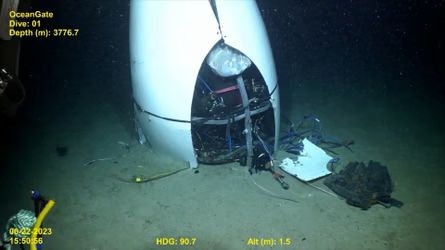
On 22 June, the Horizon Arctic arrived at the scene carrying a remotely operated vehicle capable of diving to the Titanic depth. It was deployed immediately and 90 minutes later reached the bottom. Casting its robotic gaze across the seabed, it transmitted footage to the operators above and to the US Coast Guard, which was now in command. As the vehicle was guided this way and that, they spotted something at the edge of the frame. The twisted remnants of the Titan’s tail cone hove into view. “Every indication at this point is that a catastrophic event has occurred with the Titan,” were the carefully chosen words of the US Coast Guard officer on a call to the Polar Prince. Wendy Rush and OceanGate were forced to face the truth that some of them had suspected from the start. The Titan’s hull had failed almost three hours into the dive. Under the immense pressures of the deep ocean it had imploded, collapsing inward in a fraction of a second. The five men died instantaneously.
“My first thought was, thank God,” admits Dawood. “When they said catastrophic, I knew Shahzada and Suleman didn’t even know about it. One moment they were there and the next they weren’t. Knowing they didn’t suffer has been so important. They’re gone, but the way they went does somehow make it easier.”
And that is when Dawood found herself in what she calls “the after”. “In some ways, I was terrified to leave that weird bubble,” she says. The dregs of hope she had clung to in the middle of the ocean were gone and she had to face the practical business of getting home. “What was I going to do with their stuff? Their bags? Shahzada’s clothes and things were in my cabin, so I packed his bags. But I didn’t pack Suleman’s. I couldn’t. Someone else did that.”
Before disembarking at St John’s, she was advised to disguise herself and was successfully shielded from the cameras. Shahzada’s family had flown from Pakistan to take her back to London. She carried Suleman’s backpack on to the plane and remembers how important that became to her mother-in-law. “She just wanted to hug the backpack,” Dawood recalls. “She held on to it all the way and kept apologising, saying I could take the bag back. But I said, ‘No, you can keep it. You lost them, too.’”
Over the next 18 months, the US Coast Guard carried out a forensic investigation into Stockton Rush and OceanGate. The fatal flaws that had been lying in wait came to light, along with the many warnings that Rush had blatantly ignored. Dawood was advised it would be too much for her to attend the public hearings, and to this day she continues to protect herself – she is very cautious about how many of the revelations she needs to learn about. The official report into the tragedy concluded it was preventable and caused by inadequate engineering and testing, as well as Rush’s reckless approach. If he had survived, he would have faced criminal proceedings. Tighter regulations of passenger submersibles have been recommended, but it is all far too late for Dawood and her family.
“From the beginning, I had a lot of reasons to hate Stockton, but does that really help me?” Dawood says. “He died with them. If I’m angry with him, I’m giving him power, and I refuse to do that. I’m sure people will say I’m naive, but if I start to analyse every single thing, where does that lead me? So, I choose my own … not happiness but … I choose me, every day. If I don’t, I wouldn’t be here. I would have killed myself, for sure.” Dawood pauses, then continues in a whisper. “It’s very hard. Being strong doesn’t mean you’re not feeling it.”
She tells me that there have been days when panic attacks have completely paralysed her. When the lights have felt too bright and any sound at all too loud. Everything became a challenge. She tells me that even after many hours of intense therapy, Suleman’s room remains how he left it, her husband’s study untouched.
“I have learned to give the grief attention,” she sighs. “So I go into Suleman’s room. Sometimes I find the cat sleeping on his pillow and I sit on the bed and let the grief come. And after a while I can put the grief away until the next time it gets too much. I’ve worked a lot on my grief for Suleman, but I’m only now starting to grieve for my husband. Publicly they are always put together, but they are two different relationships. Two very different pains.
“We didn’t get the bodies for nine months,” she adds. “Well, when I say bodies, I mean the slush that was left. They came in two small boxes, like shoeboxes.” The slush, as she calls it, are the remains that were recovered from the sea bed and meticulously separated and DNA tested by the US Coast Guard. “There wasn’t much they could find,” she says. “They have a big pile they can’t separate, all mixed DNA, and they asked if I wanted some of that, too. But I said no, just what you know is Suleman and Shahzada.”
After a while, Dawood takes me out into the garden. The dog follows us. It’s the first day the sun has made an appearance after weeks of rain, and the cat has found its way into a fragile square of sunlight on one of the raised beds. The dog sits good-naturedly but heavily on my foot and Dawood encourages him back to her side. “In a way, the dog reminds me of Suleman sometimes,” she says. “Because he is clumsy, spatially not aware. He doesn’t know his own strength and Suleman was sometimes awkward, didn’t quite know what to do with his physical strength. He was 19, just becoming a man.”
Recently, Dawood walked from Hampton Court to her son’s university in Glasgow. The journey took five weeks and had been something Suleman had often said he’d like to do. She walked in tribute to him. She tells me also about her advanced plans to set up a grief and trauma centre, and hearing her excitement I can see how important these are for her own healing.
“It’s the normal questions that people ask that are still the most difficult,” she says, stroking the dog’s neck. “Like, ‘Do you have children?’ That is the most dreaded question. I knew it would come, but it constantly takes me off guard. What do I say? I have two children but … if I say that, then they ask, ‘What does your older one do?’ So now I avoid saying children. I just say I have a daughter. I’m not lying, but it’s what I choose to say.”
We sit very quietly for a minute or two. It’s not easy finding a way to end the time we’ve spent discussing this unimaginable grief. But then Dawood turns her attention to the garden. “I’m waiting for the tulips now,” she says. “I have hundreds of them, and more come up every spring.” As I look closely, I notice the many clumps of wide green leaves hiding the beginnings of the flowers to come.