




The gallery appears to have been set for a party. Mismatched chairs are scattered through the space – ornate gothic throne, wing-backed recliner, stackable school chair. Each points towards a white window painted on to the wall, into which one of 43 equally miscellaneous paintings has been inserted. These paintings are the other party guests, and you must decide who to sit with.
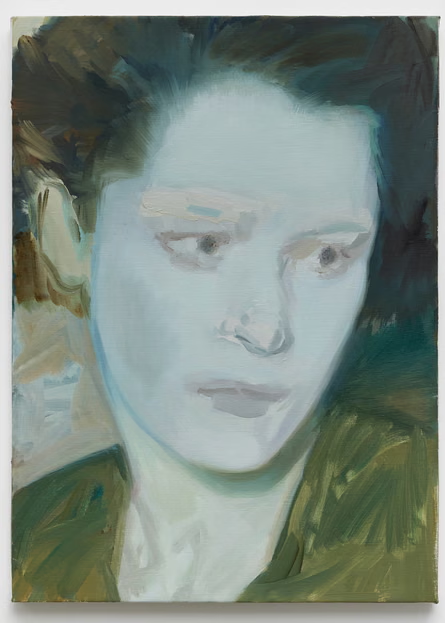
It is a ragtag bunch, and so I decide to start with the people I recognise. But on my way to meet a portrait by Denzil Forrester of the young Haile Selassie, its surface resembling scuffed and polished stone, I am distracted by the glitter of light from a small work by Andrew Cranston. It comes from a young woman who seems to have been transplanted from Dumbarton into a glamorous late Vuillard, her coat shimmering like the scales of a fish caught by late summer sun. So I take the leather-backed chair in front of it, and become engrossed in its story of a beatnik couple living a tarnished late-summer dream, the woman looking straight out at me, over her seated partner, through a veil of shadow.
When I stand, my eye is caught by the sweet autumnal tones of a patchwork landscape by the great Merlin James, which introduces me to a very weird painting by Margot Bergman that sits halfway between surrealism and what the US curator Lynne Cook has called “outlier” art. These startling juxtapositions suggest, at first, that the artists in this show are united by little more than the medium of paint and a shared eccentricity. There are nonagenarian jazz musicians, a night orderly in a psychiatric institution, the ex-manager of the Clash, names such as Gillian Carnegie, Kaye Donachie and Bill Lynch that will excite any fan of contemporary painting and names that will be obscure even to the hardcore.
The host of this “salon”, and the person whose sensibility knits it together, is Matthew Higgs, director of New York’s White Columns gallery and magpie impresario. Some of these artists he has worked with for years, while others, such as Adam Keay, who contributes an oddly compelling beach scene, were invited on the strength of a chance encounter. The paintings are provided with no justification for being here other than that the organiser believes they will contribute to the conversation. In the context of an art world apt to dress itself up in quasi-academic jargon to disguise the fact that it is organised through subjective taste and social connections, this is unexpectedly refreshing. It is a relief to discover that a show will not be a lecture on ecological catastrophe or the crisis in masculinity, as if no one who enters a gallery is capable of reading a book, but simply a gathering of artists with their own stories to tell.
Some give them up more easily than others. I had to sit for ages with Mike Silva’s superficially conventional picture of a sunlit house plant before the tangle of stems in water became a pattern of yellows and crimsons around which the painting reorganised itself. But the basic principle of the show is that if you look at anything for long enough, something will be revealed. To illustrate that point, tear yourself away from this article, set a timer on your phone, and stare at one corner of the room in which you are sitting until it rings. Things got strange, no? Next time you’re in a museum, do the same thing with a painting.
If you can stick it out to the 40-minute point at which things get really psychedelic, you will discover that you have attracted the attention of security guards. This is because exhibitions are not, for the most part, designed to encourage you to spend a long time in front of art works so much as move you through to the gift shop. But Higgs understands that to have a meaningful experience with a painting requires no technical expertise but only time, an open mind and, ideally, a chair.
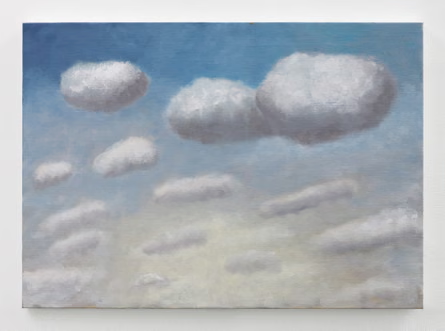
So it is that I can spend long enough, here, with a Stephen McKenna cloudscape that it transforms from an arrangement of pigment into a world of feeling into which I can fall. It doesn’t always work. I spend what feels like for ever with a painting by Walter Price, whose work I have elsewhere admired, and find that this one won’t speak to me. So I change seat, and try my luck with someone else. If you immediately like everyone at the party, after all, you’re at the wrong party. And this salon, too, is exciting not because its guests have much in common but because they are different from each other and everything else.
The word “salon” also conjures the exhibitions that the French Academy once used to promote painters working in the official style. If the academic art of the 19th century was exemplified by stereotypical paintings of scantily dressed women and picturesque peasants, then the academic art of today, as showcased at art fairs and biennials, is likewise designed to support a profitable academic system by privileging its codes and techniques over the more direct expression of idiosyncratic lived experience. That it might take the form of an installation or a video game doesn’t make it any less conventional.
Beginning in the 1860s, a number of independent salons sprang up to support artists who wanted to speak more directly to their audience than the academic system allowed. These artists (Manet, Cézanne, Whistler, Seurat, Van Gogh, and so on) were dismissed by the official authorities as backward and unrefined, and yet they prepared the grounds for the modern age. It is to Higgs’s great credit that his salon belongs to that unruly tradition.