


A few years ago the playwright Hannah Khalil was queuing for the loos at Chichester Festival theatre when she spotted Omar Sharif, in a prince’s costume, on the wall. The photograph was part of a gallery showing stars who had graced the Chichester stage. “I was like: ‘Omar, what the hell are you doing in Chichester?’” says Khalil. “I really wanted to know more.”
You could call that moment a bolt out of the loo: instantly, it set her on the trail of her latest play, Love Omar. When had the Egyptian actor visited Sussex and what had local audiences made of him? Khalil’s director husband, Chris White, hails from Chichester. “I began asking his parents because they have lived there for a long time,” she says. “They vaguely remembered him coming to do the show.”
Sharif had gone to Chichester in 1983 to play the lead role in Terence Rattigan’s 1953 drama The Sleeping Prince, which transferred to the West End. Love Omar features Sharif in his dressing room, preparing to take to the stage, and Khalil shows him to be a complicated character, by turns vain, alluring, insecure and charming. His reported gambling habit is referenced (from bridge to horse-racing) as well as his “heartthrob” status and his famed generosity.
It was an early case of celebrity casting, thinks Khalil. The theatre had just lost its sponsor (Martini) and needed money. “When he arrived, the massive car park outside the theatre was full of people – excited fans, women – waiting for him.” There are also stories about the bags of international fanmail and “complaints from the post office because they weren’t used to having to deal with so much”.
Most of the anecdotes in the script are real, says Khalil, who spent years researching this Sussex juncture in Sharif’s life. “I really love getting into an archive and interviewing people,” she says. Debbie Arnold, Sharif’s co-star, was among them. “She told me they got on well until the first night performance when no one knew that he had dyed – or put something on – his moustache to make it darker. There’s a moment when they kiss and she breaks away and the audience just laughed. She didn’t know why but it was because she had this black mark on her face … There was some tension between them because she wanted him to stop dyeing it, but he denied doing it.”
Khalil’s other interviewees included John Gale, the late artistic director of the theatre, and John Challis (famed for his TV role as Boycie in Only Fools and Horses), who was married to Arnold at the time. Serendipitously, the actor Ishia Bennison, who plays Sharif’s dresser, Daphne, had been one of Arnold’s neighbours. “She went to the opening night party where Omar kissed her hand and told her she was beautiful,” says Khalil who also found out that Frances Ruffelle had played a small part in The Sleeping Prince, and “had spent many enjoyable hours in the green room being taught how to play backgammon by Omar”.
In spirit, Khalil reflects, her play – directed by White – is a love letter to theatre itself. Born in the UK to an Irish mother and Palestinian father, Khalil grew up in Dubai, returning as a teenager to study. “I hadn’t had much access to theatre until then but when I went it totally captured my imagination. I’m interested in anything related to backstage. It’s part of the reason I got into theatre, because I love that idea of the artifice – the putting on of the makeup and the costume, and how grubby backstage is compared with the gorgeous auditorium. Everything is safe and wonderful round the front and then you go round the back and see the inner workings. I’ve always found that so exciting.”
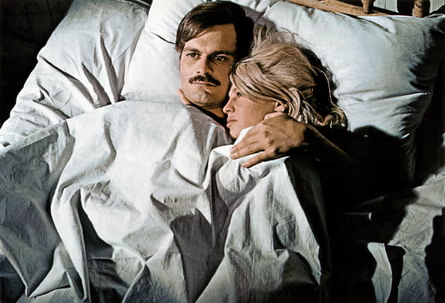
It is partly a homage to Ronald Harwood’s The Dresser, too, “pulling back the curtain of what it is to be a star on stage and off”. But Khalil is exploring something more personal at the same time. “My mum came to the UK at 16 to do nursing training. She was from a farm in very rural Ireland and she’d never met anyone non-white before.” When the film Doctor Zhivago was released, “she saw it so many times and obviously fell in love with Omar Sharif”. Khalil’s parents met at a party. “He was working as a porter in a hotel. He had been kicked out of his digs in Bayswater for some reason and he was saying to people ‘Is there anywhere you know I can stay?’ My mum said ‘oh I think the room upstairs from us is free’.” Importantly, he bore “more than a passing resemblance to Omar Sharif”, says Khalil.
In her play, a mixed-heritage character, Mag, is looking for someone who can help her navigate her identity. She represents Khalil, to some extent. “A big part of the play is what it is to be mixed-heritage in the UK, and how you honour your heritage. That’s something I struggle with. I’m Palestinian Irish but I’m constantly being challenged: ‘No you’re not an Arab or Palestinian, you can’t be Irish …’” Love Omar, she reflects, “ended up, in many ways, becoming about me and my dad”.