







Genki Kawamura is something of a polymath. A bestselling author, film-maker, script writer and producer – he is also a lifelong gamer who grew up playing and being inspired by the games of legendary Nintendo designer Shigeru Miyamoto. His latest project Exit 8, now in cinemas, is a fascinating adaptation of the Japanese horror game, developed by a lone coder based in Kyoto, operating under the name Kotake Create. “I was captivated by its game design and the beauty of its visuals,” says Kawamura. “At the same time, I watched many streamers play it. As I did, I realised that although the game is incredibly simple, each player creates their own story, and each streamer brings their own unique reactions. It felt like a device that could reveal something fundamental about human nature.”
The concept behind Exit 8 the game is simple. The player finds themselves trapped in an endlessly looping section of a Tokyo subway station. Viewing the narrow, brightly lit corridors in first-person, you pass the same posters, the same silent commuter, the same locked doors over and over again. The only way to escape is to spot anomalies each time you pass through – maybe the eyes on a poster start following you, maybe the commuter stops and smiles – at which point you have to double back the way you came. Complete eight runs without missing an anomaly and you get to leave through the eponymous way out. There’s no story, no reason for it at all. The mystery is part of the appeal.

But for the movie, Kawamura realised he would need to expand the experience with a fuller narrative and more directed themes. Exit 8 begins with a commuter on a packed underground train who sees the mother of a crying baby being berated by another passenger. He doesn’t intervene, instead turning up the music on his smartphone. When he alights the train, his ex-girlfriend calls and tells him she is pregnant. She asks what he will do now. Alarmed, he has an asthma attack and finds himself alone in a deserted subway tunnel that he cannot escape. What follows is a dizzying and unnerving psychological thriller, part Groundhog Day, part Vivarium. The silent commuter sometimes stalks him, blood drips from air vents, the lights flicker, the tunnels reinvent and reconfigure themselves like the hallways of the Overlook hotel.
“The starting point was my daily commute on the Tokyo subway,” Kawamura says. “On a packed train, everyone is absorbed in their smartphones, shut off in their own worlds. Even when a baby is crying right in front of them, they don’t notice. Our phones are filled with images of war and violence, and yet we scroll past them, turning a blind eye. Even if we’re not directly responsible, I think this small sense of guilt – of looking away – quietly accumulates inside all of us.”
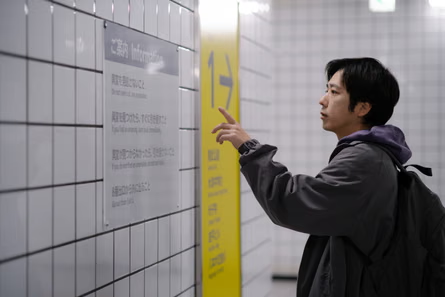
He began to wonder what it would look like if all this pent up guilt manifested as an anomaly in an endless sterile clinical corridor. How terrifying would that be? “I envisioned the corridor as a kind of purgatory, inspired by the Divine Comedy,” he says. “The yellow Exit 8 sign was designed as a godlike presence, something that governs the space and watches over humans as they confront their sins. I realised that the rule of the game itself – ‘If you notice something strange, turn back; if not, keep going’ – mirrors the constant choices we are forced to make in life. That rule became the central pillar of the film’s narrative.”
Exit 8 isn’t an anomaly itself. Three years ago, it was one of a spate of indie horror games based in featureless corridors, empty office buildings and other slightly disorientating urban locations. They were variations on The Backrooms, a “creepypasta” internet mythology, born on the anarchic message board 4chan. Starting with a single post in 2019, participants began exchanging eerie stories, images and ideas about an inescapable liminal space that unwary victims could be glitched into, becoming trapped. Games quickly took on the idea, and movies are moving in too, both with Exit 8 and A24’s forthcoming Backrooms. For many, the desolate nowhere spaces that surround us in cities – the car parks, airport terminals and hotel lobbies – are a concrete manifestations of alienation and existential dread – the modern gothic alternative to haunted castles.
“Liminal spaces feel like being inside a nightmare,” says Kawamura. “They pull out the deepest fears buried in human memory. The simpler the spatial design is, the more it invites the viewer to look inward, to confront their own mind, projecting their memories and even their guilt on to the environment.
“More than external threats like monsters or ghosts, what’s truly terrifying is opening the hidden door within ourselves. And I think people today are increasingly drawn to that ambiguity itself – the blurred boundaries between AI and reality, between games and film …”