





It was 2023. The holiday of a lifetime, in Australia, had begun, after two weeks at the Australian festival of chamber music, in which I’d played viola in several of my own works. I had fretted about this for months, not really believing that I could stand up as a soloist and deliver. Even as a full-time viola-player in the 80s, I avoided solo playing – always feeling more at home in larger chamber groups. But as my husband Peter and I set off on our holiday, I was euphoric. I had performed with the marvellous young pianist Joseph Havlat, with the legendary accordionist James Crabb and virtuoso trumpeter David Elton – and all had gone well.
But then came a horrible realisation: I had not asked for the concerts to be recorded. This had been a moment in my life that would never be repeated. And I hadn’t captured it. I sank into despair. The fact that this is a pattern in my thinking didn’t make it any less painful: the more wonderful the event, the more likely I am to find regrets to attach to it. It is a destructive mindset I have learned to live with, but for years I had no idea why my head seemed compelled to ruin every joyful memory.
The pandemic was a turning point for many. In my case, the chance to stop and think, to ruminate, was not a healthy thing. Sleepless nights piled up, as I obsessed about mistakes made years ago, relived as if they had been yesterday. Hundreds of recurring miseries. Top of the list: the poster I missed (in 2005) in the village shop, flagging up the local theatre company’s auditions for The Sound of Music. My daughter – then nine – and I, had often talked about this show. A precious childhood memory for me was going to see it when newly opened in the West End, with my aunt playing Sister Berthe. Alone, in the packed auditorium, aged five, I was transported. For my daughter to miss these auditions felt like a disaster of incalculable proportions. The only remedy, it seemed to me, was to write a musical featuring enough 10-year-olds to ensure she got a part.
Is any of this unusual? Maybe the unusual part is that, 15 years later, I was still reliving the regret, even though the show I wrote as compensation was duly staged the following year. My daughter did get a part and Shenachie made its way to the televised finals of Cameron Mackintosh’s Highland Quest competition, with my daughter in the cast. She said it was the most fun thing that had ever happened to her. But how could I have missed that poster? And why could I still not process the initial sensation of total disaster?
My pandemic experience led me to seek help, and during a course of cognitive behavioural therapy it was suggested I might be on the autistic spectrum. I was astonished. Surely autism meant lack of empathy, detachment? This wasn’t me. However, there were other traits I did recognise. Discomfort making eye contact. Failure to recognise faces – even family. Getting lost. Misunderstanding others, an often misplaced desire to please. Overwhelm in social situations, especially when not in a music environment, and self-accusation afterwards for perceived faux pas. Extreme sensitivity to noise, an obsessive need to follow rules to the letter.
I now recognise that my violinist mother would have received the same diagnosis. With singular determination, she taught me to read and write music at the age of four. On stage, she had a certain awkwardness and lack of connection. Once, after a solo concert, she simply walked off the stage without acknowledging the applause. My aversion to eye contact means I find it hard to look around me and engage with other players. This is more noticeable nowadays, when young performers seem more – well – performative. Expressive body language is part of being on stage. But however much I am enjoying playing, to quote a friend with autism, my gut doesn’t reach my face.
I wonder how I would have coped with life had I not been born into a musical family, with a pile of my grandmother’s Beethoven sonatas on the piano to read through for hours every day. I can’t help wondering if all musicians are not somewhere “on the spectrum”. After all, how many children would forgo fun with friends to stay indoors and practise an instrument for several hours a day?
If music is my autistic “special interest”, it certainly helps right wrongs and navigate emotions. Childhood events were marked by music: it was my currency for birthday presents, teachers’ gifts, new babies. And for my own processing. After a miscarriage in 1994, I wrote Gala Water for my then husband, cellist Robert Irvine. Somehow, having birthed the music comforted me for the loss of the baby.
Because of my excessive anxiety, I have a need to reframe any negative event into something positive. The theft of my beloved viola – a Gabrielli – in 1989 triggered the decision to stop playing and focus on composing, entailing a massive life change: a move away from London to Scotland. I needed to transform the disaster into something I wouldn’t otherwise have done. And the move proved hugely positive. In Scotland I found the space, support and inspiration to create a career as a composer – something I had thought was only a dream.
Then, after a gap of more than 20 years, I started playing again. The child I was expecting when I had finally sold my last viola grew up to become a luthier, and her first instrument was a viola made to similar proportions as the stolen Gabrielli.
Now I find myself with an album in my hand: the direct result of my failure to organise that Australian recording. Reeling from regret, I contacted Joseph Havlat and asked if he would record with me. He suggested approaching the Delphian label; they accepted, and suddenly this was a serious project. A chance call from my composer son Tom triggered the idea of asking him to write a piece. Well, of course, I then commissioned the other two children, Laurie and Stephanie – both singer/songwriters – full of curiosity to see what they would come up with.
My friend and patron Gerry Mattock had recently died, and his last commission was a piece to be performed with my husband Peter Thomson narrating: Night Songs. Inspired by Gerry’s passion for commissioning, I expanded my requests for pieces, and asked Joseph to write something. My friend Karin Rehnqvist contributed Cradle Song – a lullaby for a grandchild; and the Scottish fiddler and harpist duo Chris Stout and Catriona McKay, for whom I’d written Seavaigers, gifted me Sally’s Tune.
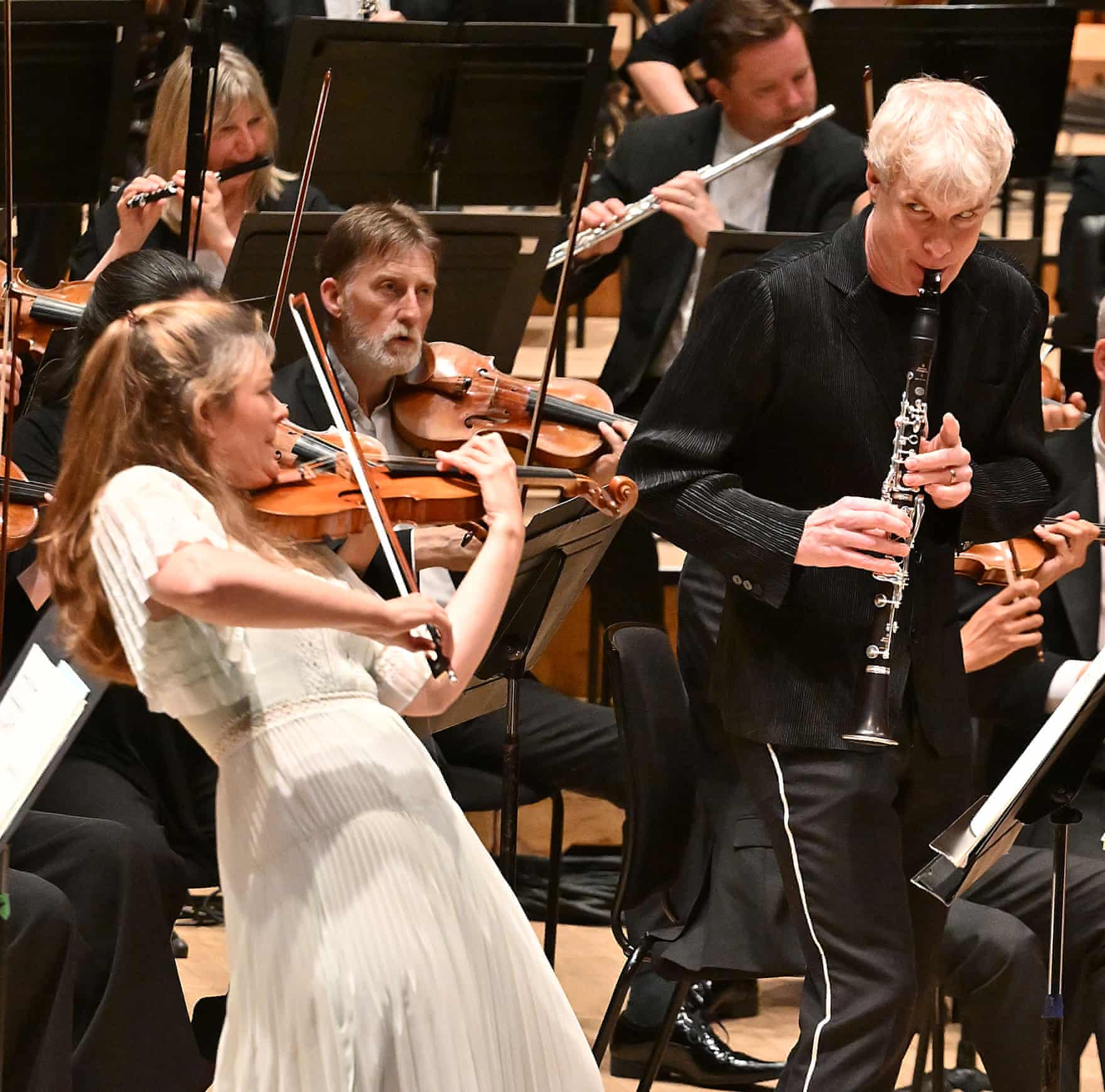
The album began to take shape, reflecting multiple aspects of my life and friendships. Its launch in my 70th birthday year now forms part of a celebratory week. The Academy of St Martin-in-the-Fields, with whom both I and my mother played, is staging a concert featuring Seavaigers with Chris and Catriona, plus the UK premiere of my concerto for basset clarinet, Izakhi, played by Michael Collins. The concerto arose from a visit to Peter’s family in South Africa, and is a reflection on the planet’s threatened environment. All around the same time, Tom’s band Celebrant is playing at World Heart Beat, Laurie has released a single with his band Middle Toe, and Stephanie’s first EP is coming out on 5 June – a month after the arrival of her first child.
My formal diagnosis of autism has proved a blessing, as it helps me (and my family) to understand my obsessive anxiety. I can forgive my mother. I can be easier on myself.
It was only after plans for the album were well under way that I discovered a recording had in fact been made in Australia …
Sally Beamish’s 70th birthday concert with Michael Collins, Chris Stout and Catriona McKay is at St Martin-in-the-Fields, London on 11 June. Her album House of Wonder is released on 12 June on Delphian Records.