





My first viral personal essay was titled: “In Defense of Casual Sex”.
It was 2008. I was 24, living in San Francisco, and working at the online magazine Salon. I was responding to a series of books about hookup culture, including one warning young women that they were ruining themselves for love and marriage by sleeping around.
I had slept around and I didn’t feel ruined, and I wrote as much in my essay. I argued that young women were “putting feminist ideals of equality into sex by refusing shame and claiming the traditionally male side of the stud/slut double standard”.
Trolls filled the comments sections and my inbox with words like “tramp” and “cum dumpster”. I printed out the cruelest remarks and taped them to the fridge in my apartment: every morning, as I opened the door for milk or eggs, I smirked at these names men had called me.
My essay landed in a sex-writing anthology, which led to a reading in Berkeley at Good Vibrations, a famous sex-positive adult toy store, just a few minutes away from my parents’ house.
“What a hoot,” my mom said when I told her. “How fun. Am I allowed to invite friends?” I carpooled with my parents to the event, the three of us laughing about our wholesome family outing to a local sex shop. When it was time for me to read, though, I watched my mom rifle through her purse, shift in her seat, cross and uncross her legs.
As I stood in front of a wall of vibrators and started to read from the book, my dad and several of my parents’ friends smiled at me, but my mom couldn’t meet my eyes. Midway through the essay, she fell into a coughing fit. My eyes focused on the words on the page, but in my periphery, I saw my mom with a fist to her mouth, her face turning red as she tried to hold in her cough, her body trembling from the effort. In retrospect, it seems a physical manifestation of anxiety, a paroxysm of panic.
After the reading, my mom’s good friend came up to say that I’d done a great job. My mom’s voice was ragged when she spoke. “Yes, she survived,” she said with a weak smile. At dinner with my parents afterward, I asked my mom about it. “Honey, you were great,” she told me. “I was expressing my own relief, my own nervousness. I worry for you sometimes.” A pause. “You’re so much braver than I was,” she added.
I knew that she was referring to her teenage pregnancy, which my mom had only told me about when I was a teenager. She sat me down one afternoon and explained that she had gotten pregnant as an 18-year-old. It was the midwest in the 60s, she said, 20 years before I was born. Her father sent her to a home for unwed mothers, where she was hidden away until she gave birth and placed her baby girl for adoption.
The room tilted. I heard my heartbeat in my ears, and my vision jumped in sync with it.
I had been raised as an only child, but it turned out I had a half-sister out there, somewhere. It was a while before I learned the rest of the story: in the wake of the adoption, my mom was so devastated that she was committed to a mental institution.
After that first talk, we rarely spoke of the adoption, but it was always in the room with us. Sometimes it showed up between the lines of conversation, like in this post-reading moment. I recognized the link between my essay and my mom’s past. I had gone viral defending casual premarital sex, the very act that had brought her world crashing down around her. My mom, who had been punished for her sexuality, had a daughter who was writing about her sexuality for hundreds of thousands of people to read on the internet.
My poor mom, I thought. She worries too much. Things are different now. I am different.
“Now companies are sending me sex toys at the office,” I told my mom one afternoon, a few years after my Good Vibrations reading.
I was visiting home from my apartment across the bay and she was sitting at the kitchen table, right next to a stack of magazines. I’d been featured in an article about the next generation of feminist activists for a publication geared toward older women, and she kept half a dozen copies on hand. Inside the magazine, several of us twentysomethings were captured in a two-page photo spread.
They had styled us in soft makeup and prim dresses, but the cover line screamed: “FEMINISTS IN FISHNETS?” The magazine couldn’t seem to decide whether it wanted to portray us as respectable daughters or matricidal Electras.
In my case, at least, the fishnets bit was starting to feel accurate. After several years working as a feminist blogger, I had been reassigned to cover the sex beat, because it was the topic I was always finding excuses to write about anyway.
“I don’t even write about sex toys,” I continued to my mom.
“What a riot,” she said.
“I don’t want to just be some Carrie Bradshaw,” I said.
“You’re not.”
“I want to write about sex with the same seriousness that’s applied to any other aspect of our culture.”
“Totally,” she said. “Sex is one of the most vital parts of our world.”
“I want to challenge all the shame and taboo.”
“I think that’s wonderful, hon.”
I took a special interest in reporting on taboo subcultures. I hiked into the Santa Cruz mountains with men dressed as leather horses and latex hounds to report on a kinky “fox hunt”. I sat in the office of a new age sexual healer, where I scribbled in my notebook and a woman squirted on to my foot as she orgasmed; I delighted in this off-color detail, never failing to note in my retellings that the experience left a weathered patina on my shoe.
“You don’t seem like a sex writer,” strangers told me more than once. I had long cloaked myself in the signatures of good-girl respectability: loafers, turtlenecks and ballerina buns. When my work came up at family gatherings or with new acquaintances, I rushed to change the topic.
In my late 20s, my mom was diagnosed with terminal lung cancer. In the midst of my grief, I hurled myself further into my reporting. The first porn shoot I ever reported on was for the BDSM-themed series Public Disgrace. I watched as a bound woman was paraded around a bar so the beer-swilling men in attendance could spit on her bare flesh. It was a staged fantasy of disgrace.
Around this time, my college alumnae magazine interviewed me about my career and I said: “My aim is to be shameless.” Those words ended up as a pull-quote in the magazine – big block letters right next to my smiling headshot, a photo of me wearing a high-neck shirt with a demure Peter Pan collar.
In my late 20s, a few years after my mom’s diagnosis, I fell in love with a feminist-minded man named Christopher.
When I published a personal essay about our engagement, a misogynistic blogger announced that I had “won the mating game”. Linking to several of my pieces from over the years, he suggested that I had cheated the system by embracing “absolute sluttery” before settling down. He seemed to marvel at my manoeuvering, as though I had outwitted the dividing line of the wife-whore dichotomy.
We walked down the aisle to the Mission: Impossible theme song in a nod toward the sexist and moralizing pressures placed on traditional marriage – from domestic inequality to lifelong monogamy. During a wedding speech, a relative referred to Christopher as a “brave man” for marrying me. I was not only a woman with a past but a woman who had written about her past.
Several years later, I started working on my first memoir, Want Me. By then my mom was gone. I had also just become a mom myself – a motherless mom. I wrote my book during maternity leave, hammering away on my keyboard during my baby’s naps, often with him sleeping on me as I contorted myself into a series of impressively unergonomic positions.
I wrote about growing up in the 90s, wedged between shouts of “girl power” and the breast-flashing of late-night Girls Gone Wild infomercials. I was trying to tell a generational story about navigating the competing pressures of commercialized feminism and sexualized pop culture. I showed how plumbing the depths of our sexual culture as a journalist helped me to confront those competing pressures – not to mention the unfinished work of the sexual revolution.
I talked about my mom’s teenage pregnancy, too, but only in passing. It was my mom’s story, not mine, I thought. After being sent away, my mom felt “marked with a scarlet letter for the rest of her life”, I wrote. I ended up “making the scarlet letter into my career”. It seemed like poetic irony or maybe a testament to generational change. I didn’t consider the possibility that I was chasing the scarlet letter because of what had happened to my mom.
Then in the spring of 2022, I took a DNA test.
I had longed for my sister ever since I learned about her – and it finally occurred to me that finding her could be as easy as spitting into a vial and dropping it in a mailbox.
A couple weeks later, the results landed in my inbox. My top genetic match was a 56-year-old woman named Kathy who lived across the country in Atlanta. “Close family”, it read. “27% shared DNA”. I could see from her profile picture that we had the same dramatic arc in our eyebrows; and her cheekbones made me think of my maternal grandmother. I blinked and felt I was looking right at my mom. It’s her, I thought, gasping. It’s her.
And it was – my sister, the daughter my mom had lost so long ago.
Within a couple hours, we were on the phone, Kathy was asking about our mom’s past, and I realized that I had my own questions that I had never asked. Over the next few weeks as Kathy and I started to get to know each, books about the history of homes for unwed mothers started to pile up on my desk.
I learned that in the pre-Roe era, thousands of parents sent their young pregnant daughters away each year to the maternity homes that had sprouted up across the country in response to the “problem” of premarital sex and pregnancy. The visual proof of their taboo sexuality was hidden behind the walls of these homes – until they gave birth and placed their babies with married couples who were struggling with infertility.
I saw that she had been pulled into a system designed to turn “bad girls” into proper women, wives and mothers. It was meant to control women’s sexuality and bolster the white nuclear family norm. I found myself opening a notebook and scrawling a list:
whore
loose
slut
ruined
bad girl
promiscuous
It was a word cloud of my reading, a litany of the judgments that unwed mothers faced in my mom’s era. Each word felt like a match lit against my skin. It was the fire of shame but also the hot flame of self-recognition, like having my name called unexpectedly in class.
I thought back to my earlier understanding: My mom was marked by the scarlet letter and I turned the scarlet letter into my career. I kept repeating it to myself like a koan. It didn’t seem like poetic irony any more. It felt like more than a coincidence. I tried replacing the “and” with “so”. My mom was marked by the scarlet letter, so I turned the scarlet letter into my career.
I had designed a career that demanded a constant face-off with shame. I wrote things that got me called “cum dumpster” on the internet and left me red-faced and sputtering at family gatherings. I reported on taboo subcultures that required me to confront my own judgments, embarrassment and discomfort.
Many of those subcultures explicitly eroticized shame – like the BDSM-themed porn shoot. It seemed uncanny, and maybe a little far-fetched, that this mysterious event from my mom’s past had so dramatically shaped my own life. But I couldn’t deny the familiar heat of those words: whore, loose, slut, ruined, bad girl, promiscuous.
This was not just my mom’s story, I realized. It was mine, too.
In many ways, I’d succeeded in challenging “all the shame”, as I had told my mom so long ago. I got regular emails and DMs from young women telling me that my first book had changed their lives. They said it made them feel less alone. It helped bring them greater pleasure, understanding and self-acceptance. Still, I privately struggled with my own sense of shame. I could barely talk about my work in my day-to-day life, especially after I became a mom; it felt indecent introducing my subject matter into our suburban parental existence, even though said parenthood was brought into existence most often by sex. I wondered, too, what it would mean for my child to grow up with a mother like me.
Over the next year, though, I started building a relationship with my sister Kathy and kept looking into our mom’s past. I searched through maternity home records and read first-person testimonials about that era. I also found myself researching the history of marriage as a tool for control and thinking about how the division of women into categories of “good” and “bad” keeps us divided – within ourselves, and from each other.
I noticed a shift that even years of writing about sex hadn’t been able to foment. When a new mom friend asked about my first book, I answered smiling and straightforward, no blushing or stuttering. “It’s a sexual coming-of-age story about the difficulties of finding yourself as a woman in this world,” I said. Similarly, I had stopped worrying about what it would mean for my kid to grow up with a mother “like me”. What, a mother who allowed her own humanity?
Shining a light on the sources of my shame caused so much of it to begin to evaporate.
-
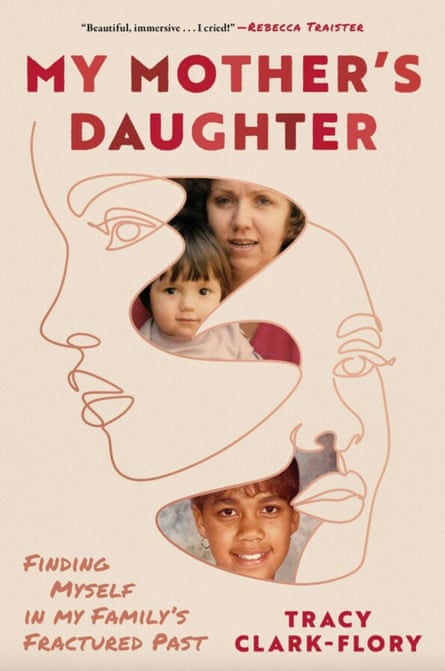
Excerpted from My Mother’s Daughter: Finding Myself in My Family’s Fractured Past by Tracy Clark-Flory, to be published by Gallery Books, an Imprint of Simon & Schuster on 5 May