


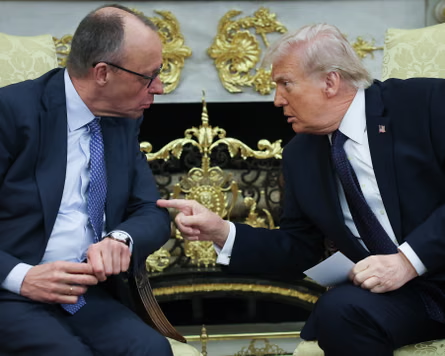
The US is being “humiliated” by Iran’s leadership, according to Friedrich Merz, Germany’s chancellor, who suggested the Trump administration was being outwitted at the negotiating table by Tehran.
Two days ago Donald Trump cancelled a trip by US negotiators to Islamabad for indirect talks with an Iranian delegation. A previous round in the Pakistani capital two weeks earlier, when JD Vance, the American vice-president, led the US delegation, broke up without progress.
Merz’s trenchant assessment of the stalled US-Iranian talks, which appeared certain to deepen the severe transatlantic rift between the US and its Nato allies, directly contradicts Trump’s effort to cast the limbo in a positive light.
A day earlier, the US president told Fox News: “We have all the cards,” adding that if Tehran wanted to talk, “they can come to us, or they can call us”.
Speaking to students in Marsberg, Merz suggested it was Trump’s team that was being outplayed. “The Iranians are obviously very skilled at negotiating, or rather, very skilful at not negotiating, letting the Americans travel to Islamabad and then leave again without any result,” he said.
“An entire nation is being humiliated by the Iranian leadership, especially by these so-called Revolutionary Guards. And so I hope that this ends as quickly as possible.”
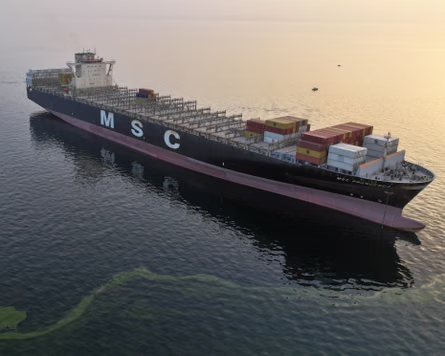
Iran put forward a new proposal on Monday for a ceasefire deal focused on opening the strait of Hormuz, setting aside discussions on nuclear weapons, missiles, sanctions and other issues for later, according to officials in the region. Under a bill being prepared by Iran’s parliament, shippers would have to pay Tehran for “services” involved in passing through the strait, which was free before the war.
The proposal, conveyed to Washington by Pakistani mediators, would help to resolve a global economic and energy crisis created by the US-Israeli attack on Iran in February, but it would achieve none of Washington’s professed war aims, which included a permanent end to Iran’s nuclear programme.
The UN’s International Maritime Organization firmly rejected the idea of imposing fees on ships passing through the strait of Hormuz. Arsenio Dominguez, the IMO’s secretary general, said: “There’s no legal basis for the introduction of any tax, any customs, or any fees on straits for international navigation.”
The “Hormuz first” offer from Iran does, however, suggest a significant shift in Tehran’s position. The regime had previously sought to use its blockade on oil, gas and other Gulf exports as leverage to win broad security guarantees.
But after the breakdown of the Islamabad talks, Trump imposed a counter-blockade of shipping using Iranian ports, exacerbating Iran’s deep economic crisis. The International Monetary Fund has forecast a 6.1% contraction in Iran’s gross domestic product this year, while year-on-year inflation is running at nearly 70%, with prices for food staples and healthcare rising at even higher rates.
The blockade has also stopped Iran’s empty tankers returning to port, where they could serve as storage facilities. Iran is running very low on ways to store its output, and winding down production would have long-term damaging effects to its energy sector.
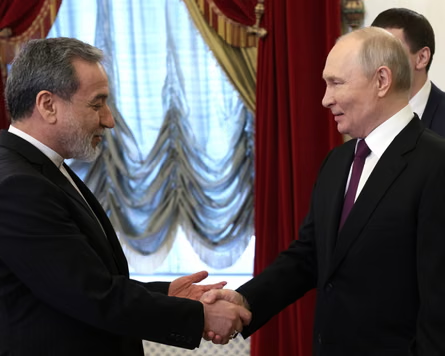
Abbas Araghchi, the Iranian foreign minister, met Vladimir Putin and a high-powered Russian delegation in Moscow on Monday, seeking in part to mitigate the crippling effects of the blockade.
According to official media, Putin pledged that Russia “will do everything that serves [Iranian] interests, the interests of all the people of the region, so that peace can be achieved as soon as possible”.
Araghchi said “the world has now realised Iran’s true power”, adding: “It has become clear that the Islamic republic of Iran is a stable, solid and powerful system.”
Nikita Smagin, an analyst of Russian-Iranian relations, said the talks focused on Russian military and economic support, including transit routes for Iranian trade. “If the US blockade continues, then the Caspian Sea and the land link with Russia will become one of the few remaining routes for connecting Iran with world markets,” Smagin wrote in a commentary on the Telegram messaging platform.
Israel attacked the Caspian route in March with the bombing of Bandar Anzali, an Iranian port. But even before the Israeli strike, it fell far short of becoming a substitute for the Hormuz strait, the gateway to more than 90% of Iran’s prewar trade.
Ali Vaez, the Iran project director for the International Crisis Group, said Trump and his team had misjudged how much the economic squeeze would force Tehran into concessions on its nuclear programme.
“Undeniably, the blockade is basically sharpening the economic pain that Iran was under even before the war started,” Vaez said. “But Iranian resilience is not a question of economic pain because Iran is in an existential battle and is willing to absorb a much higher price than it has so far. And the Iranian regime doesn’t hesitate to transfer this pain to its population.”
He said Trump was more politically sensitive on a number of fronts: the political cost of high petrol prices and general inflation at home, the president’s desire to resolve the crisis before meeting Xi Jinping in Beijing in mid-May and the fear that a global shortage of jet fuel could ruin the World Cup, due to be held in North America in June and July.
If Trump accepted Iran’s offer of a deal to reopen the strait of Hormuz, he could conceivably declare victory by pointing to the damage that the US and Israeli bombing had inflicted on Iran’s nuclear programme and military capabilities. However, such a deal would leave Iran with its stockpile of 440kg of highly enriched uranium, enough in theory for a dozen nuclear warheads.
Ariane Tabatabai, the vice-president of research, security and defence at the Chicago Council on Global Affairs, said Iran could also reconstitute at least some of its military might quite rapidly. “Their whole military doctrine is based on building and deploying capabilities that they can acquire and maintain and use on the cheap,” said Tabatabai, a former Pentagon policy adviser.
Meanwhile, Benjamin Netanyahu raised the prospect of fresh Israeli military action in Lebanon, saying rockets and drones possessed by Hezbollah, the Iran-backed militant group, remained a threat.
“There are still two central threats from Hezbollah: the 122mm rockets and the drones,” said the Israeli prime minister in a statement issued by his office. “This demands a combination of operational and technological activity.”