
惯性聚合 高效追踪和阅读你感兴趣的博客、新闻、科技资讯
阅读原文 在惯性聚合中打开

推荐订阅源

N
Netflix TechBlog - Medium
罗磊的独立博客
H
Help Net Security
I
Intezer
G
Google Developers Blog
CTFtime.org: upcoming CTF events
T
Troy Hunt's Blog
让小产品的独立变现更简单 - ezindie.com
U
Unit 42
cs.AI updates on arXiv.org
freeCodeCamp Programming Tutorials: Python, JavaScript, Git & More
钛媒体:引领未来商业与生活新知
钛媒体:引领未来商业与生活新知
N
News and Events Feed by Topic
J
Java Code Geeks
S
Security Affairs
T
The Blog of Author Tim Ferriss
Recent Commits to openclaw:main
cs.CV updates on arXiv.org
D
Docker
The GitHub Blog
The GitHub Blog
F
Full Disclosure
N
News and Events Feed by Topic
Webroot Blog
Webroot Blog
S
Security @ Cisco Blogs
腾讯CDC
人人都是产品经理
人人都是产品经理
M
MIT News - Artificial intelligence
Blog — PlanetScale
Blog — PlanetScale
T
Threatpost
D
DataBreaches.Net
Recent Announcements
博客园 - 三生石上(FineUI控件)
MongoDB | Blog
MongoDB | Blog
博客园 - 【当耐特】
L
LINUX DO - 最新话题
Google Online Security Blog
S
Schneier on Security
S
Securelist
奇客Solidot–传递最新科技情报
奇客Solidot–传递最新科技情报
Help Net Security
Help Net Security
P
Proofpoint News Feed
Project Zero
Project Zero
S
SegmentFault 最新的问题
H
Hackread – Cybersecurity News, Data Breaches, AI and More
MyScale Blog
MyScale Blog
Google DeepMind News
宝玉的分享
宝玉的分享
Y
Y Combinator Blog
C
CXSECURITY Database RSS Feed - CXSecurity.com
博客园 - 叶小钗

The Guardian

Rory McIlroy surges into six-shot Masters lead with stunning second-round flourish ‘That’ll be the end’: actor Sam Neill joins fight to stop controversial goldmine near his New Zealand vineyard Roberto De Zerbi targets ‘Ange-ball’ revival to save Spurs from relegation Bath hit back to reach semi-final after stunning Northampton in 11-try epic Secret Garden to Outcome: the week in rave reviews Zebras, wealth and power: Hungary’s election tests Orbán’s grip on power ‘TikTok effect’ brings sellout crowds and younger fans to Grand National meeting The war over Omagh’s gold: the £21bn mine plan tearing a community apart Britain’s shadow workforce is paid as little as 65p an hour. Who cares for the carers? From You, Me & Tuscany to Euphoria: your complete entertainment guide to the week ahead Six great reads: the man who let snakes bite him, masked heavy metal and the brutal reality for foreign students in the UK American Classic review – I defy you not to fall in love with Kevin Kline and Laura Linney’s tender comedy Cuba’s doctors were a lifeline for the world. Now the Caribbean is shamefully complicit in the US drive to expel them An environmental disaster in Moldova has Russia’s fingerprints all over it RMIT drops misconduct case against student who accused university of being ‘complicit in Gaza genocide’ Ichiro Suzuki statue unveiling goes awry as bronze bat snaps during ceremony Survivors of Epstein’s abuse accuse Melania Trump of ‘shifting burden’ on to victims European football: Real Madrid held at home by Girona to extend winless run Arne Slot insists he is ‘aligned’ with Liverpool board and fans as squad is rebuilt Kamala Harris ‘thinking about’ running for president again in 2028 JD Vance warns Iran against trying to ‘play’ the US in peace talks West Ham double up twice to thrash Wolves and put Spurs in relegation zone Trump administration releases new renderings of so-called ‘Arc de Trump’ Crispin Odey drops £79m libel claim against FT over sexual misconduct allegations Bafta apologises for events surrounding John Davidson’s Tourette’s outburst Cocktail of the week: Bar Shrimp’s la rosita – recipe New drug may extend survival in aggressive ovarian cancer, trial shows One dead and 27 injured after bus with British passengers crashes in Canary Islands Pope adds to Smith’s mass of Surrey runs with England woes a world away OpenAI CEO Sam Altman’s home targeted with molotov cocktail Reform UK local election candidate was twice disciplined by Tories over ‘racist comments’ Remaining in Nato is in best interests of US, says Keir Starmer Prince Harry sued for defamation by charity he co-founded Anthropic’s new AI tool has implications for us all – whether we can use it or not Concerns raised about motorbike tourist trail after death of British teenager in Vietnam The Guardian view on Trump’s civilisational threats: the words that fuel war must be condemned The Guardian view on dystopias for our times: the American nightmare Doctors’ leader claims new reduced pay offer killed chances of ending strikes in England Netanyahu-ism has achieved nothing for Israelis – and come at a monstrously high price Deborah Levy: ‘CS Lewis’s White Witch terrified me – but I wanted to meet her’ How I Shop with Michelle Ogundehin: ‘We grownups have enough stuff already’ Trump’s war and Melania’s Epstein statement, with US editor Betsy Reed – The Latest We have to stop killer motorists on Britain’s roads UK starts crackdown on EU citizens’ post-Brexit rights Londoners aren’t unfriendly – but don’t compare us to New Yorkers The religious right and the perversion of faith Artemis II images reignite moon mission memories Orbán and Magyar trade accusations in last days of Hungary election campaign Reckonwrong: How Long Has It Been? review | Safi Bugel's experimental album of the month Martin Rowson on Middle East peace talks – cartoon Masters magic, the Grand National and Premier League drama – follow with us Fears of UK and EU flight cancellations as airports warn of jet fuel shortages Reform’s petulance over slavery reparations shows it just doesn’t grasp Britain’s place in the modern world Peers vote to ban pornography depicting sex acts between stepfamily members Starbucks’s retail arm gets £13.7m tax credit even as sales increase Flyby review – interstellar musical is a voyage of epic strangeness Grand National preview: Jagwar can deny Irish cohort in Aintree classic Week in wildlife: an ostrich on the lam, a tortoise crossing a road and surfing seals Anger as swifts’ nesting holes in Derbyshire rail viaduct ‘blocked up’ Peter Mandelson faces fixed-penalty notice for urinating in public ‘There’s no shortage of terrifying technology’: how AI became TV drama’s new go-to villain ‘Fresher than anything in a shop’: the best recipe boxes and meal kits for time-poor foodies, tested Who was Hilma? Af Klint exhibition to highlight exclusion of women from abstract art Critics assemble! Here’s my list of the greatest superhero movies of all time US inflation soars in March as war on Iran drives economy into uncertainty Amazon to finally launch Leo satellite internet in ‘mid-2026’, says CEO Grand National 2026: horse-by-horse guide to all the runners Pete Hegseth’s holy war: the militant Christian theology animating the US attack on Iran Add to playlist: the beautifully dazed, countrified indie-rock of Tracey Nelson and the week’s best new tracks Not just about Gaza: the Muslim voters turning from Labour to the Greens ‘I’m worried there’s too much of me,’ says a birch: inside the interspecies council giving nature a voice Why is anyone surprised by the US and Israel’s latest war? It’s only what the world allowed them to do in Gaza Tori Amos review – fans hang on every note of this dramatic deep dive into her back catalogue Coachella 2026: Justin Bieber launches a major comeback in the desert Super Mario what?! The seven best obscure Mario games ‘An abomination’: the Lancashire town kicking up a stink over reopened landfill Pillion to Roofman: the seven best films to watch on TV this week Holly Humberstone: Cruel World review – Taylor Swift fave trades gothic melancholy for pop glow-up Thrash review – cursed shark thriller sinks like a stone on Netflix Gulf states rethink security in light of US-Israel war on Iran Go Gentle by Maria Semple review – a joyfully clever New York romcom Welcome to Y’all Street: bullish Dallas aims to steal New York’s financial crown Margo’s Got Money Troubles to Beef: the seven best shows to stream this week I baulked at the idea of ‘friction-maxxing’. But there’s more to it than meets the eye Reich: The Sextets album review – Colin Currie celebrates the minimalist master’s joy of six Benjamina Ebuehi’s sweet and salty chocolate chip cookies recipe Experience: my house was taken over by 70,000 bees Malcolm in the Middle: Life’s Still Unfair review – the TV magic they’ve created here is absolutely miraculous Lava bursts forth as Hawaii’s Kilauea volcano erupts Sonos review: Are these the best portable speakers that money can buy? I tested to find out Buy bread in the evening, hit the sales on a Tuesday: retail workers’ top tips to cut your shopping bill The best water flossers in the UK, tested for that dentist-clean feeling Where to start with: Muriel Spark You be the judge: should my girlfriend stop mixing gold and silver jewellery? The best carry-on luggage in the UK, tested on an assault course How games capture the awe and terror of cosmic isolation I never text back – and it’s ruining my relationships The pet I’ll never forget: Beau, the labrador who saved my life Life Is Strange: Reunion review – a decade-long story comes to an impassioned close Why is gaming becoming so expensive? The answer is found in AI
Ghost of far-right paramilitaries hovers over Colombia’s presidential runoff vote
https://www.theguardian.com/profile/tiago-rogero · 2026-06-20 · via The Guardian

Whoever wins Sunday’s presidential runoff vote in Colombia, the country’s next leader will have a personal history intertwined with one of the criminal forces at the heart of a decades-long armed conflict that claimed nearly half a million lives.

The lives of Iván Cepeda and Abelardo de la Espriella have, in very different ways, been shaped by their relationship with Colombia’s paramilitaries – private armies originally established by rightwing landowners, drug traffickers, businessmen, mining magnates and politicians to fight leftwing guerrilla groups.

De la Espriella, 47, a far-right admirer of Donald Trump and self-styled outsider, launched his legal career defending paramilitary leaders.

Iván Cepeda and Abelardo de la Espriella
Iván Cepeda (left) and Abelardo de la Espriella. Composite: Getty Images

Cepeda’s father was assassinated by army officers linked to a paramilitary group, and the 63-year-old leftwing senator forged his public career as a human rights activist exposing those groups’ crimes.

The winner will take office on 7 August and inherit the country’s worst violence since the landmark 2016 peace agreement between the government and most of the Revolutionary Armed Forces of Colombia.

The two candidates advocate opposing strategies for dealing with the surge in crime.

De la Espriella, who has led the polls since defeating Cepeda in the first round, supports a return to the kind of full-scale military confrontation that has done little to curb violence in the past.

A woman wearing a shirt and wide-brimmed hat in the colours of the Colombian flag salutes at the camera
Supporters of Abelardo de la Espriella at his closing campaign rally in Buga, Valle del Cauca. Photograph: Joaquín Sarmiento/AFP/Getty Images

Cepeda, who is backed by the current president, argues for a modified continuation of Gustavo Petro’s strategy of “total peace”. Petro, who is barred by the constitution from running for re-election, has proposed negotiations to dismantle all armed groups, including leftwing rebels, paramilitaries and organised crime factions. Violence has surged, however, and security experts say the strategy has broadly failed.

Sunday’s vote “reflects the reality of a country shaped by drug trafficking,” said Gustavo Duncan, one of Colombia’s leading scholars of paramilitarism.

Paramilitary groups were first formed in the 1960s in response to the emergence of leftwing rebel groups and often operated with the collusion of the Colombian military. By the 1980s, as the cocaine trade grew central to the conflict, the paramilitaries also protected trafficking routes and drug lords such as Pablo Escobar. A major faction later broke with the Medellín cartel leader, helped bring about his downfall and used the resulting power vacuum to expand.

“At its peak, these groups had more than 30,000 members. It was an enormous army spread throughout the country,” Duncan said.

In the 1990s, the paramilitaries “became notorious for massacres” – choreographed displays of extreme violence designed to terrorise entire communities – said María Teresa Ronderos, the author of major investigations on the private militias.
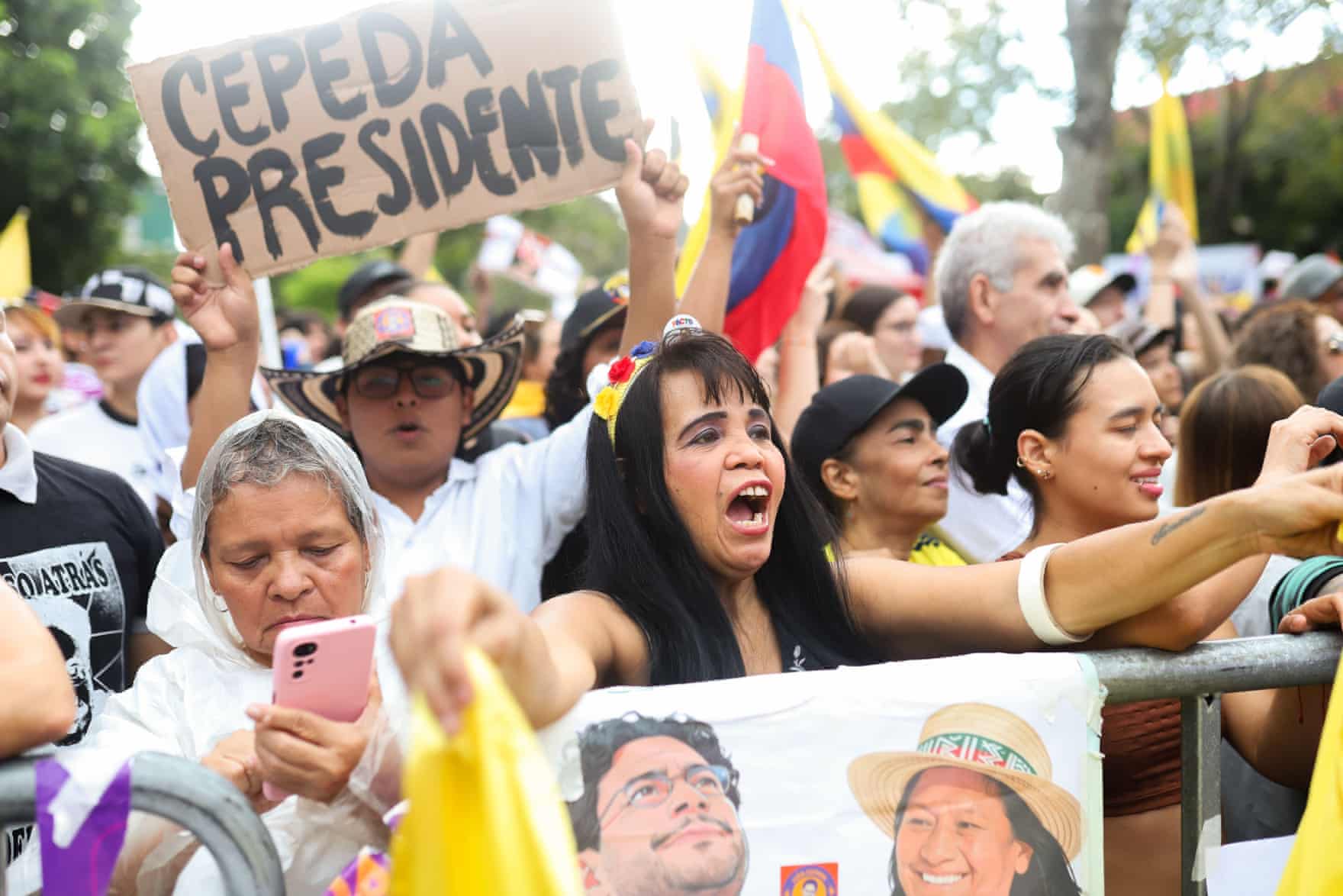
A crowd of people, one of the holding up a cardboard sign reading ‘Cepeda president’
Iván Cepeda supporters take part in a rally in Medellín in June. Photograph: Camilo Moreno/LongVisual/ZUMA Press Wire/Shutterstock

Their fighters would enter towns and rural communities and kill anyone suspected of sympathising with or providing information to the guerrillas, including peasants, Indigenous people and Afro-Colombians. They also carried out what they called social cleansing, targeting people deemed undesirable by paramilitary far-right culture, including LGBTQ+ people, sex workers, homeless people and drug users.

Massacres frequently involved extreme forms of torture, including rape followed by murder, dismemberment of victims with chainsaws while they were still alive and decapitations carried out with axes.

In 1994, paramilitaries and members of the army murdered the senator Manuel Cepeda as part of a campaign against the communist Patriotic Union party. Iván Cepeda, then a university professor, came across his father’s car riddled with bullet holes.
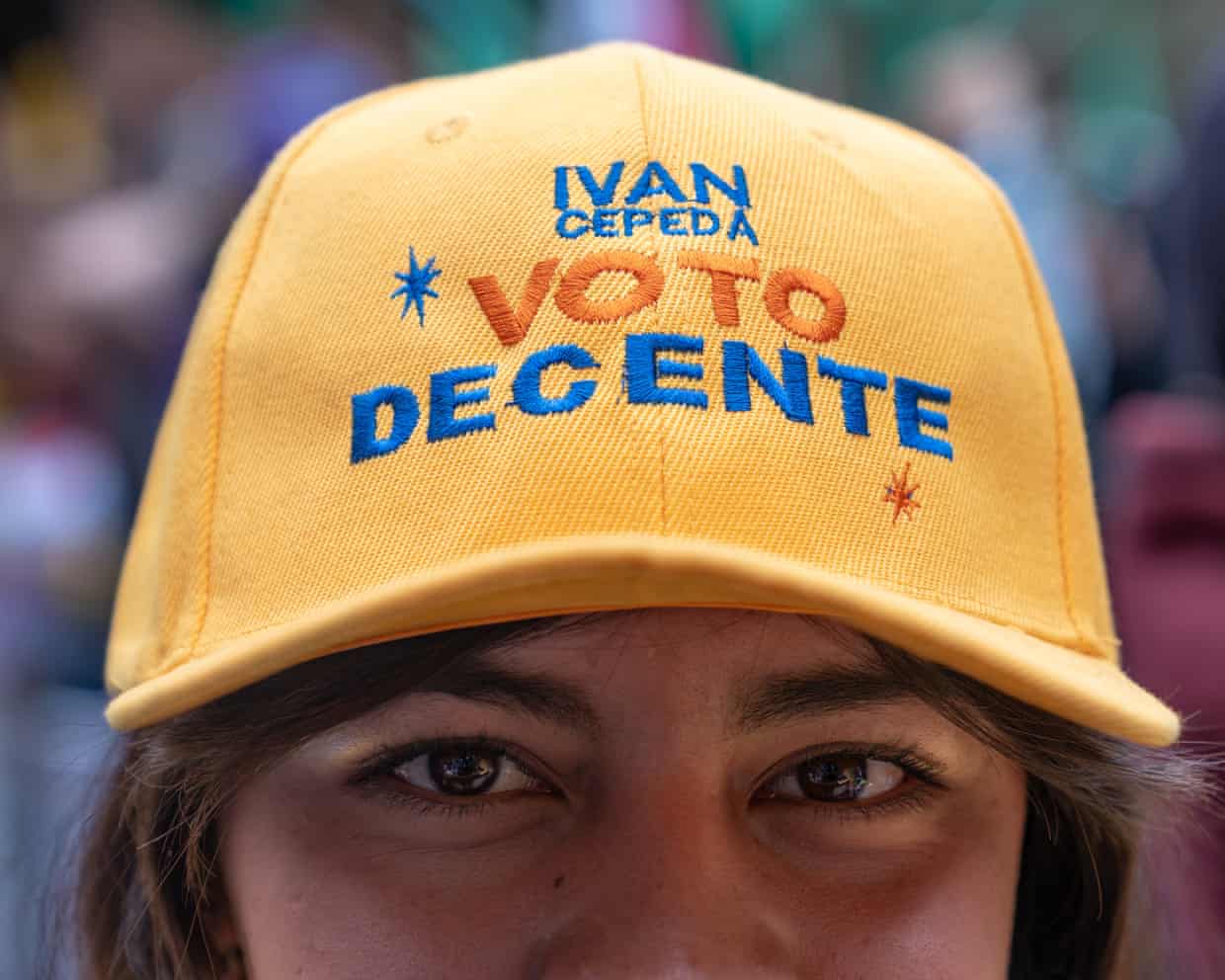
A closeup of a woman in a baseball cap bearing the words ‘Iván Cepeda, a decent vote’
A supporter of Iván Cepeda at a rally in Bogotá in June. Photograph: Bloomberg/Getty Images

In the early 2000s, the younger Cepeda founded and led a movement representing the death squads’ victims, investigating cases and visiting prisons to collect testimony from former paramilitaries.

At the same time, De la Espriella was rising to prominence as a lawyer defending leaders of the country’s main paramilitary organisation, the United Self-Defence Forces of Colombia (AUC by its Spanish acronym), while the group negotiated its demobilisation.

The AUC no longer exists, but the Gulf Clan, widely regarded as Colombia’s largest and most powerful illegal armed group, was founded by its former members and inherited much of its territory and many of its trafficking routes.

Cepeda filed a criminal complaint against De la Espriella last week, alleging that he had not only represented the AUC in court in the past but had also acted as a “possible recruiter” for the group through a foundation he created.

De la Espriella dismissed the accusations as a “smokescreen” and hit back by claiming that Cepeda maintained a “narco-political” alliance with guerrilla groups in order to secure votes.

Cepeda is regarded as the main architect of Petro’s “total peace” plan. He has repeatedly denied any links to rebel groups, but the fact that Petro was once a guerrilla has been heavily exploited in De la Espriella’s campaign.

Masked and heavily armed men in combat gear standing in formation in a field
AUC fighters train in the mountains near Catatumbo, north-west of Bogotá, in 2000. Photograph: Carlos Garcia/AFP via Getty Images

After De la Espriella emerged ahead in the first round, Trump announced on social media that he was backing the lawyer, while calling Cepeda a “radical left Marxist”.

Eleven Democratic members of the US Congress sent a letter to the Trump administration last week arguing that “rather than campaigning for [De la Espriella], our government should be examining his ties” to the AUC – which the Washington designated a foreign terrorist organisation in 2001 and which “was responsible for numerous massacres, assassinations and forced disappearances, as well as torture, forced displacement, sexual violence, collusion with state/security and political actors, and large-scale drug trafficking to the US and other countries”.

They said De la Espriella had allegedly “maintained close relations with multiple leaders” of the AUC.

De la Espriella did not respond to requests for comment. He has vehemently denied committing any crime or illegal act in relation to the paramilitaries, insisting that his contact with them was strictly professional in his capacity as a criminal lawyer.

People weeping over a sliver coffin
Relatives mourn at a funeral for people killed in an attack that authorities blamed on dissident former members of the Revolutionary Armed Forces of Colombia, in Cajibío, Cauca. Photograph: Santiago Saldarriaga/AP

For his supporters, his past seems to matter less than his promises of an iron-fist approach to crime, including building private “mega-prisons” in the Amazon and “wiping out” criminals like “cockroaches and rats”.

The past year has been the most violent since the 2016 peace agreement, with a surge in armed group attacks, homicides, kidnappings, forced displacement and massacres. The rightwing senator and presidential hopeful Miguel Uribe Turbay was shot during a campaign event last year and later died.

Security experts say current indicators are far below the extraordinarily high levels of violence recorded in the decades before the peace deal, but many Colombians feel the country has returned to its “worst moments”.

“One reason there is so much criminality in Colombia is that people rob, kill and then a few days later they are back on the streets,” said Lucy Vélez, a 38-year-old graphic designer from the western city of Manizales. “So I do like the idea of being tougher on crime.”

A former businesswoman who now works as a driver in Bogotá and asked to be identified only as Marcela does not see De la Espriella’s alleged associations with the paramilitaries as a problem. “The paramilitaries kept the guerrillas in check,” she said. “When there were too many thieves or too much crime, the paramilitaries would carry out what they called ‘social cleansing’ … Unfortunately, they have served a purpose in some ways.”
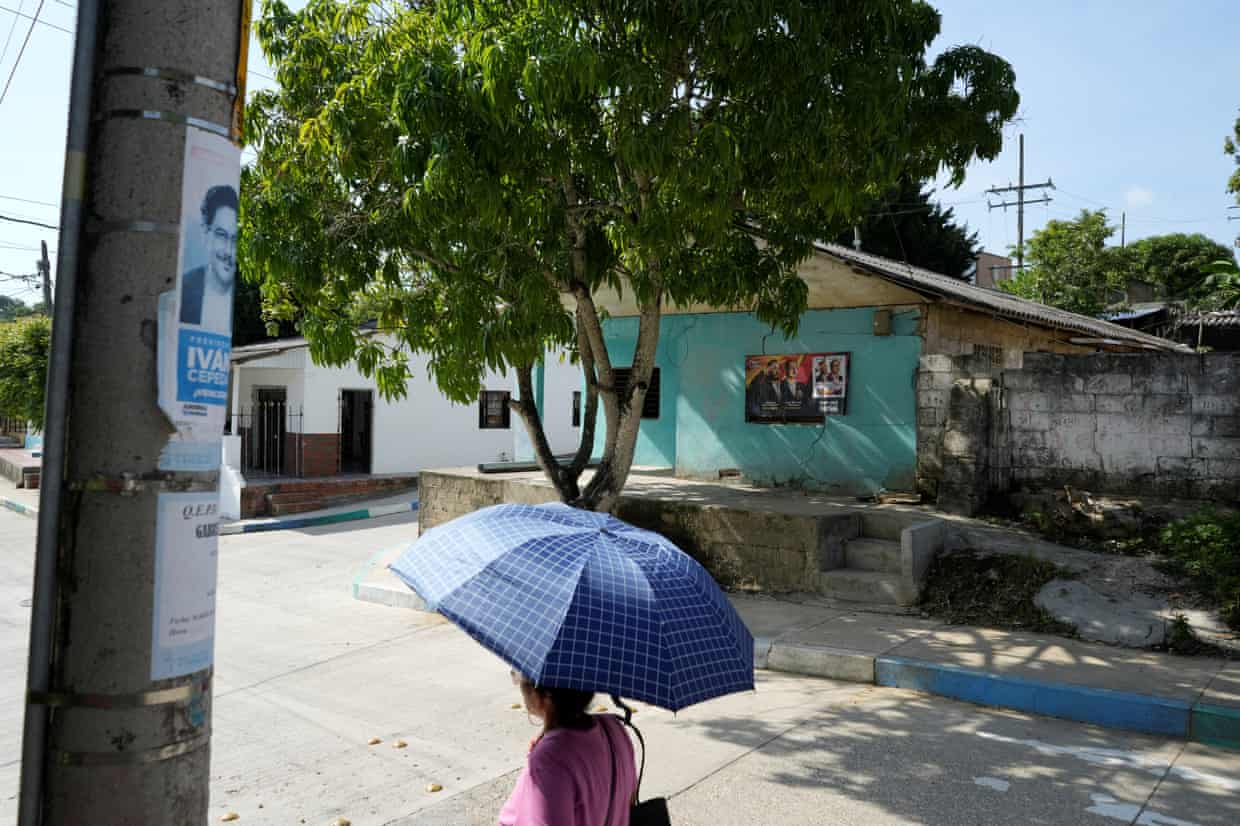
A woman using an umbrella as a sunshade walks past election campaign posters for Iván Cepeda on one side of the road and Abelardo De La Espriella on the other in a small town
A woman walks past election campaign posters for Iván Cepeda on one side of the road and Abelardo De La Espriella on the other in Tubará, Atlántico. Photograph: Charlie Cordero/Reuters

An investigation by the Colombian news outlet La Silla Vacía reported that among the minority shareholders of De la Espriella’s businesses – which include rum, wine, clothing and real estate ventures – are relatives of the convicted paramilitary leader Hugues Rodríguez Fuentes, who was known within the AUC as “Comandante Barbie”.

“That does not mean he is personally a criminal [but] De la Espriella comes from the heart of those narco-paramilitary networks,” said Ronderos.

“Colombia has spent years trying to dismantle that terrible war, and he talks about ‘disembowelling’ leftists and killing criminals,” she said. “To return to that after everything it cost us is deeply sad.”