




Mohammed Ashour was on the road at 5am, speeding towards his hometown of Shaqra. The Lebanese army, the Israel Defense Forces and Hezbollah had all told residents of south Lebanon not to return, that it was still dangerous despite a ceasefire. But the 60-year-old had been displaced for 44 days – he had counted each day – and he would not wait another hour before seeing his home.
At 3pm, Ashour was still on the road. The normally two-hour drive turned into 10, as the line of cars returning south stretched for miles down the Lebanese coastal highway. The Lebanese army had worked through the night to repair the Qasmiyeh Bridge into Tyre, bombed by Israel hours before the ceasefire, and cars were inching over the ad-hoc crossing one by one.
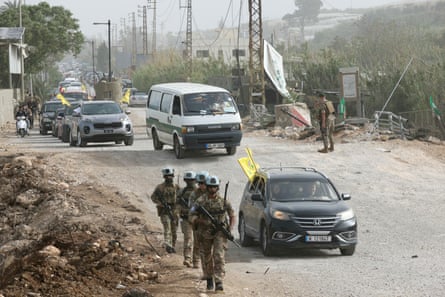
“They told me my house was destroyed. But I wanted to come and see it for myself,” said Ashour, still in his car. He had left his family in Beirut, wanting to shield them from the destruction that awaited them in their village.
Ashour was one of thousands of Lebanese who rushed back to their villages in south Lebanon on Friday in the hours after the shaky 10-day ceasefire between Israel and Lebanon took effect. People returned to south Lebanon despite the rubble-strewn roads and collapsed bridges, crossing dirt roads and even driving through the Litani River, and despite a ceasefire that promised no permanent peace.
“It’s our land. Whether the truce is short or long, even if it’s just for an hour, we will come back,” Ashour said, before driving off to see Shaqra.
Families, packed two-to-a-seat, drove cars saddled with mattresses down the highway, accompanied by crowds waving Lebanese and Hezbollah flags, cheering on the returning residents. Some held up their fingers in a V sign for victory.
But the festive atmosphere turned sombre when residents reached their villages.
Hassan Najdi, a 28-year-old electrical engineer, returned to a heavily damaged home in the town of Srifa. He stood outside and looked at the remains of his backyard, strewn with rubble and the roof of his neighbour’s house – his own home scorched black by flames. The windows had been blown in and the metal bars bent from the force of a nearby airstrike.
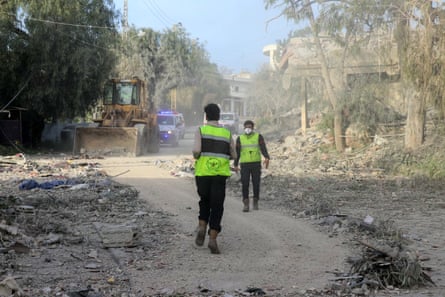
“Honestly, everything has changed a lot. The features of the place are completely different. When you first enter the village, you can’t even recognise that this is the Srifa it used to be,” said Najdi as he began to clean the entry way to his home.
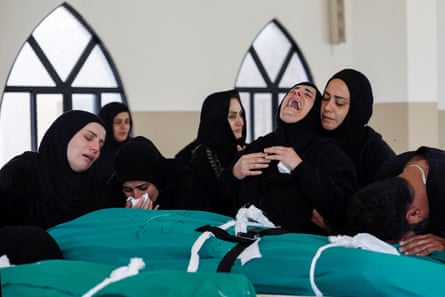
The 44 days of war had a heavy toll on Srifa. In the hours before the ceasefire was announced, the Israeli airforce carried out about a dozen airstrikes on the town. Three-quarters of the homes in Najdi’s neighbourhood had been flattened. Srifa had suffered many losses, some of the more than 2,100 people killed by Israel over the last six weeks of war in Lebanon.
Najdi’s uncle, Dr Wadih Najdeh, a surgeon who had spent the war working in the governmental hospital in Tebnine, also returned to find his and his wife’s clinic damaged. The windows were all shattered and the surgical chair was covered in debris.
Still, despite the damage, it was a relief to be home. Tebnine hospital had been damaged in two nearby Israeli strikes this week, blasts that injured 11 members of hospital staff.
“Returning brings both joy and pain. The pain comes from losing young people – friends and companions – and also from seeing the destruction on the road and in the village, especially in Srifa, where the damage is very extensive,” Najdeh said. “But God willing, all this destruction can be repaired.”
The return to their towns and villages was bittersweet, not only because of the damage, but also because residents were unsure how long they would be able to stay. The 10-day ceasefire came with warnings from both Israeli and Hezbollah officials that hostilities could resume at any time if either party violated the truce.
The war that began on 2 March when Hezbollah launched rockets at Israel in retaliation for the killing of Iran’s supreme leader, causing an Israeli bombing campaign and invasion, was frozen, but only barely. The same issues that ignited the war – Hezbollah’s presence in the south and continued Israeli bombing of Lebanon – still remained.
The Israeli prime minister, Benjamin Netanyahu, said in a statement on Friday: “One way or another, we will restore security to the residents of the north,” adding: “One of our hands holds a weapon, our other hand is extended in peace.”
Residents of south Lebanon were well aware that this ceasefire could just be a pause in the fighting, rather than a permanent peace, but had decided to exploit the truce, however brief, to get a glimpse of home.
“We’ve come back during these 10 days to see what the situation is with this truce, whether there will actually be commitment from the Israeli side,” said Hassan Najdi.
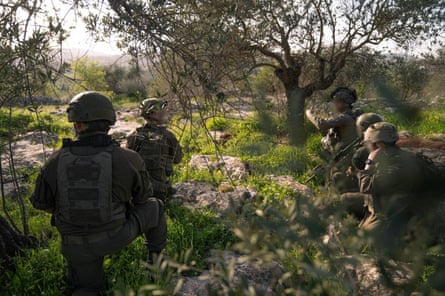
Other residents of the south could not even get a glimpse of their homes. Israeli troops maintained positions in border villages, and residents who approached were met with gunfire. Over their month-long occupation in south Lebanon, the Israeli military flattened entire villages along the border with controlled demolitions and bombings.
In that sense, both Najdi and his uncle felt lucky to have seen their villages – even if damaged, even if they could not stay.
“Of course, we in the south, we have a saying: We can live in tents, even if we don’t have houses,” Najdi said.
此内容由惯性聚合(RSS阅读器)自动聚合整理,仅供阅读参考。 原文来自 — 版权归原作者所有。