









I’m pretty careful with money, I say as I trip over piles of Amazon Prime boxes. I’ve never really been the shopping type, I insist as I stare at drawers groaning with unworn Asos clothes. Look how much I care about the environment, I tell myself as I click “buy now” on yet another battery charger I bought to replace the one, two or five I’ve lost around the house somewhere.
You don’t have to be a shopaholic to be drowning in stuff. All it takes is an averagely mindless approach to impulse buying, until one day your home is heaving with a personal landfill of tat.
I lived a positively anti-consumer existence before online shopping came along. But when one-click, instant-delivery buying took all the effort out of it, my inner zombie consumer was unleashed.
These days, I click the “buy now” button several times a week. It’s never for me, you understand, it’s for the house: quirky lighting, art supplies, bedding, cat gadgets, picture frames, DIY tools. I’m not half bad at finding a deal. Still, that’s no excuse for letting stuff pile up much faster than I can use it, wear it or take it back.
The internet teems with ever more high-concept “buy less” advice, from the no-spend challenge and cash stuffing to the 0.01% rule and gratitude journalling (oh look, here’s a gratitude journal I can buy right now from Amazon). Many of these tips are plain old budgeting dressed in viral clothes.
To find out which ones might actually work for me, I spent the month of March putting them to the test. Here’s how I got on with each anti-consumption strategy, including the one that saved me hundreds and will hopefully become a habit for life, and one that almost drove me back to retail therapy.
How to buy less stuff
Set a budget – and stick to it

Personal finance experts, from TikTok’s Her Money Mastery to Citizens Advice and Martin Lewis’s Money Saving Expert, reckon a good old-fashioned budget is the best way to rein in overconsumption. Their emphasis tends to be on spending less money, but it’s also touted as a way to amass less waste. “Ask: do I need it?” says Lewis in his Money Mantra. “Then ask: will I use it? Is it worth it?”
Most of these experts create their own budget planners that you can download and use, but I opted for the rawer approach of copying all the outgoings from my bank statement on to a blank spreadsheet and sorting them into categories. My aim was to recognise and justify everything I’ve bought, sort the essential outgoings from the tat, and then use the list to set out a realistic “buy less” plan.
My colour-coded categories included regular payments that could be cut (mainly subscriptions, including Amazon Prime, Netflix and swimming pool membership), going out (alcohol, meals out and loads of gig tickets) and impulse-bought “stuff” (a dazzling array of online purchases). In February alone, the latter included a pillow that I slept on twice before going back to my old one; Paula’s Choice oil-free moisturiser, which I like very much, thank you; Peter Carpenter’s book Bowieland; a soup maker bought for making UPF-free lunches but never used; and some cork board bought on creative impulse and, yep, never used.
Impulse buys were my biggest overspend. In some weeks, I’d frittered nearly £100 on things I didn’t need, didn’t really have time to use, and wouldn’t miss if I hadn’t bought them. I felt shame when confronted by the level of wasted stuff and money, but it also felt great to see how easily I could take control of it, albeit with some effort and discomfiting self-awareness.
I drew up a budget for March that included allowable “wants” (subscriptions and a couple of nights out) and some wriggle room for unexpected essentials. As for impulse buys, they were banned: that wooden ladder my cat might like? No, she won’t. The festival whose tickets went to waste last year, but which I might fancy this year? No, you won’t. The remote control fairy lights? Stop it. It felt liberating.
Difficulty level: 6/10, easier than expected
How much it saved me in a month: £350
Stuff I resisted buying: all of the above, plus my usual monthly impulse haul of books and skincare products for the to-read and to-use pile
Ditch Amazon Prime
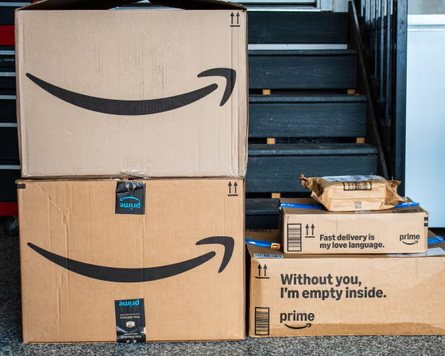
Many see Amazon as evil, I get it, but it’s also a blessing for those of us who can’t always get to the shops – and often don’t find what we want when we’re there. The option to type more or less any item into a search box, check its reviews, compare its prices and have it delivered to your door within 24 hours is nigh-on impossible to resist, especially for a non-driver like me.
That’s no excuse for the sheer volume of stuff I buy via Prime, though. It’s partly my fault and partly Prime’s because when I go there to buy, say, a window blind, my eye gets caught by all sorts of other stuff, which is exactly what Amazon hopes will happen. Quirky homewares are my soft spot, but I’m also helpless in the face of new books with great covers.
Before starting my anti-consumption month, I assessed my Amazon purchase history. You can do this by going to your account page, clicking Buy Again, then setting the “Sort by” filter to “Purchase date” to see all your buys starting with the most recent. My January list made for alarming reading, especially given that it came immediately after Christmas: I’d accumulated £50 of canvases for art, a £70 hammer drill, two £25 photo albums, £40 of skincare products, £30 of dietary supplements and a £40 compost bin. That’s £280 of stuff that I’ve barely used since.
I didn’t unsubscribe from Prime for March, or even completely avoid it; I just didn’t buy from it. I added a few bits to my shopping basket and clicked “Save for later”, so they were still potential buys. However, their appeal faded, so “Save for later” soon turned into “Save for never”.
Difficulty level: 3/10
How much it saved me in a month: £280
Stuff I resisted buying: walking treadmill, roller blind, sequin fringe trim for lampshade, two packs of Oddsocks, jute mat for the garden, plus my usual Amazon impulse tally of books and skincare
Switch back to cash
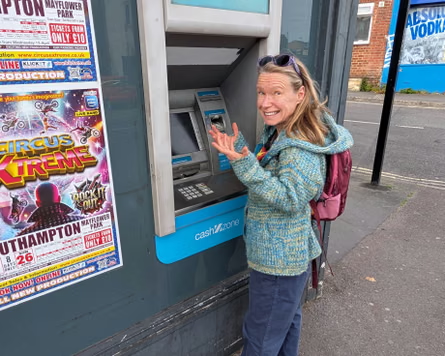
Cash stuffing, which sounds like something a hen party stripper should do with his tips, combines two things I grew up doing: getting a set amount of pocket money, and paying in cash. It’s touted as a way to dramatically reduce your spending, but could it help me accumulate less stuff?
It works because it’s really hard to do these days. Many retailers stopped accepting cash during Covid, and the habit stuck. Meanwhile, as mobile wallets replaced bank cards, we went from a cashless to a cardless society. At first, I couldn’t even find my bank card to get some cash out.
I gave myself a weekly cash allowance of £250 to cover food, socialising and other expenses. I was constantly nervous about having the cash in my bag and about using it in shops. This is absurd, given that I spent the first 30 years of my life paying with notes and coins.
I embarrass easily, and just the thought of me (4ft 10in, 54 years old) standing at the Primark checkout fumbling with coins amid a crowd of gen-Z girls was excruciating. I tried Marks & Spencer instead, and found it entirely painless to pay for running socks and bra tops with a fistful of fivers. A few independent stores, including my local pharmacist, were actively grateful to be paid in cash.
Supermarket shopping was trickier. As a non-driver, I frequent the smaller urban stores that now rely heavily on self-checkouts, and they don’t take cash. I use them most days, habitually nipping into Lidl for fresh fruit after my morning run and using my phone to pay. For this challenge, I had to queue (and queue) at the single staffed checkout, make small talk with the cashier and fumble with coins. It was a surprisingly difficult behaviour change: my Lidl habit dropped from five days a week to one and wreaked havoc with my five-a-day efforts. In better news for my health, if not for my popularity, my local pub is now cashless, so I couldn’t get a round in.
Difficulty level: 6/10-10/10, depending on the shop
How much it saved me in a month: potentially hundreds, but I failed after two weeks; at least £200 saved
Stuff I resisted buying: anything from Primark or Boots, M&S jeans that weren’t within the allowance, beer at the pub, fruit and veg

A tumble dryer, an inflatable kayak, three large boxes of camera accessories, eight saucepans, three half-painted lampshades, three duvets, six pillows, two cat beds, two cat water fountains and 12 pairs of boots. Not an 80s gameshow prize, but just some of the things my two-up-two-down house was hiding within its tat mountain before I attacked it. It was hard work, but ultimately a powerful way to stop adding to it.
“Sometimes, all it takes is a fresh look at your existing collection,” says the Sustainable Stylist Roberta Lee. After reacquainting herself with the things she already owned, Lee ended up buying no new fashion or beauty items for two years, and has “never felt better”.
Extending this strategy to my whole home was a scary prospect. It would not only take ages and create a huge mess, but also lay bare the scale of my impulse buying. All those trousers I’d never got round to altering, and power tools I’d bought the exact same model of twice or three times because I’d mislaid them somewhere … did I really want to face the waste I’d created?
I began, following Lee’s lead, with a good sort through my clothes drawers, many of which had become so crammed that I’d stopped using them. I unearthed gig T-shirts I’d forgotten I had, shirts I’d not seen in years, and M&S jeans identical to a pair I’d been eyeing up during my cash visit – because I’d forgotten I already had them. I started wearing them immediately.
Alan, my husband, and I then began by clearing the loft of all the cardboard boxes and plastic packaging (not least from testing mattresses) that we’d kept “just in case it might be useful” (it never is). It was dirty, dusty work that involved several trips to the dump in our tiny car. However, once we’d broken through the surface and into the boxes of books, CDs, clothes and camera kit, the free space and sense of accomplishment were a genuine thrill.
We were ruthless about sorting stuff into piles for the charity shop, the dump, selling online and keeping. The “keep” pile included picture frames we filled with photos, DVDs of films we lined up to watch, and vases that needed a quick clean and are now full of flowers from the garden.
Difficulty level: 9/10, but rewarding beyond the space it frees up
How much it saved me in a month: £150 or more, partly on clothes and tools I didn’t need to re-buy, but also by reducing the impulse to buy
Stuff I resisted buying: M&S jeans, home accessories, paintbrushes; and it turns out I never need to buy a single camera accessory or walking boot ever again
For more, read how to have a guilt-free wardrobe clearout
Unsubscribe from retailers’ newsletters

Late last year I bought six near-identical playsuits from Turtledove London because they’d emailed me a link to a last-minute outlet sale while I was bored at work. All the tricks worked on me: the sense of urgency, the flattery of being included in a special club, the boredom relief. All the playsuits are far too long for me, and heaven knows when I’ll get round to taking them up, but they were cheap, so it was a good buy, right?
Unsubscribing from the acquisitional catnip of retailers’ newsletters is one of the tips in Martin Lewis’s MSE Demotivator. I can confirm it really works because I cancelled a load of newsletters in a fit of self-care about a year ago, and it dramatically curbed my inbox-based boredom buying. But then, like the mafia in The Godfather, they pulled me back in. As Christmas approached, I signed up to several mailing lists using a different email address to save a few quid in “new member” discounts.
I cancelled them all again for this test, and can’t say I’ve missed them. Supermarket emails bearing special £20-off offers generally require a minimum spend, and email discounts for clothes, beauty products and electronics are rarely exclusive to the email. They’re just a way to get you to visit the store. Stop reading them, and get back to work.
Difficulty level: 1/10, it takes seconds
How much it saved me in a month: they could easily have had £100 from me
Stuff it saved me from buying: premium cat food, boys’ pyjamas, craft beer that costs five times as much as the delicious wine we’ve already got plenty of
Buy secondhand
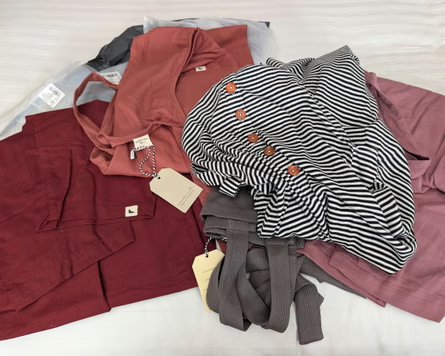
Secondhand stuff is still stuff, and my main motivation in this adventure is to acquire less of it. Buying preloved rather than new is significantly less wasteful on a global scale, though, and unless you spend a lot of time in charity shops, there’s less risk of it being an impulse buy because I’ve always found it time-consuming.
I began by looking on eBay and Vinted for things I’ve recently bought new. The search was much quicker and easier than anticipated. It took me two minutes on eBay to find an excellent-condition Bosch hammer drill (“used twice”) in its box for £17.99 with free delivery. I’d just spent £70 on one of those from Amazon. A set of artists’ canvases, still in plastic, was going for £2.70 or nearest offer. I’d just bought a similar set for £30.
Next time I felt an impulse buy coming along, I converted it into a secondhand find. On Vinted, I found vitamin A serum recommended by Sali Hughes, Medik8 Crystal Retinal, for £8 – £37 cheaper than its price on Amazon at the time of writing. Vinted is a goldmine of new clothes and homewares, many of whose sellers will have bought them on impulse, just like me. Maybe I should follow their lead. Anyone want six Turtledove playsuits?
Difficulty level: 5/10, some searching and risk is required
How much it saved me in a month: I could have saved £90 on February’s buys
Stuff it saved me from buying: brand new vitamin A serum, SPF facial mist
Don’t get the Filter delivered to your inbox? Sign up here
Jane Hoskyn is a journalist who’s spent more than 30 years writing about, and often failing to resist, the consumer temptations of the internet. She wrote the first edition of eBay for Dummies, covered Amazon’s growth from bookstore to global power, and has reviewed everything from smartwatches to solar panels. She would always rather be at home