

惯性聚合 高效追踪和阅读你感兴趣的博客、新闻、科技资讯
阅读原文 在惯性聚合中打开

推荐订阅源

T
The Exploit Database - CXSecurity.com
C
Cyber Attacks, Cyber Crime and Cyber Security
Forbes - Security
Forbes - Security
The Last Watchdog
The Last Watchdog
F
Full Disclosure
GbyAI
GbyAI
G
Google Developers Blog
Security Archives - TechRepublic
阮一峰的网络日志
阮一峰的网络日志
T
The Blog of Author Tim Ferriss
C
Check Point Blog
S
Security @ Cisco Blogs
H
Help Net Security
N
News | PayPal Newsroom
D
DataBreaches.Net
L
LINUX DO - 最新话题
cs.AI updates on arXiv.org
U
Unit 42
WordPress大学
WordPress大学
月光博客
月光博客
Security Latest
Security Latest
V
V2EX
Schneier on Security
美团技术团队
Y
Y Combinator Blog
G
GRAHAM CLULEY
K
KPMG report finds enterprise disconnect between AI and its ROI | CIO
S
Securelist
The Cloudflare Blog
Engineering at Meta
Engineering at Meta
P
Proofpoint News Feed
O
OpenAI News
Cisco Talos Blog
Cisco Talos Blog
Martin Fowler
Martin Fowler
N
News and Events Feed by Topic
小众软件
小众软件
S
Schneier on Security
Webroot Blog
Webroot Blog
freeCodeCamp Programming Tutorials: Python, JavaScript, Git & More
V
Visual Studio Blog
T
Threatpost
钛媒体:引领未来商业与生活新知
钛媒体:引领未来商业与生活新知
Scott Helme
Scott Helme
N
Netflix TechBlog - Medium
有赞技术团队
有赞技术团队
W
WeLiveSecurity
S
SegmentFault 最新的问题
Cloudbric
Cloudbric
奇客Solidot–传递最新科技情报
奇客Solidot–传递最新科技情报
M
MIT News - Artificial intelligence

The Guardian

Rory McIlroy surges into six-shot Masters lead with stunning second-round flourish ‘That’ll be the end’: actor Sam Neill joins fight to stop controversial goldmine near his New Zealand vineyard Roberto De Zerbi targets ‘Ange-ball’ revival to save Spurs from relegation Bath hit back to reach semi-final after stunning Northampton in 11-try epic Secret Garden to Outcome: the week in rave reviews Zebras, wealth and power: Hungary’s election tests Orbán’s grip on power ‘TikTok effect’ brings sellout crowds and younger fans to Grand National meeting The war over Omagh’s gold: the £21bn mine plan tearing a community apart Britain’s shadow workforce is paid as little as 65p an hour. Who cares for the carers? From You, Me & Tuscany to Euphoria: your complete entertainment guide to the week ahead Six great reads: the man who let snakes bite him, masked heavy metal and the brutal reality for foreign students in the UK American Classic review – I defy you not to fall in love with Kevin Kline and Laura Linney’s tender comedy Cuba’s doctors were a lifeline for the world. Now the Caribbean is shamefully complicit in the US drive to expel them An environmental disaster in Moldova has Russia’s fingerprints all over it RMIT drops misconduct case against student who accused university of being ‘complicit in Gaza genocide’ Ichiro Suzuki statue unveiling goes awry as bronze bat snaps during ceremony Survivors of Epstein’s abuse accuse Melania Trump of ‘shifting burden’ on to victims European football: Real Madrid held at home by Girona to extend winless run Arne Slot insists he is ‘aligned’ with Liverpool board and fans as squad is rebuilt Kamala Harris ‘thinking about’ running for president again in 2028 JD Vance warns Iran against trying to ‘play’ the US in peace talks West Ham double up twice to thrash Wolves and put Spurs in relegation zone Trump administration releases new renderings of so-called ‘Arc de Trump’ Crispin Odey drops £79m libel claim against FT over sexual misconduct allegations Bafta apologises for events surrounding John Davidson’s Tourette’s outburst Cocktail of the week: Bar Shrimp’s la rosita – recipe New drug may extend survival in aggressive ovarian cancer, trial shows One dead and 27 injured after bus with British passengers crashes in Canary Islands Pope adds to Smith’s mass of Surrey runs with England woes a world away OpenAI CEO Sam Altman’s home targeted with molotov cocktail Reform UK local election candidate was twice disciplined by Tories over ‘racist comments’ Remaining in Nato is in best interests of US, says Keir Starmer Prince Harry sued for defamation by charity he co-founded Anthropic’s new AI tool has implications for us all – whether we can use it or not Concerns raised about motorbike tourist trail after death of British teenager in Vietnam The Guardian view on Trump’s civilisational threats: the words that fuel war must be condemned The Guardian view on dystopias for our times: the American nightmare Doctors’ leader claims new reduced pay offer killed chances of ending strikes in England Netanyahu-ism has achieved nothing for Israelis – and come at a monstrously high price Deborah Levy: ‘CS Lewis’s White Witch terrified me – but I wanted to meet her’ How I Shop with Michelle Ogundehin: ‘We grownups have enough stuff already’ Trump’s war and Melania’s Epstein statement, with US editor Betsy Reed – The Latest We have to stop killer motorists on Britain’s roads UK starts crackdown on EU citizens’ post-Brexit rights Londoners aren’t unfriendly – but don’t compare us to New Yorkers The religious right and the perversion of faith Artemis II images reignite moon mission memories Orbán and Magyar trade accusations in last days of Hungary election campaign Reckonwrong: How Long Has It Been? review | Safi Bugel's experimental album of the month Martin Rowson on Middle East peace talks – cartoon Masters magic, the Grand National and Premier League drama – follow with us Fears of UK and EU flight cancellations as airports warn of jet fuel shortages Reform’s petulance over slavery reparations shows it just doesn’t grasp Britain’s place in the modern world Peers vote to ban pornography depicting sex acts between stepfamily members Starbucks’s retail arm gets £13.7m tax credit even as sales increase Flyby review – interstellar musical is a voyage of epic strangeness Grand National preview: Jagwar can deny Irish cohort in Aintree classic Week in wildlife: an ostrich on the lam, a tortoise crossing a road and surfing seals Anger as swifts’ nesting holes in Derbyshire rail viaduct ‘blocked up’ Peter Mandelson faces fixed-penalty notice for urinating in public ‘There’s no shortage of terrifying technology’: how AI became TV drama’s new go-to villain ‘Fresher than anything in a shop’: the best recipe boxes and meal kits for time-poor foodies, tested Who was Hilma? Af Klint exhibition to highlight exclusion of women from abstract art Critics assemble! Here’s my list of the greatest superhero movies of all time US inflation soars in March as war on Iran drives economy into uncertainty Amazon to finally launch Leo satellite internet in ‘mid-2026’, says CEO Grand National 2026: horse-by-horse guide to all the runners Pete Hegseth’s holy war: the militant Christian theology animating the US attack on Iran Add to playlist: the beautifully dazed, countrified indie-rock of Tracey Nelson and the week’s best new tracks Not just about Gaza: the Muslim voters turning from Labour to the Greens ‘I’m worried there’s too much of me,’ says a birch: inside the interspecies council giving nature a voice Why is anyone surprised by the US and Israel’s latest war? It’s only what the world allowed them to do in Gaza Tori Amos review – fans hang on every note of this dramatic deep dive into her back catalogue Coachella 2026: Justin Bieber launches a major comeback in the desert Super Mario what?! The seven best obscure Mario games ‘An abomination’: the Lancashire town kicking up a stink over reopened landfill Pillion to Roofman: the seven best films to watch on TV this week Holly Humberstone: Cruel World review – Taylor Swift fave trades gothic melancholy for pop glow-up Thrash review – cursed shark thriller sinks like a stone on Netflix Gulf states rethink security in light of US-Israel war on Iran Go Gentle by Maria Semple review – a joyfully clever New York romcom Welcome to Y’all Street: bullish Dallas aims to steal New York’s financial crown Margo’s Got Money Troubles to Beef: the seven best shows to stream this week I baulked at the idea of ‘friction-maxxing’. But there’s more to it than meets the eye Reich: The Sextets album review – Colin Currie celebrates the minimalist master’s joy of six Benjamina Ebuehi’s sweet and salty chocolate chip cookies recipe Experience: my house was taken over by 70,000 bees Malcolm in the Middle: Life’s Still Unfair review – the TV magic they’ve created here is absolutely miraculous Lava bursts forth as Hawaii’s Kilauea volcano erupts Sonos review: Are these the best portable speakers that money can buy? I tested to find out Buy bread in the evening, hit the sales on a Tuesday: retail workers’ top tips to cut your shopping bill The best water flossers in the UK, tested for that dentist-clean feeling Where to start with: Muriel Spark You be the judge: should my girlfriend stop mixing gold and silver jewellery? The best carry-on luggage in the UK, tested on an assault course How games capture the awe and terror of cosmic isolation I never text back – and it’s ruining my relationships The pet I’ll never forget: Beau, the labrador who saved my life Life Is Strange: Reunion review – a decade-long story comes to an impassioned close Why is gaming becoming so expensive? The answer is found in AI
Initiation stones, buried recordings, and Ringo Starr’s drumkit: inside the visionary world of reggae master Lee ‘Scratch’ Perry
https://www.theguardian.com/profile/lanre-bakare · 2026-06-26 · via The Guardian

David Katz’s introduction to the world of Lee “Scratch” Perry was bewildering. The Jamaican producer had been living in London for several years, and Katz, a Jewish reggae historian who had fallen in love with the music as a teenager in San Francisco, had moved to the UK capital in 1987 and wanted to interview the notoriously evasive artist.

Katz tracked him down to a recording studio in Rotherhithe, just over the river in south London. Perry welcomed him before insisting he present him with “13 stones from your country” with no further explanation. When Katz informed him he could hardly just pop back to the west coast, Perry told him to “go down to the River Thames and get me 13 stones!”.

When he returned, Perry counted the rocks then walked over to a TV monitor. “He unscrews the monitor, puts the stones inside, screws it together, and goes back to work,” says Katz. He then spent a few hours with Perry, which involved attempting to mic up an alsatian dog.

The whole thing seemed to be a hazing of Katz – who would later work with Perry on his biography – and an initiation into the production pioneer’s eccentric, inscrutable and utterly unique approach to making music.

As bizarre as Perry’s methods were, they bore spectacular results. Before moving to London, he helped Bob Marley and the Wailers shape their sound on Soul Rebel and Soul Revolution (before a violent bust up over royalties). He produced Super Ape, arguably the most important dub record of all time, and through his own Black Ark studio came up with almost a decade’s worth of peerless roots reggae.

His productions, which featured samples of crying babies, sub-bass low enough to crack a rib and an often overlooked penchant for a beautiful melody, attracted artists from beyond Jamaica who wanted his counsel. The Beastie Boys sought him out, as did the Clash and Keith Richards, while it is said that John Lydon tracked him down at the Black Ark to rework some of the Sex Pistols’ back catalogue, although Lydon’s representatives told me that story is apocryphal.

Five years after his death, as fans try to unpick the lies from the lore, a much-needed reappraisal of reggae’s great eccentric is taking place. Katz’s new book, Dub Revolution, explores the genre through its practitioners such as Perry, and is part of a wave of activity. This year has seen a spate of reissues featuring classic productions, including the Congos’ sensual spiritual, Ark of the Covenant. Another book – illustrated doorstopper Lee “Scratch” Perry: Black Ark – unveils the secrets of Perry’s famed studio; and there’s his “final” album, a collaboration with German electro outfit Mouse on Mars recorded two years before his death.
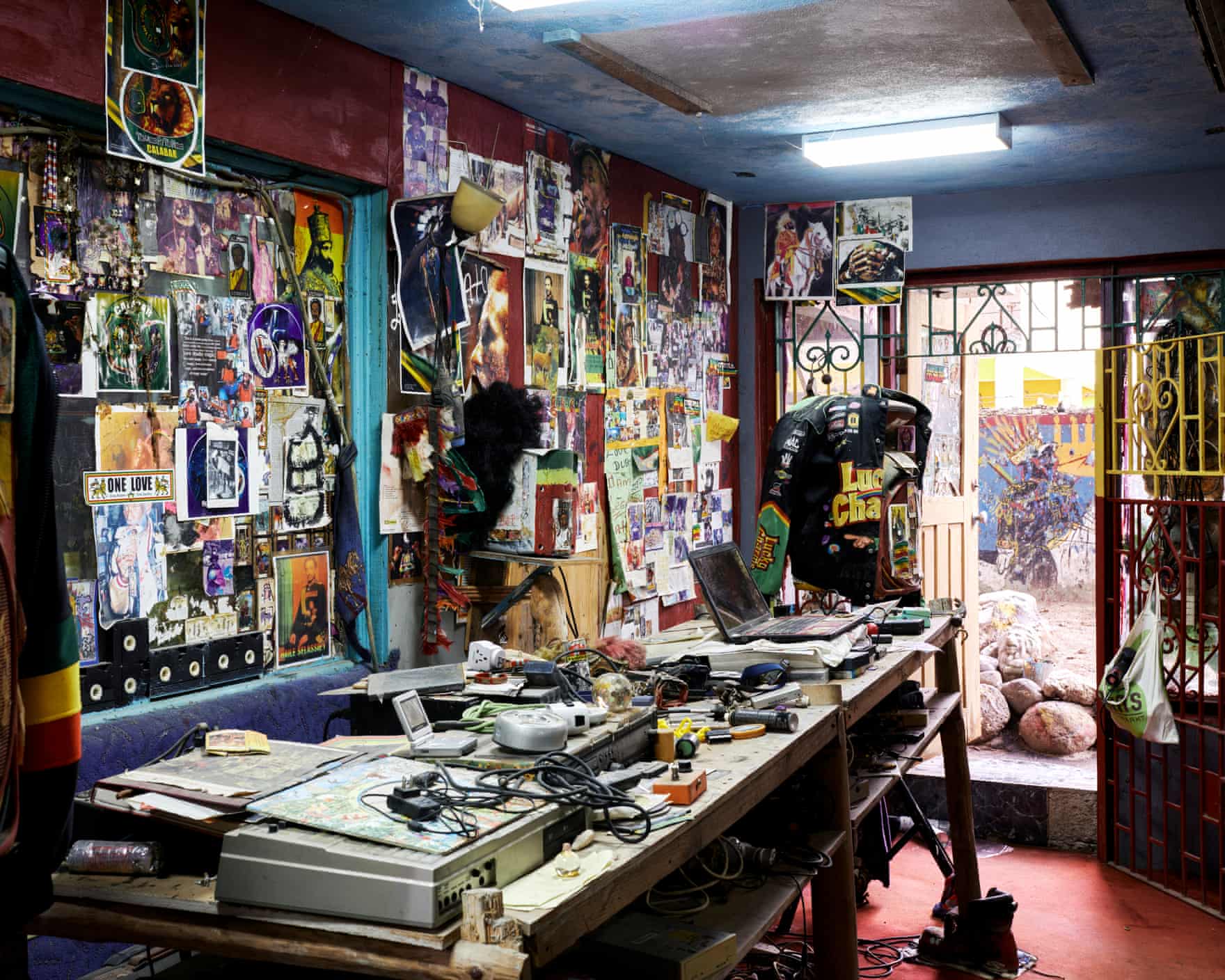
Hugely cluttered interior of Lee Scratch Perry’s studio, as seen in the new book Black Ark
Holy smoke … the interior of Perry’s studio, as seen in the book Black Ark: Lee ‘Scratch’ Perry. Photograph: Edition Patrick Frey/Visual Estate of Lee ‘Scratch’ Perry

Perhaps part of the reason for this burst of activity is a desire to truly grasp Perry, an artist who is seen by many in Europe as reggae’s court jester. Towards the end of his life he was often draped in fluorescent clothes, sported dyed red hair and beard, spoke in riddles, and declared himself a “madman”. A lack of quality control during his last decade didn’t help.

There was also his tendency to turn interviews into farce. Krishnan Guru-Murthy famously tried to interview him in 2009. I say try, because he might as well have been talking to a cloud of smoke. Perry delivered his answers in rhyming couplets while intermittently sticking his tongue out, saying things like: “I kill the devil brain, so that the devil can’t reign.” Jools Holland once asked Perry why he’d placed a toaster on top of a breeze block wall in his Jamaican compound. “It means that I’m a toaster,” he replied, deadpan. (Presumably he was referring to “toasting”, or emceeing, but he seemed to enjoy implying that he believed he was a small electrical appliance.)

Adrian Sherwood, his longtime collaborator and friend, says Perry revelled in a good wind-up. The pair once sat next to each other at a screening of Volker Schaner’s 2015 documentary, which followed Perry’s exploits over 15 years. Whenever he was shown baffling an interviewer during the film, Perry would turn to his friend. “He kept elbowing me in the ribs and laughing,” says Sherwood, who believes Perry “always loved mischief”.

Katz tells me that if you want to understand Perry, you need to go back to Jamaica. Born in 1936, Rainford Hugh Perry grew up in Kendal in the north-western parish of Hanover. His father was a dance champion and manual labourer, while his mother practised obeah, a form of west African spiritual healing and “magic” that was outlawed by British colonists in the 16th century and is still illegal today (Perry’s first hit with Marley, Duppy Conqueror, satirised attitudes towards the practice).

Katz’s “stone initiation” on the Thames can be traced back to Perry’s belief in obeah, which he thought provided guidance throughout his life. After working in a quarry as a young man, he claimed that the sound of clashing stones directed him to Kingston (“I go up to King Stone”) where he ended up working for Studio One’s Coxsone Dodd as an A&R and handyman. He discovered the Maytals, worked with a young Delroy Wilson and had hits of his own, such as Chicken Scratch, which gave him his nickname.

skip past newsletter promotion
A colourfully dressed, ageing Lee ‘Scratch’ Perry on stage in Chicago, 2015.
‘I’m a toaster’ … Lee ‘Scratch’ Perry on stage in Chicago, 2015. Photograph: Daniel Boczarski/Redferns

But it was in his studio, the Black Ark, where Perry’s legend grew. Completed in 1973 on the grounds of his house in Kingston’s Washington Gardens, it boasted a rudimentary setup and was attached to an annexe and recording booth. The original mixing desk was bought for £35 in London, the drum kit was reportedly once owned by Ringo Starr, while tracks were assembled on an inexpensive four-track Teac 3340. A Roland Space Echo delay showered Perry’s productions in cascading reverb. What he lacked in cutting-edge gear he made up for in theatrics and ceremony: he blew weed smoke into the desk; poured whisky and urine on some of the equipment; and buried recordings in the garden. Compared with other Jamaican studios, Perry’s was underpowered but his skill meant nothing that came out of his production house was puny.

The artist Edward George, who has demystified the world of reggae via his Strangeness of Dub radio series, says the technical brilliance of Perry is only one dimension of his – and the Black Ark’s – greatness. It was also part community centre, part spiritual sanctuary. “The idea of the Ark was that it would be something through which black people, Jamaicans in particular, could be saved and rescued through music,” says George.

Rastafarians were always welcome at the Ark and the politics of black empowerment flowed through his output. “On the one hand, it was a production house, but it also had this kind of metaphysical cultural and political aspect to it,” says George.

The open-door policy at the Black Ark made it a chaotic space, open to abuse by hangers on and grifters who posed as devout Rastas. Perry initially closed the space to outsiders in 1978. Then there was a botched redesign – which culminated in him throwing some of the faulty equipment into a septic tank. In 1982, after he set a fire to “cleanse” the space, he burned down the control room. Perry maintained he did it intentionally; family members who were present said it was an accident. Either way, the episode brought a tragic end to one of the world’s most important recording studios.

Books, records, videos and equipment beneath paving flags, possibly at Black Ark in Jamaica
A treasury … Books, records, videos and equipment, some of which Scratch would bury at Black Ark and his other addresses. Photograph: Edition Patrick Frey/Visual Estate of Lee ‘Scratch’ Perry

Despite the classic records made at the Black Ark such as Super Ape and Heart of the Congos, some Scratchheads swear that his earlier era as a gun for hire moving between studios was his best. My favourite version of Perry is him as the Black Ark producer, or the “Black Emperor” as one recent compilation cast him, sprinkling his genius on other people’s songs. Listen to Junior Delgado’s Sons of Slave, a thunderous roots anthem, or his ode to Rasta, Don’t Blame It on I by the Congos, then stick on Leo Graham’s Doctor Demand, where a simple keyboard line and a wah-wah effect on a guitar provide a sparse backdrop. They’re sonic opposites, but all are imbued with Perry’s magic, his own aural obeah.

Sherwood argues that Perry’s antics often mask his genius. “What upset me in later years was people marvelling at him as some kind of joke,” says Sherwood. People saw a clown, when they should have seen someone who re-engineered music. From reimagining the studio as an instrument, pushing dub reggae to the sonic limits or inventing sampling, few producers have come anywhere close to matching Perry’s impact.

“When you listen to those records, what he achieved, it’s astounding,” adds Katz. “He had a very unorthodox way of working and a very unusual approach to life. But the circus stuff? That’s a diversion: the genius is in the music.”

When Mouse on Mars played their album live at Barbican Centre’s Pit theatre earlier this month, there was a single chair that faced away from the band. On it was a miniature shrine to Perry, made up of a “We Love Bob Marley” mug, an empty bottle of Wray & Nephew rum, some apples and a candle. The group’s vocalist, Louis Chude-Sokei, had visited the site of the Black Ark to take field recordings, which played over the rootsy bass, drums and electronics.

As Chude-Sokei walked around the audience, Jamaican birdsong could be heard as he repeated the refrain: “This is a testament.” It felt like a fitting one to Lee “Scratch” Perry: the reggae innovator, the mischief maker, dub’s Black Emperor.

Black Ark: Lee ‘Scratch’ Perry is out now (Edition Patrick Frey); Dub Revolution by David Katz is published on 2 July (White Rabbit); Lee ‘Scratch’ Perry and Mouse on Mars’s album Spatial, No Problem is out now on Domino Recordings.