Cabinet Office officials delayed telling Starmer about Ma...
Andrew Sparr·2026-04-23·via The Guardian
From
Little says she delayed telling PM about Mandelson vetting recommendation because she wanted legal advice first
Little said she saw the UKSV report on Mandelson on 25 March.
She said she dicussed it with the cabinet secretary, Antonia Romeo, shortly afterwards. But they did not tell the PM until 14 April.
Asked why it took so long to inform him, she replied:
I immediately sought legal … advice, because this is such an unusual thing for a government official to do, to handle that sort of security information.
I believe I have a responsibility to handle that sensitive information within the framework of both the law and the guidance that I’m subject to, and I did not feel that I could share that information until I understood the consequences and the authority that I had.
Q: Do you think it is right that the PM was kept in the dark about the UKSV recommendations? Has he been properly served by the civil service code of conduct?
Little said that was not for her to “opine on”. She said the PM had set out his views.
Thornberry asked about reports covering whether or not Keir Starmer asked Robbins to explain why he had withheld information about the UKSV recommendations when he sacked him.
Lo and behold, a source close to Robbins tells the Indy’s David Maddox that the prime minister, while sacking the mandarin on the phone, did not ask Robbins for an explanation on why he didn’t share the vetting conclusions with him. The PM told MPs in the Commons on Monday he had asked Robbins for an explanation and that he didn’t accept it.
No. 10 was insisting last night the assertion from Robbins’ allies is misleading, because the PM’s office asked Robbins to provide an account of what happened before Starmer phoned him. But a senior government official was not willing to confirm Robbins had actually provided that account to Downing Street before the call took place … which means they are not denying the possibility Starmer sacked Robbins before he had explained his actions.
Thornberry asked if there would be a record of this.
Little said information about the PM’s decision making process on this would not be withing the scope of the humble address.
Asked if she thought there would be a record of the meeting where Robbins and the Foreign Office head of security agreed that Mandelson’s vetting should be approved, Little replied:
Civil servants are great administrators. We are famous for our record keeping, and the civil service code requires us, to take accurate notes, and to handle information within the legal framework.
Abtisam Mohamed (Lab) asked Little if she had ever seen a UKSV form (of the kind published by No 10 last week) before this process.
No, Little replied.
Q: And is it fair to say most senior civil servants never see these forms?
Little said that was correct.
Alex Ballinger (Lab) said there were two leaks relating to the vetting recommendations: one to the Independent in September, and then the Guardian leak, published last week. He asked who would have had access to this sort of information.
Little said there were four stages of the appointment process that were relevant: the due diligence scrutiny conducted by the propriety and ethics team in the Cabinet Office; the conflict of interest checks carried out by the Foreign Office; the UKSV process; and vetting for top secret STRAP intelligence access.
Little says she delayed telling PM about Mandelson vetting recommendation because she wanted legal advice first
Little said she saw the UKSV report on Mandelson on 25 March.
She said she dicussed it with the cabinet secretary, Antonia Romeo, shortly afterwards. But they did not tell the PM until 14 April.
Asked why it took so long to inform him, she replied:
I immediately sought legal … advice, because this is such an unusual thing for a government official to do, to handle that sort of security information.
I believe I have a responsibility to handle that sensitive information within the framework of both the law and the guidance that I’m subject to, and I did not feel that I could share that information until I understood the consequences and the authority that I had.
Asked to confirm that, on Mandleson’s form, the red boxes were ticked, Little said she would not comment on confidential information in a UKSV report.
Whittingdale asked how it could be possible for the Foreign Office to have the 10-page UKSV summary report on Mandelson, including the form with the tick in the red box saying clearance should be denied, but Robbins to say he was not aware of that.
Little said the Foreign Office had the document. She said she could not comment on what was or was not shown to Robbins.
Little says due process was followed in Mandelson vetting process
John Whittingdale (Con) said Simon Case, the former cabinet secretary, said the vetting should be carried out before the appointment was announced. Olly Robbins said he thought the same. Is that the Cabinet Office view?
Little said the due process was followed.
(This backs up Keir Starmer’s claim to MPs, that “due process” was followed.)
Q: But the appointment was announced before the vetting had been carried out. Does the Cabinet Office support that?
Little sidestepped the question, saying she only became involved when implementing the humble address.
She said issues about when vetting was carried out would be looked at by Adrian Fulford in his review.
Little says Robbins refused to give her access to Mandelson's vetting report
Little says in March she had a meeting when she asked to see the Foreign Office’s documentation about the decision to grant Mandelson vetting. She said she was asking because this was documentation covered by the humble address. She said was told that “that information would not be forthcoming”.
In the middle of March, I have a meeting with Sir Olly and a senior member of his team, and this is after the point that I’ve been told that this summary document exists.
I specifically ask to see this document and any decision-making audit trail around those judgments at the time. It was made clear to me that that information would not be forthcoming.
Asked who was not forthcoming, Little replied: “Sir Olly.”
Little said at that point she decided to request the document directly from UKSV.
I took the very unusual judgment that I should directly request the information from UK Security Vetting.
And I did that because I go back to my responsibilities, to discharge the humble address, which is a responsibility that is unique to me and I take very seriously.
I felt that I needed to see some relevant documentation so that I could advise the prime minister as to whether we had fully complied and gathered the information that it’s available and within scope.
Q: Why did Robbins refuse?
Little said Robbins covered some of that in his evidence. She said she cannot talk about his decisions. “I can only talk about my judgments and decisions.”
Thornberry said that, in his evidence, Robbins said he tried to get access to that file, but was told he could not see it without a national security reason.
Little said she could not find an audit trail for that request.
Little said that in September last year, just after Mandelson was sacked, the Foreign Office requested to see his vetting file. She said she did not know exactly who saw that document.
Little said UKSV produces a report after the DV process with two recommendations.
One sets out the level of concern and the other sets out the overall recommendation on whether to grant developed vetting that is non-binding.
It is meant to be helpful information for the ultimate decision maker, in this case, the Foreign Office, to make a final decision.
She says the summary report from UKSV on Mandelson ran to about 10 pages.
Little dismisses Olly Robbins' claim that it was Cabinet Office that suggested Mandelson did not need vetting
Emily Thornberry, the committee chair, starts the questioning.
Q: What can you say about the vetting process for Mandelson?
Little says she does not have records of verbal meetings.
But she has seen an email trail.
She says there was an email dicussion about the process which she has seen.
She says the Foreign Office got in touch the UKSV and the Cabinet Office to see if Mandelson needed developed vetting (DV).
Because the presumption had been that, given Peter Mandelson had been a member of the House of Lords, that the long standing convention that he didn’t require develop vetting was assumed, and they wanted to get proper policy advice from experts on whether that was the case …
Ishould say it is unusual, although not unprecedented, for a political appointee to take up post as an ambassador.
What I can see is there is a senior official from the Government Security Group that goes back to the Foreign Office security team and advises two things. One, that this is a decision for the Foreign Office, and two, that they would advise developed vetting is sought.
This contradicts a suggestion made by Olly Robbins in his evidence on Tuesday. Robbins said he thought the Cabinet Office had asked if vetting was really necessary. Darren Jones, the chief secretary to the PM, told MPs on Tuesday afternoon that that was wrong, and that in fact it was the Foreign Office that asked if vetting was really needed.
Cat Little, head of Cabinet Office, gives evidence to foreign affairs committee
Cat Little is giving evidence now.
She says she has two key relevant responsibilities.
She is the official responsible for the government’s response to the humble address relating to the disclosure of the Mandleson documents.
And she is permanent secretary of the Cabinet Office, which means she is responsible for services provided to other departments, including UK Security Vetting.
But she was not involved in the decision to appoint Peter Mandelson as ambassador to the US.
And the sanctity of vetting is essential for national security. She says, although overseeing UKSV, she has nothing to do with its day-to-day operations.
Cat Little will only be able to say 'exactly what she's been told to say by ministers', former civil servant leader says
Helen MacNamara, the former deputy cabinet secretary, was on the Today programme this morning talking about the Cat Little hearing. MacNamara, who is best known to the public for standing up to Dominic Cummings, and for her evidence to the Covid inquiry about this, said there would be a limit to what Little could say. Addressing the presenter, she explained:
You said in your introduction there that Cat Little was going to give an account supporting the prime minister. That is literally her job. Cat can’t sit before the committee and say what she thinks or what her own personal opinion is. Her little job is to sit there and say exactly what she’s been told to say by her ministers.
MacNamara said the head of the Cabinet Office should not be giving evidence to the foreign affairs committee anyway.
The foreign affairs select committee is not the select committee that Cat Little, the permanent Secretary of the Cabinet Office, should be going to …
We spent a long time in really turbulent days during Brexit defending the principle that accountability in parliament is proper and that ministers are accountable, and the civil servants who work for them, are accountable for their committees. And this sort of vandalism, where the foreign affairs committee can just call whoever they like in public, [is improper].
Minister claims reports about cabinet divisions over Olly Robbins sacking 'load of guff'
Alex Norris, the border security and asylum minister, was representing the government on the morning news programmes. He was there to promote the new UK-France small boats deal being signed today. Rajeev Syal has the details.
Inevitably, though, Norris was asked about the stories like the one in the Guardian (see 8.45am) about cabinet divisions over the sacking of Olly Robbins. He opted for the outright denial strategy, telling LBC:
No, it’s a load of guff. If I had a pound, certainly under the previous government, for the number of times I saw cabinet stories in the papers, my St George’s pints would probably be more multiple than there will be in reality.
You would expect a junior minister to say something like this; he won’t get points for accuracy, but he will get credit for loyalty, which matters more to No 10.
But it was an odd comparison to make. Under the Tories, there were multiple newspaper stories about cabinet splits. But they were also largely true, which is why the Conservatives got through three prime ministers in the course of the last parliament.
In an interview with Sky News, asked if he expected Keir Starmer to lead the party into the next elecion, Norris replied: “Yes.”
UK undershoots annual borrowing target by £700m
The UK government budget came in below its annual borrowing target by £700m, official figures show – but the Iran war is likely to blow a hole in Rachel Reeves’s carefully calculated fiscal “headroom” over the coming months. Tom Knowles has the story.
Top Cabinet Office official to give evidence to MPs about Peter Mandelson’s vetting
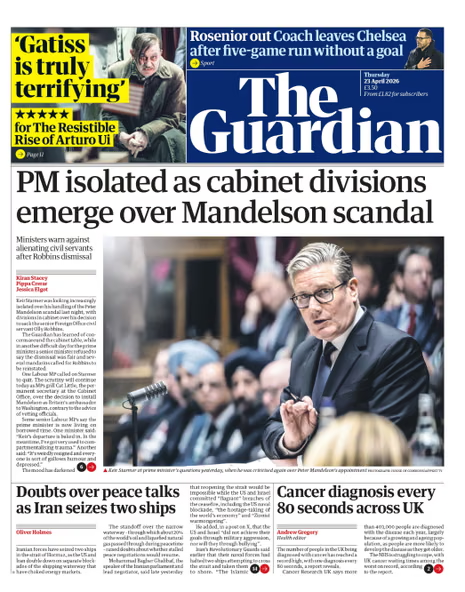
Good morning. As Kiran Stacey, Pippa Crerar and Jessica Elgot report in the Guardian’s splash, “Keir Starmer is looking increasingly isolated over his handling of the Peter Mandelson scandal with divisions emerging in cabinet over his decision to sack the Foreign Office civil servant Olly Robbins.”
Guardian splash Photograph: Guardian
And this morning the saga continues, with Cat Little, permanent secretary at the Cabinet Office, giving evidence to the Commons foreign affairs committee about the Peter Mandelson vetting controversy.
The Little hearing is unlikely to be as revelatory as the Olly Robbins session on Tuesday. But Little is a key figure in this story, for two reasons. First, as head of the Cabinet Office, she is in charge of collecting all the documents relating to Mandelson’s appointment as ambassador to the US, and Mandelson’s communications with ministers and officials, which have to be published as a result of the humble address passed by parliament. It was in this capacity that she discovered the UK Security Vetting (UKSV) document that revealed that the UKSV officials who interviewed Mandelson for his developed vetting (DV) advised that he should not get clearance. At a meeting on Tuesday last week she reported this bombshell news to the PM. Here is the extract from the minute of that meeting released by No 10.
Cat set out that the vetting process involved UKSV in the Cabinet Office producing a vetting file which included a recommendation on whether DV should be granted, which was then passed to the sponsor department, in this case FCDO. As part of the humble address process, that file had been shared with Cat. On reviewing the file she had therefore learned that the recommendation from the vetting officer had been that DV should not be granted to Peter Mandelson. There is some discretion for departments to proceed with clearance and the FCDO had exercised it in this case, granting Mandelson vetting clearance. Cat had not seen the audit trail for this decision so we did not yet know on what basis the decision had been taken, contrary to the recommendation.
Second, UKSV is part of the Cabinet Office, which means she has oversight that entire process.
After Keir Starmer learned about this information, and after it was made public by a Guardian report, he sacked Olly Robbins, the Foreign Office permanent secretary, on the grounds that he should have followed the UKSV advice in relation to Mandelson – or at least flagged up these concerns to No 10. As Robbins explained to the committee on Tuesday, he insists that UKSV can only make a recommendation, that the final decision was one for the Foreign Office and its own security team, and that he was fully entitled to conclude that the risks flagged up by UKSV could be managed.
Little may shed some light on this dispute, although we know whose side she will take. Unlike Robbins, she is still a serving civil servant; she works for the PM. It will be surprising if she says anything that will cause him significant embarrassment.
But these hearings are also interesting for what they tell us about the workings of the British state. The Cabinet Office is at the centre of the UK’s security network, and the DV process is one of the most secretive parts of this system. It will be odd if we don’t learn something.
Here is the agenda for the day.
9.30am: Cat Little, permanent secretary at the Cabinet Office, gives evidence to the foreign affairs committee.
9.30am: The ONS publishes crime figures for England and Wales
Morning:Keir Starmer is on a St George’s Day-related visit in the north-east.
11.30am: Downing Street holds a lobby briefing.
Afternoon: Kemi Badenoch is on a visit in Pembrokeshire, with the Welsh Tory leader, Darren Millar.
Afternoon: Starmer attends a military planning meeting at Northwood headquarters as part of strait of Hormuz coalition process
4.30pm: Lord Hermer, the attorney general, speaks at an Oxford University event alongside the Council of Europe secretary general, Alain Berset.
If you want to contact me, please post a message below the line when comments are open (between 10am and 3pm), or message me on social media. I can’t read all the messages BTL, but if you put “Andrew” in a message aimed at me, I am more likely to see it because I search for posts containing that word.
If you want to flag something up urgently, it is best to use social media. You can reach me on Bluesky at @andrewsparrowgdn.bsky.social. The Guardian has given up posting from its official accounts on X, but individual Guardian journalists are there, I still have my account, and if you message me there at @AndrewSparrow, I will see it and respond if necessary.
I find it very helpful when readers point out mistakes, even minor typos. No error is too small to correct. And I find your questions very interesting too. I can’t promise to reply to them all, but I will try to reply to as many as I can, either BTL or sometimes in the blog.