





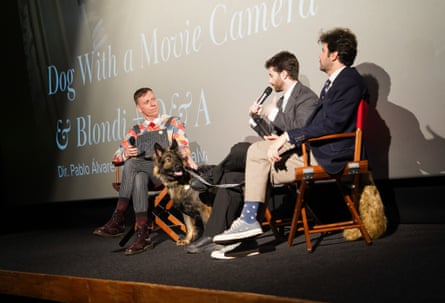
When Pablo Álvarez-Hornia stood up to present Blondi – a new film about the dying days of the Third Reich – at its premiere at a cinema in Brixton earlier this month, he went in big. Picture the scene, he told the audience: it’s 1924 and FW Murnau has just strapped a movie camera to a bicycle and invented subjective cinematic perspective. The result was The Last Laugh which captured the precariousness of life in Germany after the first world war with such poignant precision it foreshadowed the following decade – and revolutionised cinema.
For Blondi, shot 102 years later, the camera was strapped to a dog. Lexie, a seven-month-old German shepherd, is both the title character – Hitler’s last dog, possibly the most famous hound in geopolitics – but is also the director of photography, or cinemadographer if you prefer, as both Álvarez-Hornia (the film’s producer) and Jack Salvadori (its director) certainly do. It makes for a novel cinematic experience. Sometimes you feel a bit sick at the sudden changes of pace and freaky angles. “Some things need to be made uncomfortable,” says Álvarez-Hornia, “and, in a way, it needed to be dirtier and grittier and uglier for it to work.”
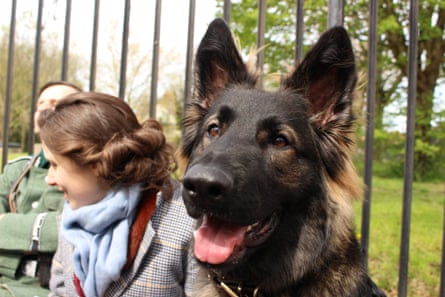
The image throughout is framed by Lexie’s two enthusiastic ears, since the camera is on her back. Salvadori loves most the elements he didn’t expect, “the shakiness, for instance, is something I’d never thought of. And that’s why I really wanted to trust the dog to do this project, because I wanted to see, you know, a completely different creative input.” Originally fromItaly, Salvadori, 29, met Álvarez-Hornia, 27 and from Spain, in Cannes six years ago; both had studied directing in London.
Salvadori has always loved dogs; Álvarez-Hornia is allergic but was “happy to sacrifice a small bit of my health in exchange for making that movie.” The premiere of the short film was accompanied by an even shorter behind-the-scenes documentary, the latter of which was hilarious, part caper, part descent-into-chaos, since even though the canine element is the most experimental, none of the making of this film was what you’d call conventional. They didn’t get any permission to shoot, for one thing, so behind each scene is a crew of guys trying to redress a hotel room or London’s Senate House as a 1940s office of state, without getting busted by security guys. But the film itself is not funny.
From 1941, when she was given to Hitler by the Nazi party secretary Martin Bormann, Blondi was a propaganda tool, trotted out to demonstrate the Führer’s love of animals. She was a signalling and enforcement animal from the days before “emotional support”, whereby German citizens would show their Nazi loyalty by keeping a dog that resembled Blondi, and shop each other to the Gestapo if they were insufficiently alsatian-curious. The day before Hitler’s death in April 1945, Blondi performed her last act of service, eating a cyanide pill to test its potency. Though “performed” is maybe the wrong word since, as Álvarez-Hornia points out, “Blondi in the film is the truly innocent being, she has no conscience, no ideology, no capacity for any moral reckoning whatsoever.” The film covers the last gasps of the Third Reich, as generals deliver bad news, quaking, to Hitler, their obsequiousness does nothing to alter the course of the war and they end up, a skeleton crew, in the bunker.
The script was written by Peter Greenaway, “always one of my cinematic heroes”, Salvadori says, “and while I was working on Blondi, I realised that Greenaway had written a short story about her. I rushed to the library to find it, and it was full of wit and genius.” Greenaway agreed to repurpose it as a script from this simple approach from a fan. Another giant of cinema, the cinematographer Roger Deakins, also lent a hand, advising Salvadori not to work with professionally trained dogs: “just get a real dog that behaves like a real dog.” He was, says Salvadori, “100% right.”
Casting the human roles, the pair were always clear with the actors that they didn’t even know who would actually end up in the film, as that would depend on who Lexie happened to look at. “They didn’t have to think about the camera at all,” says Salvadori, “so it became almost like theatre. They were just acting within themselves.” This caveat – no promise of screen time – narrowed down their pool of actors, but it also changed the mood of the piece, in an apposite way. “All of these generals of Hitler,” Álvarez-Horcnia says, “were chasing the dog for attention, because they knew whoever got the dog’s attention got Hitler’s attention. But they also had to fight the dog for the attention of their boss, so in a way it replicated that deep insecurity.” It also creates that indignity of being the last man standing in a fascist death cult: to erase yourself so totally you’ll abase yourself before an animal, including an evocative scene in which a soldier frantically and covertly fights Blondi for a piece of meat.

“I wanted to be amazed myself,” says Salvadori. “For once, I wanted to be the spectator, not just the film-maker.” Casting the Führer was another challenge, although, he says, “funnily enough, in the UK, everyone wants to play Hitler. It looks quite good on your showreel, I guess, to play the bad guy.” But both he and his producer wanted a German speaker, yet “German actors don’t want to play the Führer. We struggled a lot to find someone who could not just deliver the lines, but really vibe with the dog.” They finally found Nicola Pedrozzi – who doesn’t resemble Hitler but catches that frenetic, needy coldness – halfway up a Swiss mountain.
“Vibing with the dog” is not a throwaway line. The whole film depends on a creature highly responsive to atmosphere. “There are no jokes or pratfalls,” says Salvadori. “The idea that you’re watching something so horrible from this unique perspective was the humour that we were aiming for. But there is nothing to laugh at. They’re down in the bunker, and nobody’s happy, not even the dog. Dogs capture energies.” That the crew hadn’t yet secured permission to shoot in this bunker added to the anxiety and claustrophobia. Pity the dog who could pick up on the grim ennui and the anticlimax of the Nazi defeat, with no clue on earth what it all meant.

The pair’s next film is a full-length feature set in a colonial villa in South America, about “a Nazi exile who lives in complete seclusion, just maids and a dog. Then his daily routine starts to crumble down, and he has to step into the jungle.” That film, says Salvadori, will be shot more conventionally – and less stressfully. “I could not have given up any more control than I did in giving the camera to a dog.”