






I have never driven with more determination than when rushing away from Shelby Park in Nashville. We had reached Davidson Street when my husband shouted: “There! There’s sunlight!” I skidded into a car park of a printing company with barely any time to spare. We jumped out of the car, put on our dark glasses, and looked at the quickly disappearing sun. It was surrounded by clouds, but a tiny sliver of light was still shining. This was 1.27pm on 21 August 2017. We had travelled all the way from London to Tennessee to experience the Great American Eclipse – an astronomical phenomenon I had never seen before.
As an Italian-born astronomer, I had always felt at a bit of a disadvantage. I have a doctorate in astrophysics, focused on collisions between galaxies. I have seen many celestial phenomena – comets, planetary alignments, fireballs, galaxies, northern lights – but not a total solar eclipse.
Moving to the UK in 2007, I heard so many stories about the 1999 total solar eclipse. I hadn’t witnessed it myself, as it was not visible from Italy. Several friends mentioned they had gone to Cornwall or crossed the Channel to France to get a glimpse of this once-in-a-century event. The UK is not going to have another until 23 September 2090. I felt cheated by geographical fate.
For the following 18 years, I chased partial eclipses of the sun, telling myself the difference between 90% cover and totality couldn’t be that great. It turns out the difference is vast.
That morning, in 2017, the sky was crystal clear. We found a hilltop park and perched there, ready for the lunchtime show. We regularly checked the sun through a small solar telescope while wearing our eclipse glasses. It’s extremely dangerous to look at the sun without them: you do not want to ruin your sight for a quick glimpse at our star.
As often happens when I set up my telescope in a public space, people flock to it. Many were gathered to witness the spectacle, all talking about the wonder of the universe and the imminent eclipse. I knew the theory, but I was not ready for the experience.
Finally, just before noon, we watched as the moon slowly crossed the face of the sun. Then, minutes before totality, the worst happened: clouds. Many rolling clouds from every direction. We knew we couldn’t stay in place: if we wanted to see the eclipse, we needed to move to where the sun was shining. We jumped in the car and chased the last rays into that car park.
In the moment of totality, the world around you changes completely. As the moon covers the sun, you are plunged into a peculiar twilight. The outermost layer of the sun’s atmosphere, the corona, usually invisible to the naked eye, becomes apparent. We only had about 50 seconds of the eclipse before a cloud blocked it, but its beauty shook me to my core.
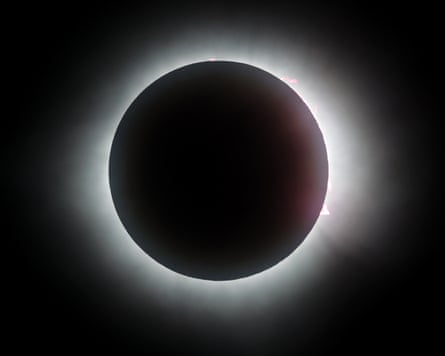
Everything went quiet as birds landed and hushed, believing night was imminent. My husband and I found ourselves moved to tears. I had expected to witness a rare astronomical event, but I gained a new appreciation for the incredible coincidences that make the eclipses possible. We live on a planet where the apparent sizes of the moon and the sun are the same, so that one can cover the other in the sky. You don’t get this on Mars!
I understood in that moment why solar eclipses have often been viewed as omens or auspicious signs from the gods, and why astronomers have long sought to predict these events: there was power in this knowledge. Suddenly, I felt that seeing only one was not enough; I had to experience more.
In April 2024, my husband and I travelled to Mexico to see the second Great American Eclipse. On a beach in Mazatlán, we saw the moon cover the sun for over four minutes. It was very different from 2017 because the sun was at the peak of its solar cycle, so the corona was wispier. The laughter and joyful chatter of the tens of thousands of people gathered to watch immediately turned into a profound and quasi-religious silence as the sun turned black. Once again came the feeling of overwhelming appreciation for our extraordinary universe.
I now describe myself as an “eclipse hunter”. I have already booked trips to Spain for the total eclipses on 12 August 2026 and 2 August 2027. The latter will be the longest eclipse for the rest of the century, with totality lasting over six minutes due to an excellent alignment between the Earth, moon and sun – so long that one might almost get bored by it … but I know that, for me, this cosmic phenomenon will remain endlessly fascinating.
Invisible Rainbows by Alfredo Carpineti is out on 21 May (Wilton Square Books, £16.99) To support the Guardian, order your copy at guardianbookshop.com. Delivery charges may apply.