









‘I didn’t really plan to do Eurovision at all,” muses Sam Battle as he takes me round his museum, pushing a shock of ever-so-slightly mad scientist hair from his youthful face and coaxing drone sounds out of abstract metal boxes as we go. “I was chatting to Johnny, my friend who works here, and we were saying wouldn’t it be funny to do it. So, we sent an email to the BBC asking, ‘Is there any way we can get on it?’ and they said, ‘Well this guy might be interesting …’”
Known to his fans as Look Mum No Computer, Battle has built a cult following with his wild fusions of music and esoteric technology. The persona started life as a side project when he was lead singer with the indie could-have-beens Zibra in the mid 00s. When the band split up in 2016, Battle threw himself into the world of Look Mum No Computer, filling his YouTube with videos of him rejigging everyday technology into weird and wonderful new shapes, whether that be by turning Sega Megadrives into working synths, or Henry vacuum cleaners into flame-throwers. In this world, nothing was thrown away, and any amount of lead could be transmuted into the gold of a song.
Which brings us to his treasure trove of resuscitated audio technology, known as This Museum is (Not) Obsolete, hidden away on a street in Ramsgate. Push the front door open, and you’re met with a heavy gate that has been covered with Nintendo Game Boys. Heave that open and you burst into a cavernous warren, somewhere between an inventor’s shed and Adam West’s Batcave, rammed floor-to-ceiling with flickering screens, flashing lights, obscure dials, trailing wires, inexplicable toys and rattling speakers. It’s a teeming collection of centuries of forgotten analogue technology, defying the modest exterior with Tardis-like flair. Everything is bleeping, yodelling, droning or cackling in synthetic cacophony.
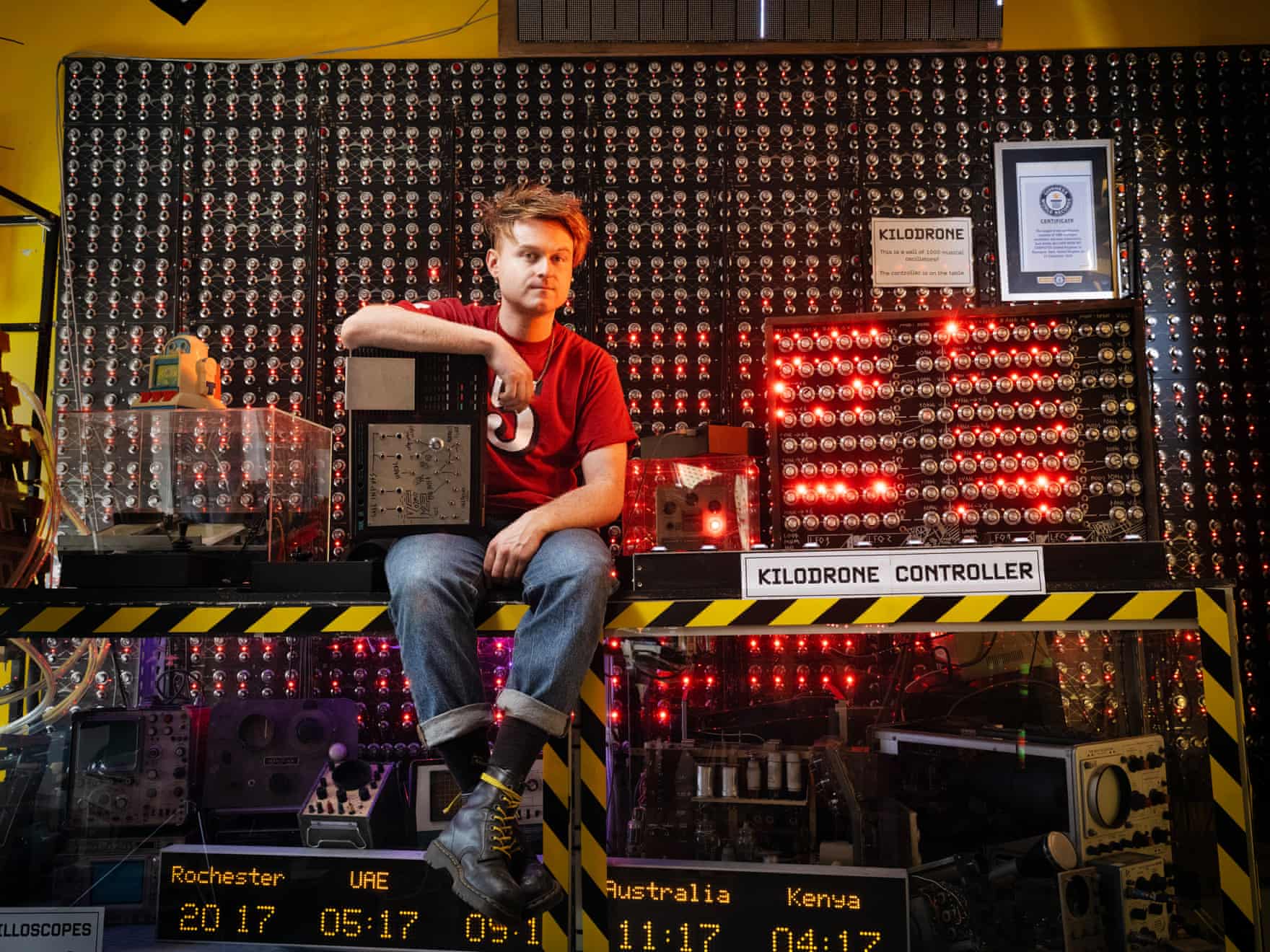
Battle is amid it all, clad in his trademark boilersuit, pushing levers, checking levels, prodding wires and maintaining order like a skipper bailing a boat. And now, after a few emails and an afternoon spent writing a song, he finds himself in the unlikely position of representing Britain at the 70th Eurovision song contest. “It feels like a village battle of the bands, but international!” he shrugs with a grin.
Battle started dismantling electronics “since before I can remember – I took apart every toy my parents bought me.” Now with over 700,000 subscribers to his YouTube channel, he has turned curiosity into a career. His musical projects range from the whimsical – a synth entirely from rejigged Furby toys, tuned to chirp atonal songs from their beaks – to his massive creation the Megadrone. This modular synthesiser is a beast so big, Battle had to find his Ramsgate space to be able to complete it.
Battle had always dreamed of running a museum dedicated to the restoration of obsolete technology. All of his kit is on display, free to be grabbed and messed with by the public, with Battle the unflappable centre of the chaos. He’s not at all precious about this stuff. “Oh yeah,” he shrugs, “the kids can be really heavy handed, often on purpose, but they almost never actually break anything. It’s good, they should be able to get stuck in!”
Today, the Megadrone takes up an entire side of the museum, a collection of 1,000 oscillators connected together, their little red eyes blinking, which can be played simultaneously in one immense swell of sound. Battle sparks up the Megadrone, hitting a button on the connected keyboard. Nothing happens.
“Ah. Wait – what – what’s going on, this …” he twiddles wires, completing an arcane series of adjustments. “Hold on … it’s …” Nothing. He presses another key. Suddenly an ethereal drone roars out like a plane taking off to heaven.
“That’s just a hundred of them,” he yells. “It takes hours to tune a thousand!”
When – to his great surprise – the BBC responded to his Eurovision request and asked him to come in for a writing session, Battle was determined to keep true to the Look Mum No Computer ethos. Unable to transport the monstrous Megadrone itself, he instead showed up with his Kosmo synth, a “mini” version of the Megadrone that comes in a mere six flight cases. “I turned up,” he remembers, “and said, ‘OK so who are we writing for?’ There were three people in the room, they turned around and said, ‘We’re writing for you!’ I completely panicked.” Having recovered from his mistaken belief that he was going to be writing for someone else rather than performing the song himself, he started laying down the parameters.
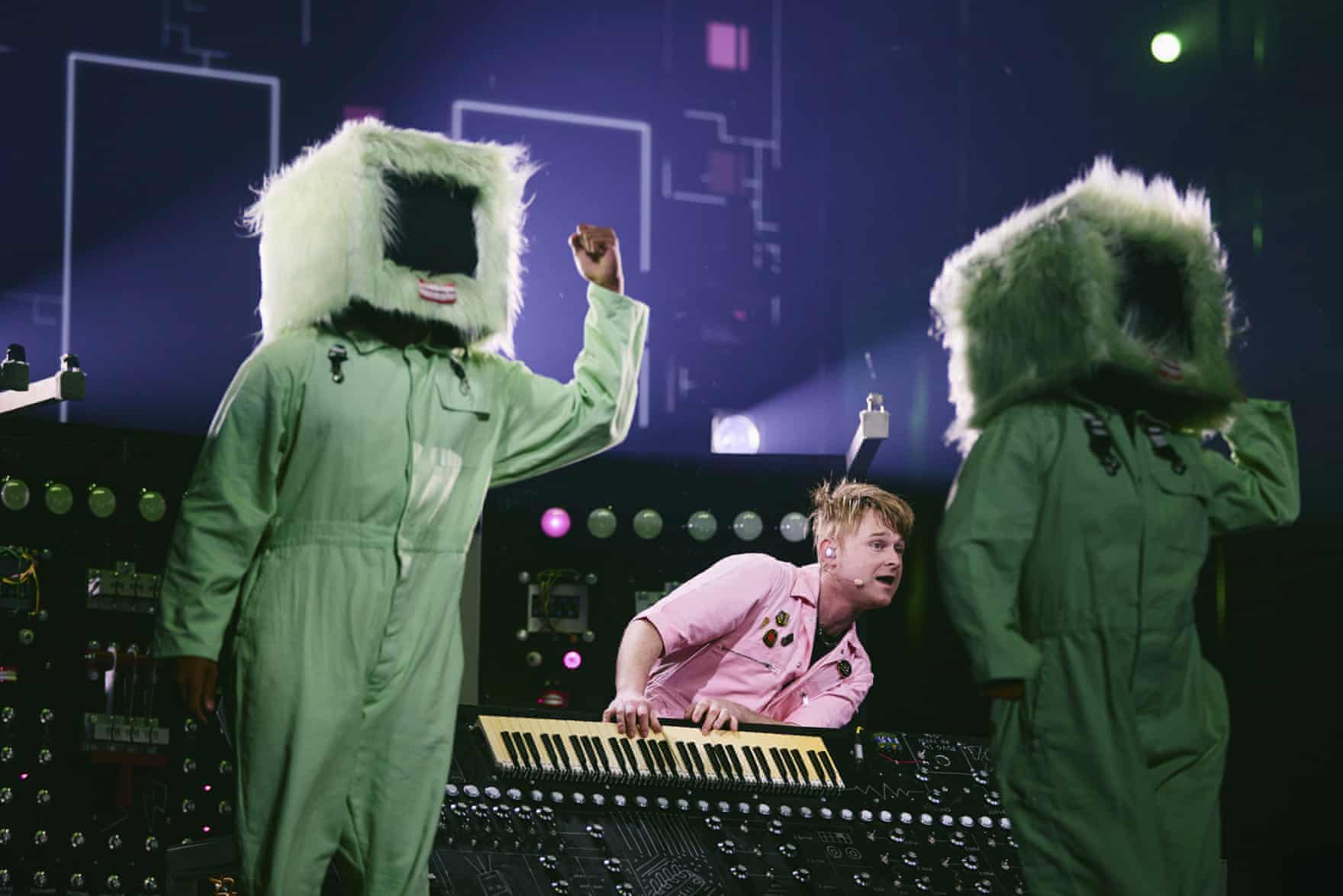
“I put the Kosmo synth together and showed them how to play it and told them, ‘If we’re doing a song for me let’s write it on this.’ They were really confused!” Battle says. “Initially they weren’t sold on it, but soon they got a riff going. Then we spent 12 hours making the song. Halfway through we were all in agreement that it was never going to get chosen, so we started not taking it seriously, and making a song that was just fun. We got to midnight and said, ‘OK, well it’s there, it’s done, they’re never gonna choose that, nice to meet you!’ The next morning the BBC guys were like, ‘What have you done? This was not what we were expecting, we had a plan and this has completely thrown it.’”
Much to Battle’s amazement, his song – with a chorus of him counting to three in German (“I’d just come back from tour in Germany so it just popped into my head”) – had been picked as the official UK entry. Somewhere between angsty new wave and 80s Europop, the lyrics contrast him moaning about the things that are bringing him down, with the joy he feels when he counts: “Eins, zwei, drei.”
“When writing it, there was a certain sentiment of, ‘How do I picture myself doing a Eurovision song?’ A bit in German, a bit upbeat, and it makes no bloody sense …” He laughs. “It’s a very British thing. We love to complain about the things we love. It’s like a form of endearment.” To augment the absurdity of the song, he’s spent the last month meticulously constructing a stage set for the final in Vienna. He’s staying tight-lipped about the particulars, other than to describe the set as “pretty complicated … there’s a bunch of things I’ve got to jump on. If I fall off I’m gonna look like a fool in front of thousands of people. My shins are covered in bruises from rehearsing.”
Make no mistake though – musically he’s deadly serious. “The Kosmo has a certain heavy sound,” he says. “I’ve spent six or seven years building a sound on it, it’s like Brian May and his pedals or Lars Ulrich and his snare drum, it’s my band in a box. I’m going to Eurovision open to anything. It would be cool to do all right, to do well. We’re setting ourselves up to make a mark – whether that’s going to have any results is completely up to other people.”
But as much as he’s going out to Vienna to win, he’s already thinking of his next project. With a gleam in his eye, he indicates a bulky, military looking tube on the floor.
“That is an air raid siren – if you have multiple of those on the same shaft you can make different notes and it makes a really loud organ. One siren for each note. So I’m getting eight or more of them and putting them together. I’m making the plan now, I’m going to finish it up while I’m in Vienna and hopefully when I get back, I’m putting it on the roof of the museum.”
I point out that an air raid siren might be, by nature, insanely loud. “Well …” he grins, unfazed as ever, “I’ll use it while I can before it gets pulled down.”