








When Paula Rego was nine, she drew her grandmother sitting comfortably in a chair. The old woman’s hair is pinned back, and she wears dangly earrings and thick-rimmed glasses on a chain. She might be reading or sewing – it’s hard to tell. Whatever it is, she’s absorbed in the task at hand. Just like the young artist, who, even as a child, diligently signed and dated her work, in neat script shooting up from the tip of her grandmother’s shoe like a flare in a night sky.

This small, tender sketch is part of the largest exhibition of the Portuguese-born artist’s drawings to date. Curated by her son, Nick Willing, the show features works on paper from the 1950s, right around the time that she settled in Britain, to her death in 2022. Unspooling from lines in pencil, pastel, pen and ink are tantalising tales of people and places real and imagined, and periods in Rego’s own life when she felt afraid, inspired or fierce. Sometimes the tales intertwine. Sometimes they stand alone. They can be mischievous, moving, troubled. All are full of feeling.
Made in response to the failed referendum to legalise abortion in Portugal in 1998, an intimate pencil drawing shows the sad and lonely aftermath of a backstreet abortion, with a girl sitting alone in a room with her back to us, legs crossed, head dipped in despair. In Study for Annunciation (2002), which hangs far away from the abortion study but feels eerily connected to it, Rego models Mary on a school girl who cocks her head as she weighs up the vast, winged angel before her, and nervously presses her knees together.
Rego was born in 1935, during the early years of the Salazar dictatorship, and criticised the fascist regime in her art until it was overthrown in 1974. By then, she was married to fellow artist Victor Willing, and living in England; apparently her father had told her, aged 17, to leave Portugal, that it was no country for a woman. Women were repressed, and for the rest of her life she would rally against that.
A beautiful and moving 2002 pastel of the pieta depicts the Christ figure’s right arm twice, in two different angles, as if it had flopped about a bit before he died. Alongside the biblical references are literary greats: the figure of Jane Eyre, less straightened than sturdy, as well as the young and handsome Mr Rochester; Orpheus and the maenads, wild and free; Germaine Greer sitting with her knees apart and the soles of her feet together.
It’s the little gestures that linger in my mind. A bent eyebrow. Curled fingers. The childlike twist of a toe. Even in the most disturbing works, feeling is conveyed not through terrible acts but expressions. In Rape (2009), the sense of horror doesn’t come from the bulk of the man pressing into the woman lying on her back, but from the way she turns her head to one side and determinedly, desperately, fixes her gaze on something far, far away.
Here, too, are studies for the formidable paintings from the late 1980s, made when she was caring for Willing, who died of multiple sclerosis in 1988. I would be lying if I said that I didn’t miss the colour and the daring of those paintings, the sheer size of them, which after all would work better in Victoria Miro’s big, stark spaces. But there’s something about the sharp pencil lines and delicate strokes of pen, the pastel smudges and washes of watercolour, that feel more intuitive, less laboured.

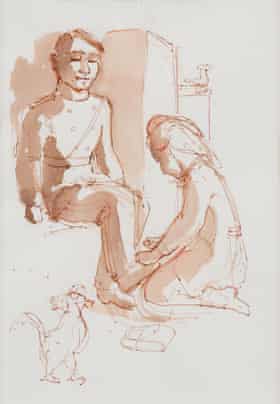
A study for The Policeman’s Daughter (1987) shows two versions of the girl side by side, polishing her father’s boot, with small tweaks (from relaxed jaw to clenched jaw; from flat foot to flexed foot) that switch up the mood from dutiful to defiant. A study for The Soldier’s Daughter (1987) features five versions of her youthful face in pencil on an otherwise blank page, each with a gently varied smile.
Look closely at that second study and you’ll notice the smudge of fingerprints, as well as shoeprints. Displayed in a cabinet along with notes, letters and sketchbooks are photographs of Rego crouching over a drawing on the floor. She often worked on the floor, and she sometimes walked over drawings that she’d tossed there earlier. No wonder it’s the medium she felt most connected to.
Towards the end of the exhibition is a self-portrait of the artist in her 80s drawn in 2017. Emerging from the page, her aged face bears two deep purple rings beneath watchful eyes; her lips part to reveal white teeth against red gums. She’s a different woman from that young girl who drew her grandmother, in a different time, and yet, she remains focused on the task at hand. Nearby, as if floating in space, is a lone finger, probably gripping a pastel.