惯性聚合 高效追踪和阅读你感兴趣的博客、新闻、科技资讯
阅读原文 在惯性聚合中打开

推荐订阅源

B
Blog RSS Feed
C
CERT Recently Published Vulnerability Notes
P
Proofpoint News Feed
Y
Y Combinator Blog
T
The Blog of Author Tim Ferriss
云风的 BLOG
云风的 BLOG
H
Help Net Security
Recorded Future
Recorded Future
The Register - Security
F
Full Disclosure
N
Netflix TechBlog - Medium
Cyber Security Advisories - MS-ISAC
酷 壳 – CoolShell
酷 壳 – CoolShell
H
Hackread – Cybersecurity News, Data Breaches, AI and More
爱范儿
爱范儿
Security Archives - TechRepublic
Simon Willison's Weblog
Cisco Talos Blog
Cisco Talos Blog
I
InfoQ
T
Tenable Blog
T
Tor Project blog
人人都是产品经理
人人都是产品经理
D
DataBreaches.Net
NISL@THU
NISL@THU
Google DeepMind News
博客园 - 叶小钗
B
Blog
V
V2EX
Jina AI
Jina AI
L
LangChain Blog
月光博客
月光博客
W
WeLiveSecurity
U
Unit 42
AWS News Blog
AWS News Blog
C
Cyber Attacks, Cyber Crime and Cyber Security
博客园 - 聂微东
V
Visual Studio Blog
A
Arctic Wolf
T
Tailwind CSS Blog
The Cloudflare Blog
SecWiki News
SecWiki News
S
SegmentFault 最新的问题
Hacker News - Newest:
Hacker News - Newest: "LLM"
宝玉的分享
宝玉的分享
MyScale Blog
MyScale Blog
cs.CL updates on arXiv.org
S
Securelist
www.infosecurity-magazine.com
腾讯CDC
雷峰网
雷峰网

The Guardian

Rory McIlroy surges into six-shot Masters lead with stunning second-round flourish ‘That’ll be the end’: actor Sam Neill joins fight to stop controversial goldmine near his New Zealand vineyard Roberto De Zerbi targets ‘Ange-ball’ revival to save Spurs from relegation Bath hit back to reach semi-final after stunning Northampton in 11-try epic Secret Garden to Outcome: the week in rave reviews Zebras, wealth and power: Hungary’s election tests Orbán’s grip on power ‘TikTok effect’ brings sellout crowds and younger fans to Grand National meeting The war over Omagh’s gold: the £21bn mine plan tearing a community apart Britain’s shadow workforce is paid as little as 65p an hour. Who cares for the carers? From You, Me & Tuscany to Euphoria: your complete entertainment guide to the week ahead Six great reads: the man who let snakes bite him, masked heavy metal and the brutal reality for foreign students in the UK American Classic review – I defy you not to fall in love with Kevin Kline and Laura Linney’s tender comedy Cuba’s doctors were a lifeline for the world. Now the Caribbean is shamefully complicit in the US drive to expel them An environmental disaster in Moldova has Russia’s fingerprints all over it RMIT drops misconduct case against student who accused university of being ‘complicit in Gaza genocide’ Ichiro Suzuki statue unveiling goes awry as bronze bat snaps during ceremony Survivors of Epstein’s abuse accuse Melania Trump of ‘shifting burden’ on to victims European football: Real Madrid held at home by Girona to extend winless run Arne Slot insists he is ‘aligned’ with Liverpool board and fans as squad is rebuilt Kamala Harris ‘thinking about’ running for president again in 2028 JD Vance warns Iran against trying to ‘play’ the US in peace talks West Ham double up twice to thrash Wolves and put Spurs in relegation zone Trump administration releases new renderings of so-called ‘Arc de Trump’ Crispin Odey drops £79m libel claim against FT over sexual misconduct allegations Bafta apologises for events surrounding John Davidson’s Tourette’s outburst Cocktail of the week: Bar Shrimp’s la rosita – recipe New drug may extend survival in aggressive ovarian cancer, trial shows One dead and 27 injured after bus with British passengers crashes in Canary Islands Pope adds to Smith’s mass of Surrey runs with England woes a world away OpenAI CEO Sam Altman’s home targeted with molotov cocktail Reform UK local election candidate was twice disciplined by Tories over ‘racist comments’ Remaining in Nato is in best interests of US, says Keir Starmer Prince Harry sued for defamation by charity he co-founded Anthropic’s new AI tool has implications for us all – whether we can use it or not Concerns raised about motorbike tourist trail after death of British teenager in Vietnam The Guardian view on Trump’s civilisational threats: the words that fuel war must be condemned The Guardian view on dystopias for our times: the American nightmare Doctors’ leader claims new reduced pay offer killed chances of ending strikes in England Netanyahu-ism has achieved nothing for Israelis – and come at a monstrously high price Deborah Levy: ‘CS Lewis’s White Witch terrified me – but I wanted to meet her’ How I Shop with Michelle Ogundehin: ‘We grownups have enough stuff already’ Trump’s war and Melania’s Epstein statement, with US editor Betsy Reed – The Latest We have to stop killer motorists on Britain’s roads UK starts crackdown on EU citizens’ post-Brexit rights Londoners aren’t unfriendly – but don’t compare us to New Yorkers The religious right and the perversion of faith Artemis II images reignite moon mission memories Orbán and Magyar trade accusations in last days of Hungary election campaign Reckonwrong: How Long Has It Been? review | Safi Bugel's experimental album of the month Martin Rowson on Middle East peace talks – cartoon Masters magic, the Grand National and Premier League drama – follow with us Fears of UK and EU flight cancellations as airports warn of jet fuel shortages Reform’s petulance over slavery reparations shows it just doesn’t grasp Britain’s place in the modern world Peers vote to ban pornography depicting sex acts between stepfamily members Starbucks’s retail arm gets £13.7m tax credit even as sales increase Flyby review – interstellar musical is a voyage of epic strangeness Grand National preview: Jagwar can deny Irish cohort in Aintree classic Week in wildlife: an ostrich on the lam, a tortoise crossing a road and surfing seals Anger as swifts’ nesting holes in Derbyshire rail viaduct ‘blocked up’ Peter Mandelson faces fixed-penalty notice for urinating in public ‘There’s no shortage of terrifying technology’: how AI became TV drama’s new go-to villain ‘Fresher than anything in a shop’: the best recipe boxes and meal kits for time-poor foodies, tested Who was Hilma? Af Klint exhibition to highlight exclusion of women from abstract art Critics assemble! Here’s my list of the greatest superhero movies of all time US inflation soars in March as war on Iran drives economy into uncertainty Amazon to finally launch Leo satellite internet in ‘mid-2026’, says CEO Grand National 2026: horse-by-horse guide to all the runners Pete Hegseth’s holy war: the militant Christian theology animating the US attack on Iran Add to playlist: the beautifully dazed, countrified indie-rock of Tracey Nelson and the week’s best new tracks Not just about Gaza: the Muslim voters turning from Labour to the Greens ‘I’m worried there’s too much of me,’ says a birch: inside the interspecies council giving nature a voice Why is anyone surprised by the US and Israel’s latest war? It’s only what the world allowed them to do in Gaza Tori Amos review – fans hang on every note of this dramatic deep dive into her back catalogue Coachella 2026: Justin Bieber launches a major comeback in the desert Super Mario what?! The seven best obscure Mario games ‘An abomination’: the Lancashire town kicking up a stink over reopened landfill Pillion to Roofman: the seven best films to watch on TV this week Holly Humberstone: Cruel World review – Taylor Swift fave trades gothic melancholy for pop glow-up Thrash review – cursed shark thriller sinks like a stone on Netflix Gulf states rethink security in light of US-Israel war on Iran Go Gentle by Maria Semple review – a joyfully clever New York romcom Welcome to Y’all Street: bullish Dallas aims to steal New York’s financial crown Margo’s Got Money Troubles to Beef: the seven best shows to stream this week I baulked at the idea of ‘friction-maxxing’. But there’s more to it than meets the eye Reich: The Sextets album review – Colin Currie celebrates the minimalist master’s joy of six Benjamina Ebuehi’s sweet and salty chocolate chip cookies recipe Experience: my house was taken over by 70,000 bees Malcolm in the Middle: Life’s Still Unfair review – the TV magic they’ve created here is absolutely miraculous Lava bursts forth as Hawaii’s Kilauea volcano erupts Sonos review: Are these the best portable speakers that money can buy? I tested to find out Buy bread in the evening, hit the sales on a Tuesday: retail workers’ top tips to cut your shopping bill The best water flossers in the UK, tested for that dentist-clean feeling Where to start with: Muriel Spark You be the judge: should my girlfriend stop mixing gold and silver jewellery? The best carry-on luggage in the UK, tested on an assault course How games capture the awe and terror of cosmic isolation I never text back – and it’s ruining my relationships The pet I’ll never forget: Beau, the labrador who saved my life Life Is Strange: Reunion review – a decade-long story comes to an impassioned close Why is gaming becoming so expensive? The answer is found in AI
Europe’s last coal – a photo essay
Alessandro G · 2026-04-20 · via The Guardian

Coal dust is fine; it seeps into the pores of the skin. That is why a thin black line permanently traces the outline of Rafal Dzuman’s eyes, as if he were wearing makeup. Team leader of the G-2 mining crew, 49-year-old Rafal Dzuman has been descending every day to 700 metres below ground for at least 20 years, at the Murcki-Staszic coalmine in southern Poland. Opened in the mid-17th century and today owned by the Polish giant PGG, the mine sits on the southern outskirts of Katowice, and still extracts about 23,000 tonnes of coal a day.
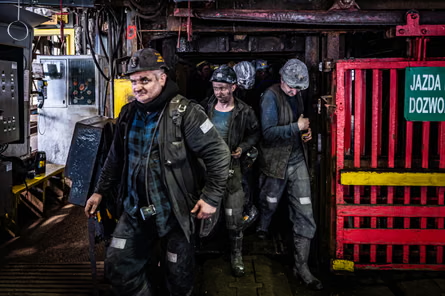
Miners wearing helmets and uniforms step out of a lift.
  • Katowice, Poland: Miners exit the lift after working in the coal-mining tunnels at the Murcki-Staszic Mine (PGG Group), located on the southern outskirts of the city. Coal mining began here in 1657; today, the mine’s daily production stands at about 23,000 tonnes
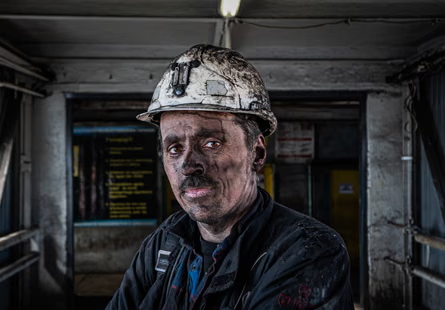
A miner after his shift covered in coal dust looks at the camera. He is wearing overalls and a white helmet.
  • Rafal Dzuman, a 49-year-old coal miner at the Murcki-Staszic mine (PGG Group), poses for a photograph after his shift. The mine’s reserves are estimated to last about 50 years
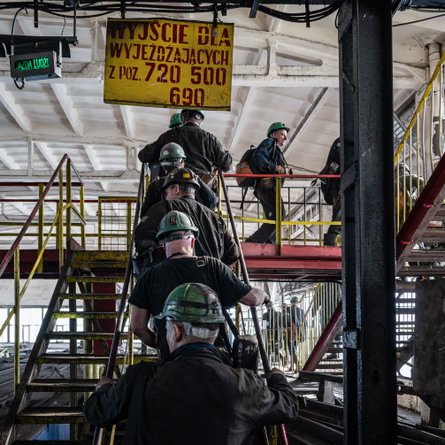
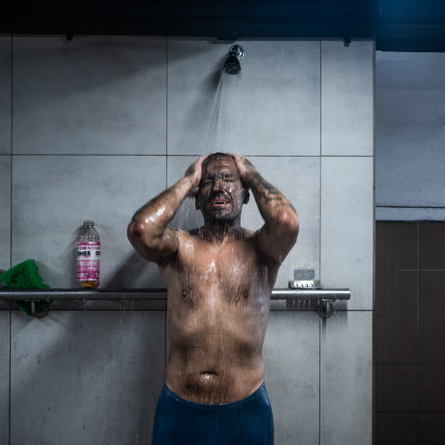
Coal miners step out of the elevator and head toward the changing rooms and showers
a coal miner takes a shower in a communal shower after his shift. He is covered in black coal dust.
  • Coal miners step out of the lift and head towards the changing rooms and showers. The dust is particularly fine, and even though a hot shower lasts several minutes, the coal can sometimes leave indelible stains on his skin

Katowice – once called Stalinogród – is the most important city in Upper Silesia, for centuries the coal-mining heartland of the old continent and today the last district in the European Union where hard coal is still extracted. Here in southern Poland there are still schools training young miners, and 80,000 people descend underground every day to extract thousands of tonnes of black rock – the same rock still used to produce half of the country’s electricity. But Upper Silesia is also the most complex laboratory of an already deeply complex European energy transition.
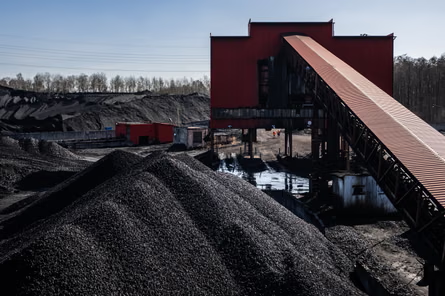
Coal stored in the open air, ready to be loaded on to train cars at the Murcki-Staszic mine (PGG Group),
  • Coal stored in the open air, ready to be loaded on to train cars

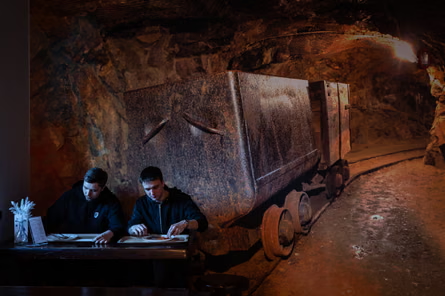
Two students are having lunch in front of a large poster depicting a mining tunnel with a mine car
  • Two students eat their lunch in front of a large poster depicting a mining tunnel with a mine car in the cafeteria of the Faculty of Mining, Safety Engineering, and Industrial Automation at the Silesian University of Technology in Gliwice

The decarbonisation decision made in Brussels makes no exceptions, and within a few decades, the Polish coal economy will have to give way to a “climate-neutral” model. The target date is 2049, though it is likely that the transition could accelerate and coal could be abandoned entirely by 2035.
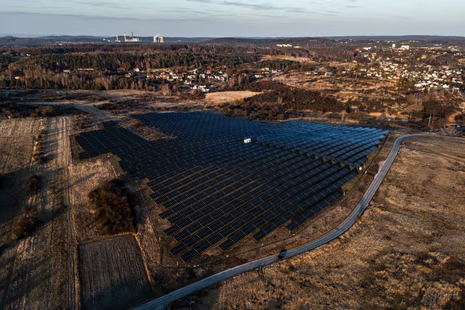
Luszowice (Poland), solar panels in the countryside east of Katowice. The plant was developed by Regesta, a Polish company specializing in renewable energy sources and power generation.
  • Luszowice, Poland: solar panels in the countryside east of Katowice. The plant was developed by Regesta, a Polish company specialising in renewable energy sources and power generation
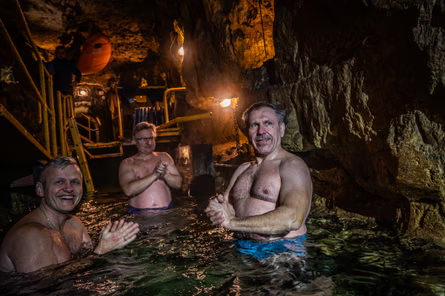
Three men stand in cold water wearing swimming shorts
  • Tarnowskie Góry, Poland: Three friends take a dip in the 6C water of the Black Trout Adit. The tunnel is part of a network of drainage tunnels in the former local silver and lead mine, now a Unesco world heritage site
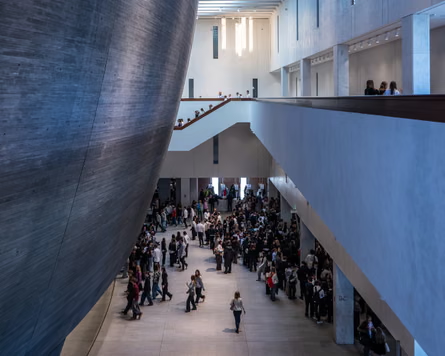
Students and teachers crowd the entrance to the National Polish Radio Symphony Orchestra
  • Students and teachers crowd the entrance to the National Polish Radio Symphony Orchestra before a concert for schools. Built on the site of a former coalmine, the redbrick building’s exterior resembles the public housing in the nearby mining district of Nikiszowiec

Katowice (Poland): Students attend a concert by the National Polish Radio Symphony Orchestra (NOSPR). Built on the site of a former coal mine, the red-brick building’s exterior resembles the public housing in the nearby mining district of Nikiszowiec.
  • Students attend a concert by the National Polish Radio Symphony Orchestra

Today, no new exploration is permitted and no new mines may be opened. On one hand, existing mines survive only thanks to substantial state subsidies – extracting coal requires digging ever deeper, sometimes beyond 1,000 metres – while on the other, the price of coal extracted abroad is falling, where labour costs are lower. It can therefore become economically attractive to buy it elsewhere: Indonesia, Kazakhstan, Colombia, and, until the outbreak of the war in Ukraine, Russia.
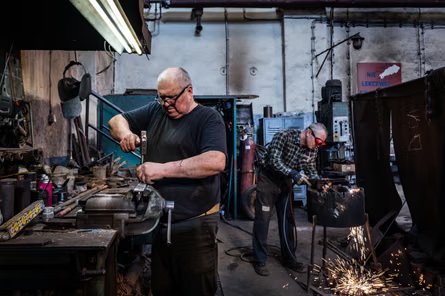
Katowice (Poland): two workers at the foundry of the Wujek coalmine, which is still in operation and managed by PGG
  • Two workers at the foundry of the Wujek coalmine, which is still in operation and managed by Polska Grupa Górnicza in Katowice. In 1981, nine striking miners were killed by the army during clashes aimed at suppressing industrial action at the mine, an event that is known as the Pacification of Wujek
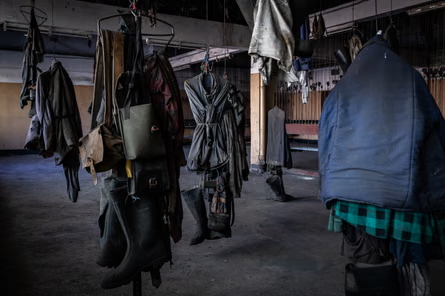
Miners’ work clothes hang from pegs at the Wujek coalmine
  • Miners’ work clothes from the Wujek coalmine, which is still in operation and managed by PGG in Katowice

That, at least, was the calculation made before the conflict in the Middle East erupted and before oil and gas prices began to rise. What will happen now? In Poland, questions pile up: will the billions of euros from the European just transition fund be enough to transform a mono-industrial region into a diversified economy? Will they manage to redeploy the workers who, between active mines – around 20 – and the supply chain, still number more than 200,000? And above all, could the current geopolitical uncertainty somehow persuade Poland and the European Union to slow the pace of a process that appears unavoidable?
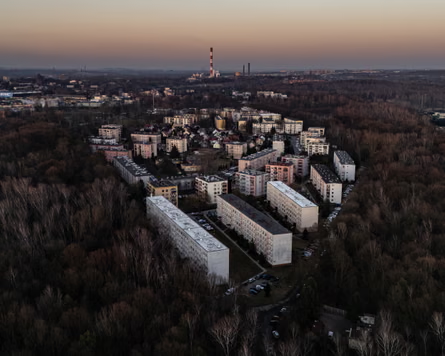
Zabrze, a southern district of the city, famous for its mining industry seen from above
  • Zabrze, a southern district of the city, famous for its mining industry. In the background is the smokestack of the Fortum Silesia power plant, which is still partially coal-fired
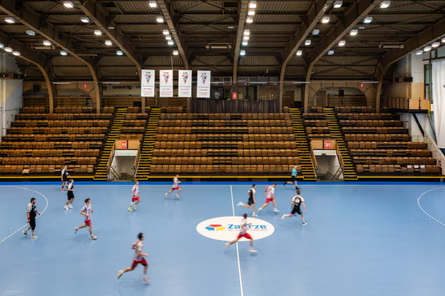
Handball is played at the “Pogoń” sports arena, a building originally belonging to a nearby coal mine that was donated in 1987 to the Pogoń Zabrze handball team, which at the time represented the mining industry.
  • The Pogoń sports arena, a building originally belonging to a nearby coalmine that was donated in 1987 to the Pogoń Zabrze handball team, which at the time represented the mining industry

In 2025, the world extracted more coal than in any previous year: more than 9bn tonnes, much of it in China, India and Indonesia. Coal is a polluting energy source that contributes to global heating, but it is also cheap, and today generates one-third of the world’s electricity. Poland extracts a mere 85m tonnes, less than 1% of the global total, yet for Upper Silesia, giving up coal carries the weight of an identity trauma as much as an economic one. “On one hand, we will lose a centuries-old tradition and a stable energy source,” says Jacek Nowak, geologist at the Silesian University of Technology, “and on the other we will continue to buy coal where extraction happens in a predatory way, from countries that respect neither environmental standards nor workers’ rights.”
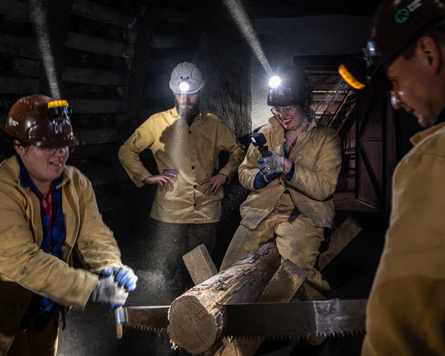
Tourists dressed as miners simulate the work of cutting logs 350 metres underground in the Guido coal mine, founded in 1855 by the wealthy German Guido Henckel and closed in 1960. Today it is a popular museum in Zabrze.
  • Tourists dressed as miners simulate the work of cutting logs 350 metres underground in the Guido coalmine, founded in 1855 by the wealthy German Guido Henckel and closed in 1960. Today, it is a popular museum in Zabrze
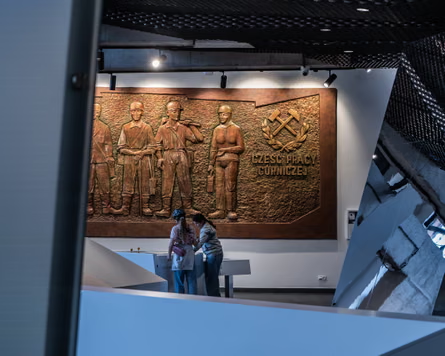
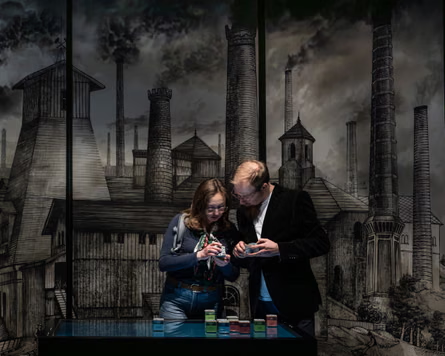
Two young girls visit the Saturn Museum in Czeladź, a museum dedicated to mining that takes its name from the former local coal mine, Saturn.
In a room at the Museum of the History of Katowice, two visitors explore historical information.
  • Two young girls visit the Saturn Museum in Czeladź, dedicated to mining that takes its name from the former local coalmine Saturn. Two visitors read up on the historical information in a room at the Museum of the History of Katowice
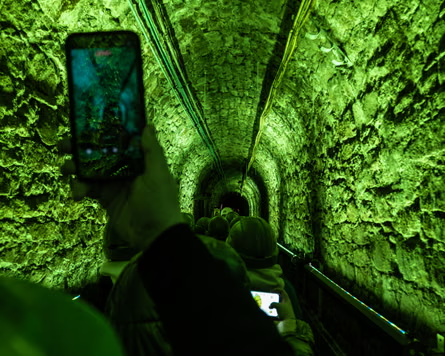
Tourists photograph an underground tunnel during a boat tour of the Queen Luiza Mine. The tunnel is lit with green light
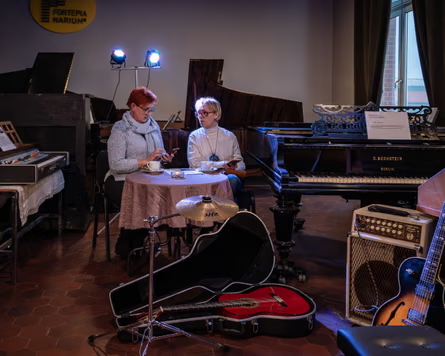
Two people sit at a small round table in a music-filled room, talking over cups of coffee, surrounded by instruments including a grand piano, guitars, and amplifiers.
  • Tourists photograph an underground tunnel during a boat tour of Queen Luiza Mine. Founded in 1791 under Prussian rule, the coalmine faced problems with water infiltration, and many of its tunnels have since been flooded. Two women wait for a guitar concert to begin in a hall located in a former coalmine that now houses the Kopalnia Sztuki (Art Mine) association in Zabrze

The European Green Deal is under way, and as power plants abandon coal in favour of gas, two-thirds of the mines have already been closed or repurposed. In Zabrze, the former Guido and Queen Luiza mines have become museums where visitors explore the tunnels dressed as real miners.
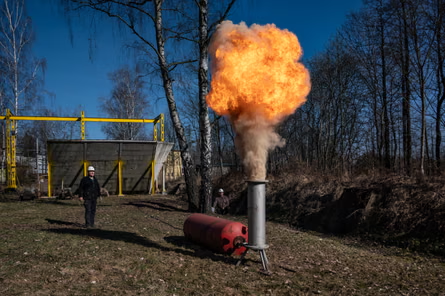
Mikołów (Poland), Barbara Experimental Mine: A large burst of flame erupts from a metal pipe in an outdoor, wooded area. Two people in protective gear stand nearby, observing the flare.
  • Technicians conduct a coal dust explosion risk test involving the ignition of methane, flammable liquid vapours and other gases at the Barbara Experimental mine in Mikołów
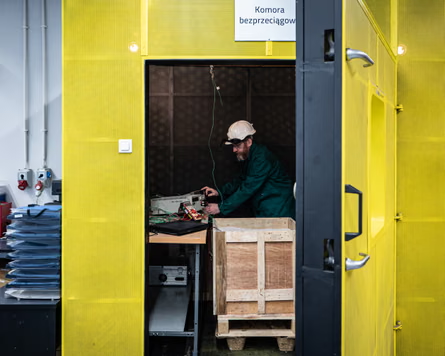
A man wearing protective gear works at a cluttered desk inside a bright yellow enclosed chamber, adjusting electronic equipment and cables.
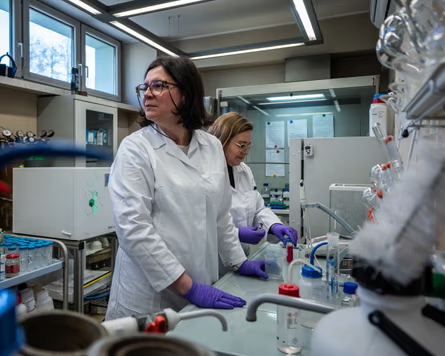
Researchers at work in a chemistry lab in Barbara Experimental Mine
  • A technician prepares a test in a containment chamber to study industrial dust explosion, and researchers at work in a chemistry lab in Barbara Experimental mine

In Mikołów, a mine has been transformed into the Barbara Experimental mine, a research centre specialising in the study of extraction techniques and risks associated with explosive gases, particularly methane.
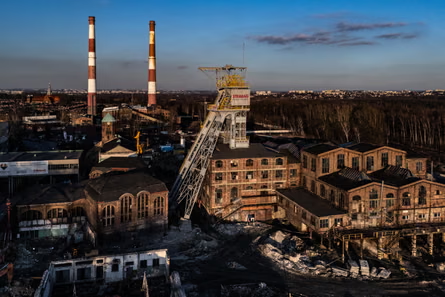
The former Wieczorek coalmine with two large chimneys.
  • The former Wieczorek coalmine, which is now closed and undergoing redevelopment thanks in part to European funding. A centre for the hi-tech development of the creative industries and the gaming sector will be built here
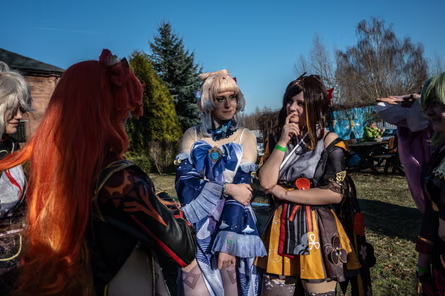
Katowice (Poland): A group of people in colourful cosplay costumes stand outdoors on a sunny day, chatting together.
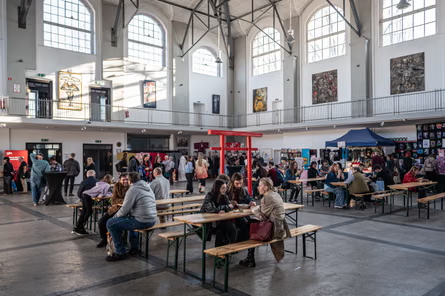
Katowice (Poland): People eat lunch and visit the booths at a Japan-themed fair at the Wilson Shaft Gallery, an exhibition space housed in the former “Wieczorek” coal mine, which dates back to 1826.
  • Girls dressed in Japanese manga-style outfits get ready for a show at the Wilson Shaft gallery. People eat lunch and visit the booths at a Japan-themed fair

Some mines have become art galleries – such as the Wilson Shaft gallery in Katowice – while others have been turned into golf courses, such as the Armada golf club in Bytom, and one of them – the former Wieczorek mine – is to become a hub dedicated to hi-tech, creativity and gaming. “But if the transition imposed by Brussels is too fast,” says Arkadiusz Sienczak of the miners’ union ZZG, “we will not manage to offset the losses in the mining sector with new jobs.”
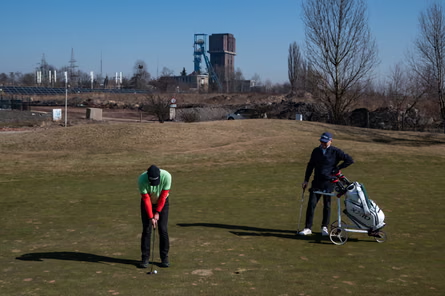
People play golf under a blue sky at  Armada golf club in Bytom
  • Golfers at the Armada golf club in Bytom. An example of industrial redevelopment, the golf club, which opened in 2013, was built on the site of the former KWK Szombierki – the first in Poland to be built on a post-mining site
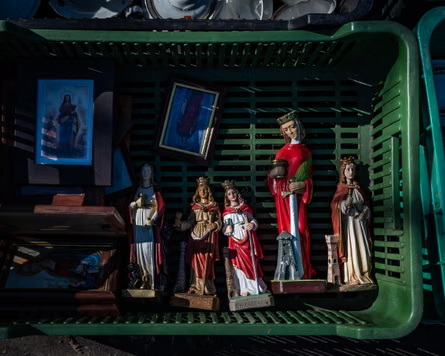
Several figurines of St Barbara for sale at a flea market
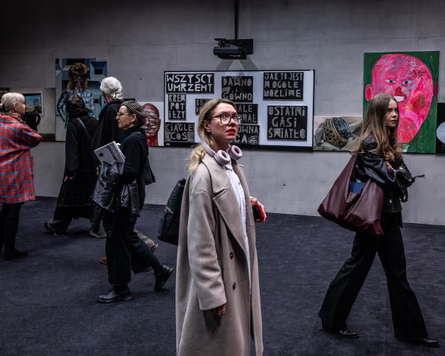
A woman views works of art on display at Art Collect, a contemporary art fair held at the International Conference Centre
  • Old figurines of St Barbara for sale at a flea market in a park south of the city. Traditionally, the patron saint of miners, on 4 December, her feast day, many mines would close and the occasion was celebrated with masses and lunches. A woman views works of art on display at Art Collect, a contemporary art fair held at the international conference centre, next to the Spodek Arena, a true symbol of the development that coal mining has brought to the city and the entire Upper Silesia region

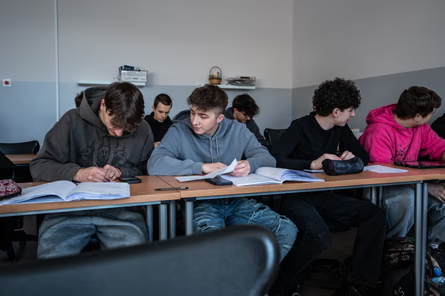
Coal has shaped the history of Silesia, transforming the landscape and influencing generations of families. Some local schools – such as the technical school complex in Rybnik – continue to train the miners of the future. “They are aware workers,” says headteacher Piotr Tokarz, “knowledgable about the latest mining technologies but also informed on issues such as safety and sustainable extraction.” At one time, more than 140,000 people worked in the coalmines of Rybnik; today 6,000 remain. The job of a miner no longer guarantees a long-term future and is considered physically demanding: retirement comes at 50 after 25 years of service, 15 of them underground. Despite this, around 20 young people have chosen to become miners.
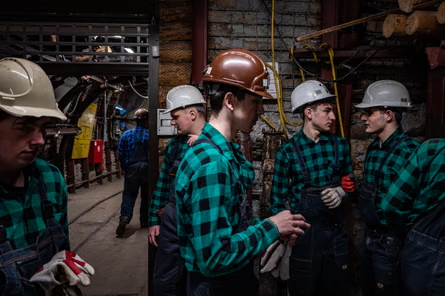
Rybnik (Poland): a group of student miners during a class in a tunnel-laboratory at the Technical School Complex wearing hard hats.
  • A group of student miners during a class in a tunnel-laboratory at the technical school complex in Rybnik
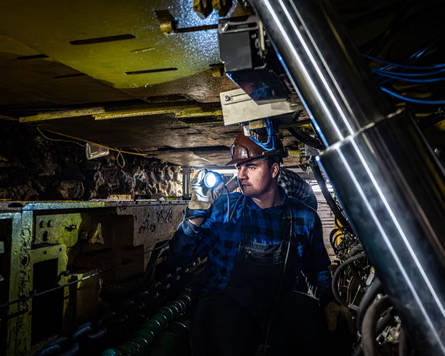
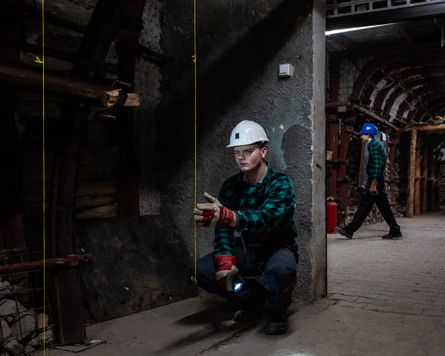
A student miner during a class in a laboratory tunnel
Rybnik (Poland): Students at work in a classroom at the Technical School Complex. The school, which opened in 1945 to train coal mining technicians, still has classrooms where students learn underground mining techniques.
  • Students at work in a classroom at the technical school complex, Rybnik. The school, which opened in 1945 to train coal mining technicians, still has classrooms where students learn underground mining techniques

Among them is Wiktor Dudek, 17 years old, hard hat and green-and-black checked shirt, who, together with his classmates, attends lessons in a tunnel-laboratory beneath the school. Wiktor does not speak English, but I noticed that during lessons, he does not speak Polish either. “We don’t need English down in the mine,” he says, “and we don’t need Polish either — our language as miners is Silesian. It’s a matter of tradition. Of course, the outlook for us young people is not rosy, but my grandfather was a miner and so was my father, and that is why I will be one too.”