







It was almost over before it even started. This year’s Venice Biennale has been tearing itself apart for months: countries not showing up, artists getting fired, exhibitions being cancelled, funding getting pulled. There were petitions and protests months before a painting was on the wall. The jury quit in the days leading up to the opening, then Iran quit, then the European Commission quit. There were protests against Israel and Russia during the preview, artists went on strike, and artworks were replaced with installations of Palestinian flags.
The whole thing was a massive mess of conflicting politics, personal tragedy and unresolvable ideological differences from the very beginning. And all this without even mentioning that the curator, Koyo Kouoh, died last year and wasn’t able to see her artistic vision through to completion. In a sense, the 2026 Venice Biennale never stood a chance.
Kouoh’s idea for her biennale was to chuck aside the ire and invective of outright political art, and focus on quiet, contemplation and healing. Titled In Minor Keys, this exhibition is about “spiritual and physical rest” in “oases” of art. It’s about “low notes” and “deep listening”. Seriously? I mean, the world is collapsing out there, wars are breaking out every few minutes, the far right is flourishing, the planet is dying, and AI is about to turn us all into batteries. But the biggest art exhibition on Earth wants us to relax? It’s a tough pill to swallow.
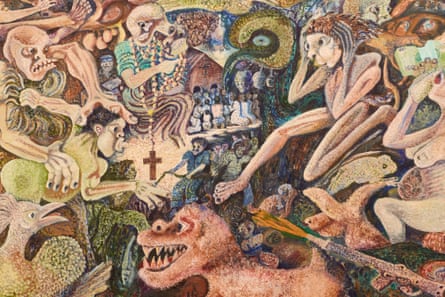
A five-person curatorial team stepped up in Kouoh’s absence, and boy can you tell. This is an exhibition curated by committee. The two central shows in the Giardini and Arsenale are a vast, near-incomprehensible mess of totally disparate, poorly explained art. The focus is on artists from the global south, but that’s not explained or contextualised (or even all that new for the biennale – Okwui Enwezor did it brilliantly in 2015). You go from room to room trying to somehow figure out why this artist is shown next to that one, how one room is connected to another. And you can’t. That’s what happens when your curatorial theme is this vague: you get to whack anything you want together and feel like you’ve hit the brief.
There’s barely any war or conflict here, no rise of fascism, no tech. Hell, politics is barely in it. It’s like the world outside doesn’t exist. There are multiple installations using slide projectors, there are absolutely loads of rocks and stones, at least three serene videos of forests. It’s a tedious mixture of the anachronistic, irrelevant and dull.
You walk into the Giardini and you’re greeted by a sea of ceramics, textiles and paintings. It’s full of pots and weavings, natural dyes, screenprints of starscapes, abstracted landscapes and still lifes. It’s all so gentle, so incredibly safe. They’ve somehow made the biennale feel like an art fair.
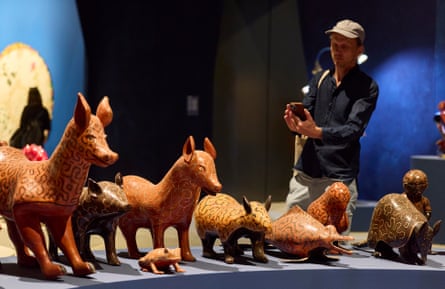
It doesn’t work as an exhibition, which is a shame as some of the art has value. Seyni Awa Camara’s stunning animal-human hybrid pots have taken up residence in one of the opening spaces, multi-limbed, towering terracotta mythical beings made real. A gathering of glazed creatures by Peruvian artist Celia Vásquez Yui transforms another gallery into a little slice of jungle.
Among the endless, anonymous abstractions, there are a bunch of great paintings. Mohammed Z Rahman’s tiny images on matchboxes of shells, flowers, condoms, knobs and skulls are excellent depictions of queer heartbreak. Tammy Nguyen uses her huge, complex canvases to expose links between the cold war and Vietnam. Wardha Shabbir takes the tradition of Pakistani miniature painting and blows it up to maximal scale, resulting in some head-spinningly gorgeous paintings of flowers and foliage.
The room of work by artists from the Nairobi Contemporary Art Institute is excellent: Josephine Alacu’s work is a pointillist, gothic nightmare; C Driciru paints a parade of grotesque green figures; Charles Mukiibi drags the viewer into the middle of a fistfight. Eerie, tortured, aggressive paintings. But for the most part, the Giardini is over-hung, chaotic and aimless. The second space, the Arsenale, works better. It’s still a disjointed mess, but with bigger, weirder stuff.
And the big weird stuff is good: Guadalupe Maravilla’s giant trashy thrones deal with his experience of both cancer and life as an immigrant in the US; Theo Eshetu sets an olive tree spinning in the middle of the gallery in a brutal meditation on death (the tree will slowly wilt and die here); Kaloki Nyamai’s humongous handmade canvases show the aftermath of violence and trauma; Dawn DeDeaux uses meteorites and shattered glass to confront the pain caused by Hurricane Katrina. One of the most striking works is by Alfredo Jaar, a long, blindingly bright red corridor leading to a single cube of rare-earth minerals – a horrifying display of exploitative greed that’s destroying the planet.
But there’s no material diversity. There’s so much terracotta and dye, so many textiles and beads, that it all blurs into one. Even if this had been a good curatorial idea, this is a poor execution of it.
The national pavilions are much less aggravating than the main show. Some of them are even quite fun – not something you normally associate with contemporary art. The Denmark pavilion is a hi-tech sperm bank, Luxembourg’s features a singing turd, Japan’s forces visitors to look after fake babies. There’s a lifesize chocolate Russell Crowe in the Malta pavilion and the Belgian one is like a hyper-serious art school version of the Blue Man Group with a bunch of bozos in black screaming and hitting drums. Ludicrous, silly, quite funny.
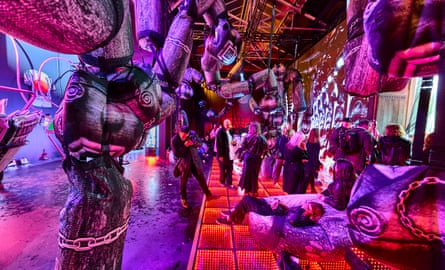
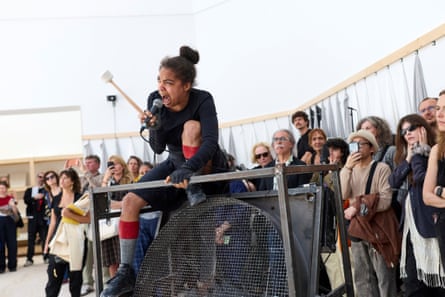
Andreas Angelidakis has turned Plato’s Cave into a nightclub/kink dungeon for the Greek pavilion, filling it with huge deflated phallic columns. It’s about the commercialisation of Greek culture and the way our history gets commodified and exploited. But it’s Florentina Holzinger’s Austria pavilion that everyone was queueing for, a confrontational, stomach-turning, sewage-drenched performance piece. She kicks it all off by ringing a huge bell with her own naked body. Inside the pavilion, nude women climb up a metal mast while another performer does doughnuts on a jetski.
In the middle of it all a woman in a scuba mask is submerged in a tank connected to two portaloos. Go on, go in and do your business. Your urine is filtered and fed back into the tank. She is swimming in your processed piss, and she stays in there for hours. Next door, a sewage system belches and sprays raw effluent into a locked room, the hoses spinning and covering the windows in thick brown fluid. It’s sealed, but you’re only a cracked window away from the filth.
It’s brilliantly obscene and vile. You could see the work as a diatribe about climate change and rising sea levels, the bell sounding for ecological catastrophe. But it’s also about how closely we live to these hidden support systems, and how close they are to collapse. We’re inches away from everything in the world falling apart and covering us in our own mistakes.
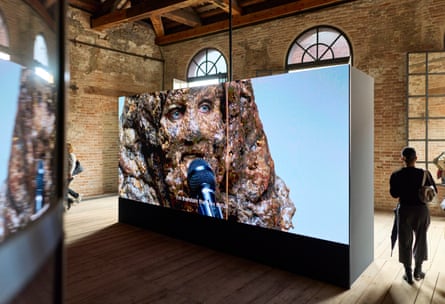
Slovenia’s pavilion is pretty powerful too. It has fallen to ruin, a wasteland covered in piles of cinder blocks and mounds of rubble. The work is by Nonument Group, and it commemorates a mosque built among military barracks in the Slovenian Alps in 1917. It’s a deeply moving monument to loss, militarisation and the erasure of history. It’s one of the only works here that tackles war and its legacy, which feels like a shocking thing to say in 2026.
Out in the mystical gardens of the Carmelite Brotherhood, behind the train station, the Vatican has created a space of sonic calm and aural bliss for its off-site pavilion. Musicians including Devonte Hynes, Terry Riley, Meredith Monk and Brian Eno were asked to make music inspired by the 12th-century saint Hildegard of Bingen. You walk slowly through the garden, taking deep breaths of lavender and verbena, watching the vines sway in the breeze. The sounds in your headphones drag you into a meditative state, force you to lose yourself in nature. I saw it in the middle of a thunderstorm, rain pelting my back as I contemplated some courgettes and fennel fronds. Nothing else hits Kouoh’s brief like this. For 30 minutes, I forget about war and conflict, I find quiet, I escape. I get it.
And how about those contested pavilions that everyone wanted to ban? The Israeli pavilion is just a water feature, the Russian pavilion looks like the world’s worst florists and the American pavilion is boring hotel lobby art. All that furore and rancour, and the problematic pavilions just hoisted themselves by their own petards anyway.
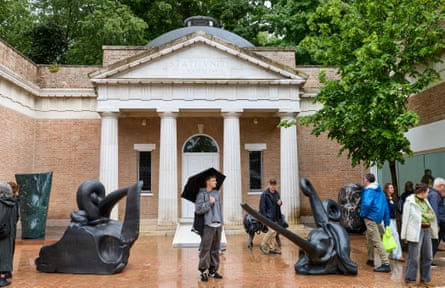
It’s left to the work dotted around Venice in unofficial exhibitions to really throw the political cowardice of the main exhibition into stark relief. This is where true artistic bravery lies. There’s Belarus Free Theatre’s unofficial presentation that dares to expose the reality of life under totalitarianism with a field of wheat and a crucifix made of CCTV cameras.
And not far from the Arsenale, you’ll find Gabrielle Goliath’s installation. She was meant to be in the South African pavilion, but their culture minister cancelled the show at the last minute for being “too divisive”, so she took up residence in a church down the road. Her video installation is a series of pained songs of mourning for women lost to colonial and sexual violence. In each one, a singer sustains a single note until her lungs can take no more and another singer steps up to fill the sonic void. The church hums with the sound of tortured, heartbroken voices. It’s a stunning lament, a protest against racial and sexual injustice. This is what’s missing from the main biennale – power, emotions, ideas, clarity.
It’s amazing to see two great American appropriators together in the Fondazione Prada’s Richard Prince and Arthur Jafa show. This is room after room of punk thievery, of knicking images and twisting them into new forms in an angry exploration of America and its people. Racial hatred, sexual exploitation, and a deep, cultural and spiritual malaise courses through this show. This is the true US pavilion.
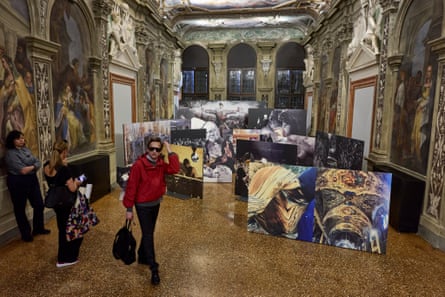
At the Pinault Collection, a retrospective of work by Lorna Simpson, another great American appropriator, is full of images of race riots and bullet holes, repainted and reframed in a desperate attempt to make sense of the senseless. At Fondazione Inbetween Art Film, the brilliant Lawrence Abu Hamdan also proves how powerful art can be when it engages with contemporary issues with a confrontational and beautiful film about sonic weapons being used against students in Belgrade. Also on show is a work by Maya Watanabe – a film of a mammoth carcass appearing out of the Siberian permafrost, a disturbing portrait of death and imminent ecological disaster.
While tech is pretty much entirely absent in the main show, you can find plenty of it around town. At Palazzo Franchetti, Eva and Franco Mattes cleverly and amusingly tackle AI and cat memes. At Palazzo Diedo, Holly Herndon and Mat Dryhurst’s co-curated group show dives into the complex world of “protocol art” with room after room of AI networks and machine learning (including brilliant appearances by New Models and Simon Denny, dealing with military tech, futurism and the alt right).
But it’s Lydia Ourahmane’s show at Nicoletta Fiorucci Foundation that stuck with me the most. The smell of simmering stock greets you as you explore the space, bumping into moulds for Venetian sculptures and walking through beaded curtains. It’s the materials of Venice, reconstituted and decontextualised. It’s as if she’s excavated the city to understand what it means to belong here, to come from here. It’s ultra-minimalist, ultra-conceptual, but also extremely moving.
The truth is, this review barely scratches the surface of the art you can see across Venice right now. I’ve not even mentioned Georg Baselitz’s haunting final works on San Giorgio, or the Jenny Saville or Sanya Kantarovsky shows. There are thousands of artworks, countless exhibitions, endless installations, billions of ideas. It’s overwhelming, so all you can do is seek out connection, try to find something that triggers your heart or your brain in some way. What triggers yours might be different from what triggers mine, but if you’re going to find it anywhere, it’s here, somewhere in the alleys and palazzos of Venice and its vast, messy biennale.