













Karl Standley and his assistant Cameron Hutcheon have gathered in their usual spot in the south-west corner of Wembley Stadium clutching hot cups of tea. Standley is a coffee devotee but on matchdays, as a nod to his mum who enjoys a brew whatever the temperature, he mixes things up.
After every kick-off the pair gaze out at 7,140 sq metres of glistening green perfection like lions surveying their savannah. Every thinkable controllable has been controlled and, for a short time at least, the teams – this time Manchester City and Southampton – have dual custody of the Wembley pitch.
Standley – Wembley’s head of grounds and surface transitions – and his six-strong team are only halfway through a day that began eight hours prior, but the mountain has been scaled.
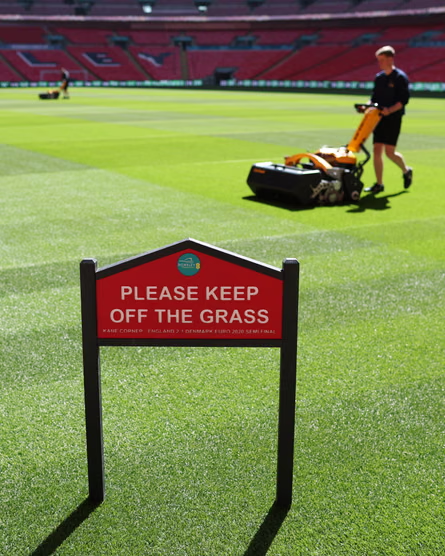
The morning played out in front of the peaceful silence of 90,000 unoccupied seats. Dew was brushed from the playing surface. Every blade of ryegrass was then cut lengthways and widthways to its exact 22mm length, team member David Moulds having painstakingly set each mower to the required height. Each in-house sharpened blade is tested on paper strands.
“You wouldn’t perform an operation with a Stanley knife,” Standley began. “It wouldn’t heal. It’s like a surgeon’s scalpel – we need our blades to be as sharp as possible. A rough cut could attract diseases.”
Standley spent 90 solitary minutes repainting the pitch lines, with the exception of the east-end penalty spot: that job was entrusted to your correspondent.
Concurrently, Brendan Abbott and Liddy Ford erected goalposts, with the switch from resting into their position a synchronised acrobatic masterpiece. Abbott, a 17-year Wembley veteran, orchestrated every move. Ford followed his lead. They only joined the team 18 months back but with Standley and Hutcheon’s encouragement, are flourishing and have already led the ground staff during Lionesses games.
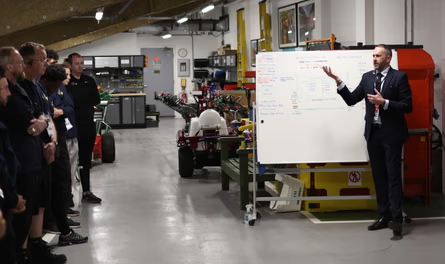
Once every job on the whiteboard had been ticked off, the team gathered to take a breath and eat before entering game mode. Apprentice James Cruz was teased gently for having received a ticking off for overzealously filling his canteen salad box during the week. They are a strong, meticulous unit with an evident closeness and hierarchy only evident when performing duties. Cruz’s later offer to work late, even though it meant missing his last bus home, was swiftly and firmly rejected.
Two-hours pre-kick-off, the team’s watering window began. “One half of the ground is in the baking sun, the other in the shade,” Standley told the Guardian. . “The east end is windy, the west end dead, so we’re effectively dealing with four pitches.
“We discuss them as a team. It’s a case of, ‘we’ve seen this movie before, this is how it ends’. Our culture is such that, if the team think I’m wrong, they’re in a safe space to tell me. There are a lot of judgment calls that come from experience.”
Indeed, Standley, Moulds and Abbott have 57 years between them at Wembley alone, with Moulds and Abbott recently celebrating 20-year anniversaries. “We had expected to be preparing pitches straight away, but the first year ended up being a desk job.” Moulds recalled.
Moisture readings taken over the previous 48 hours, and data on traction and hardness, were turned into a full report by AI. From that the team concluded that Wembley’s 24 sprinklers would evenly apply 2mm of water before the warm-ups, plus a further millimetre after them and at the break. All is controlled by a programmed radio device in Standley’s possession. “We could do it using an app,” Hutcheon said, “but that would leave us liable to hacking.”
During watering, he and a suited Standley are positioned by the tunnel, offering greetings to players and officials. Each team received prior notice of their designated warm-up areas and are gently reminded. Some adhere strictly to requirements; others take the odd liberty.
Stakeholders also need managing with broadcasters attempting to negotiate changes to sprinkler schedules to keep their on-air talent dry.
The players returning to their dressing rooms brings a first divoting opportunity. Often the window is tiny, with finals and internationals bringing pageantry and a military presence. But a semi-final offers a dozen or so minutes for fixing minor blemishes.
On Saturday, the first peep of Craig Pawson’s whistle was Standley’s cue to return to the groundskeeping corner, uttering the words “blue valve off” into the earpieces of the entire team as he walked. The irrigation system is shut during play.
It is just one example of an astonishing level of perfectionism. The team talk regularly of the “1%-ers” and no chances are taken. Everything that can be done, is done, on the day and in the buildup.
The “lay and play” pitch hosting the FA Cup semi-finals began life in August 2025 at a secret location. In January, it was cut into 700-plus 10m x 1.2m strips and driven overnight to north London. “Our record for an install is two and a half days – that was between Oasis’s fifth concert and the 2025 Community Shield,” Standley said. It will probably be broken later in 2026.
Once a pitch has reached its end of life, its approximately 5% plastic content is recycled into benches, key rings, planters and, most recently, LPs gifted to visiting artists as a memento.
It was an idea the ground staff conjured and enacted themselves, with the first items shaped over a barbecue in Standley’s garden. “I still owe my wife and daughter a baking tin,” he said grinning.
When we visited on matchday minus two, one of a rotational cast of resident falcons was on duty. An increasingly residential local area has meant birds of prey are released weekly to ward off pigeons.
On matchday minus one, Abbott and Moulds painstakingly spent four and a half hours aerating the ground with 1.8m holes. Relieving compactions enhances playability.
As the Saints and Citizens duelled, the ground staff had a watching brief, spare corner flags readied in case of incident. Half-time brought another divoting chance, gardening lemmings fetching forks from an immaculately kept cavern.
Among them were Yousef Shah and Josh Wenham, Saturday being the culmination of a week-long work experience placement via the King’s Trust, a partner of the FA who runs an employability programme for local young adults. Wembley is a place for opportunity. “Somebody took a chance on me once, so it’s important we do the same,” Standley said. Shah walked off, visibly beaming. “Two weeks ago, I never could have imagined I’d be doing that,” he said. “Wow … so cool.”
Full time means the team is on again, literally and metaphorically. First, University Campus of Football Business student Dylan Samways led a group pulling orange brushes lengthways. “It’s called drag brushing. We’re standing the grass back up to remove loose debris.”
Lewis Arscott, who commutes from Exeter to support matchdays, proudly started the next wave of action – a quartet of lawnmowers hoovering up the displaced remnants.
With dark having descended, the final divoting packs form. Simon Rudkins, head of grounds at Lewes FC’s Dripping Pan, and Chris Horsler, who holds the same position at a state school, discussed the merits of a new tool being trialled. It is a horticultural savasana, with soft, merry chatter among the calm.
Shortly before 10pm, after a concerted effort to push into the evening in order to lighten Sunday’s load, Standley gathers the team. “We have a rule,” he said. “When those two teams arrive tomorrow, they should not be able to tell there was a game today.” It all began again nine hours later.