





T Venkanna’s paintings land like a sucker-punch. At the centre of his first institutional solo show at London’s Studio Voltaire is an overbearing altarpiece, modified by two squat side panels to take the overall shape of a juvenile dick drawing. Perched at the bottom, on either side, are Adam and Eve. Their backs are turned as they look out on an orgasmic thicket of desire. A female figure is pleasured by another’s nose, someone copulates with the hindquarters of an animal and others fondle in a kaleidoscopic blur of colours and styles that make Hieronymus Bosch look restrained.
But carnal enjoyment is merely the footnote. “It is a way to consider many things, including the myth of religions,” says Venkanna. Scattered within this longing landscape are stony figures redolent of India’s pantheon of gods and goddesses. Women worship a topiary lingam – the aniconic depiction of Shiva – and a man caresses a statuesque woman’s breast (while drinking from her vagina). Graphic? “That is what you see in ancient temples,” says Venkanna. “People touch the breasts of sculptures so that over time they become very smooth and shiny.”

The disparity between puritanical religious doctrine and licentious reality started to become evident to Venkanna in his childhood. Born in 1980, he grew up in Gajwel, a small town in south-central India roughly the size of Ipswich. The one-room home he shared with five other members of his family doubled as the rectory of his father, a Hindu priest. “Village people would come to ask about what rituals they had to do, when was a good day to do things,” says Venkanna. These rules and expectations of appropriate behaviour, such as the ideal of chastity, had a convenient degree of flexibility, Venkanna discovered. “Can you imagine that I used to find European porn books hidden around?”
Those could be considered some of his early source material. He painted and drew naked figures at home, and while his family was ambivalent about the content, they could not overlook his skill. Sent to train as a drawing teacher and destined for a job in a government school, it was only while preparing for his exams in Hyderabad that he encountered the concept of a fine art college. He enrolled. With the support of teachers who donated their spare materials, employed him as their assistant and went so far as to give him a place to stay, he learned printmaking, miniature painting and how to make and work with tempera – an egg-based paint favoured by the Renaissance greats which he continues to use today.
Although Venkanna left with a gold medal, he stalled as he embarked on his master’s at Maharaja Sayajirao University of Baroda, one of India’s most prestigious art schools. “It was a difficult time,” he says. “I did not know what to paint. I only knew how to do it.” The course included art history and theory. Venkanna soon came to see his experiences through the lens of Frida Kahlo and Henri Rousseau, and for a time painted intoxicating pastiches of the western art canon.
Charles Saatchi snapped up one of Venkanna’s early works, but audiences in India were not enamoured. At his graduate show in 2006 – when the country’s art market was so electric that, according to Venkanna, “whatever artists did, people bought” – all he sold was a paltry etching. Now, in his mid 40s, he says with more than a hint of pride that “the people who didn’t want” his early output “now do”.
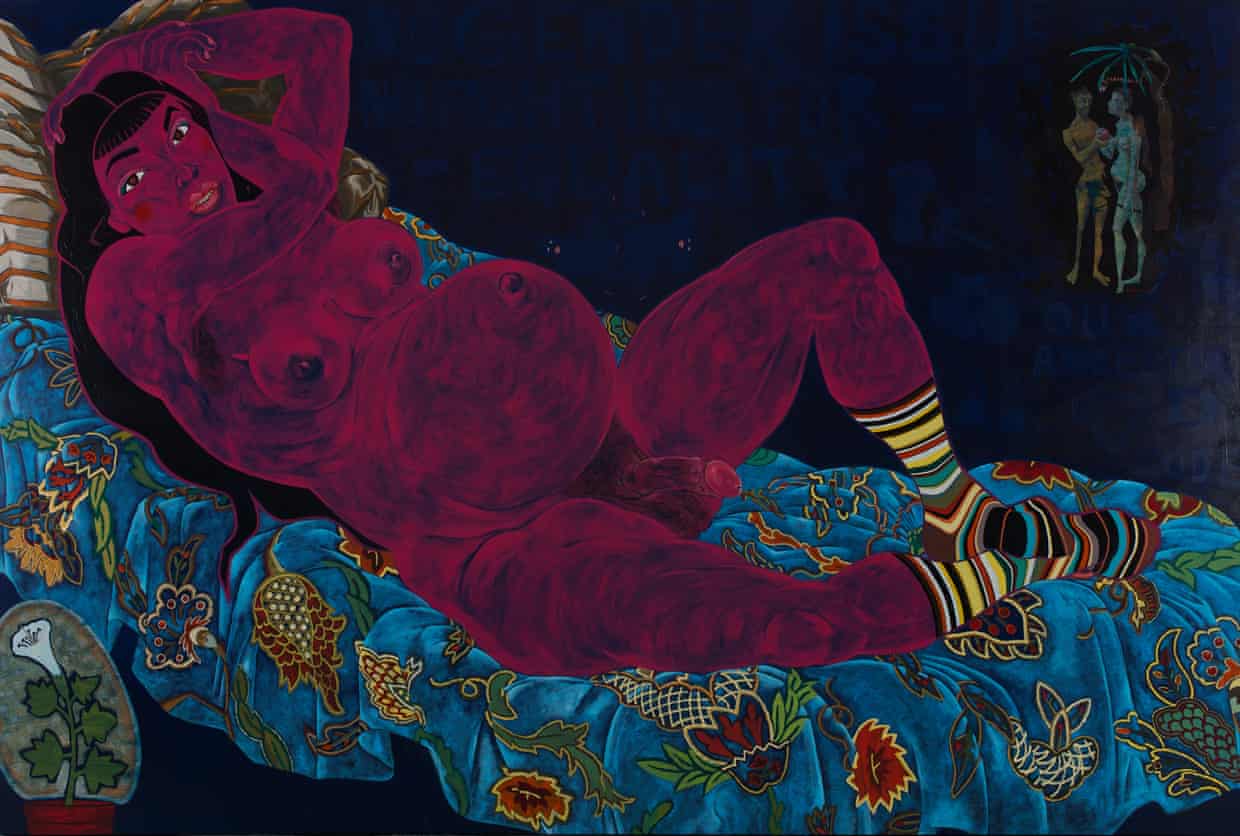
Not all of the attention has been adulatory, however. In India, Venkanna has been accused of blasphemy and has received death threats. When a print of his, showing a woman hoisting herself up on to the erect penises of two men, was exhibited at one of Delhi’s most notable cultural institutions, it had to be hidden behind a black curtain. “It’s absurd,” he says. “Read the newspaper, and you’ll see much more violence. This is what I’m trying to show.”
Venkanna is also trying to offer a counterpoint to the gender inequality and prejudice he continues to witness. Women’s experiences are foregrounded, particularly the ways in which they satiate their sexual appetite. Sometimes Venkanna depicts this as a vengeful act; in Golden Quartet (2025), for instance, amid sprays of straw-coloured and gold leaf urine, two women each ride a skeletal-looking man at a pace that seems to be drawing the men closer to their death.
It is these pre-cataclysmic scenes that so brilliantly consider the murky distinctions between intimacy and isolation, consent and violation, decency and obscenity. “I don’t want to shock,” Venkanna says. “What I’m showing are things around us.”