





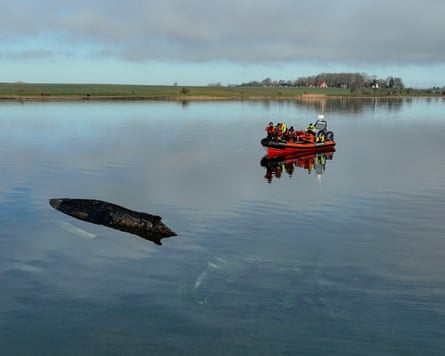
For weeks now, a humpback whale has been trying to die. Entangled in ropes, it had wandered into the shallow Baltic Sea. Unable to feed, it is now subject to extreme dehydration, since whales satisfy their thirst through the fish they eat.
In such a parlous situation, the whale’s last resort was to strand itself on Poel Island, in the Bay of Wismar. Sadly, it has been a slow death. Beached whales die because they are crushed by their own weight. The German humpback’s agony may have been prolonged because it lay in shallow water and was thus only partly submerged.
On Thursday, streamed live on YouTube, one final desperate attempt was being made to rescue the whale by inflating cushions under it before floating it out to sea.
A whale laid at our feet is a powerful parable. Our empathy with the giants of the sea must be set against the fact that we are shrinking their world. In our relentless push for economic progress, we have managed to reduce the vast ocean to an extension of ourselves. The result is clear: there is almost nowhere in which these animals are able to live peaceful, sustaining lives without being affected by our sway over the planet.
The seas, the beaches, the islands are now ours. From deep ocean trenches to wide open sandy shores, the warming and acidifying seas are reducing their feeding zones. At the same time, chemical pollution in seawater affects their fertility and immunity, while the constant noise of our industrial and recreational activities affects their cultural lives.
It is ironic that human intervention may have made this animal’s demise more painful by prolonging its death with our ignorance, our sympathy.
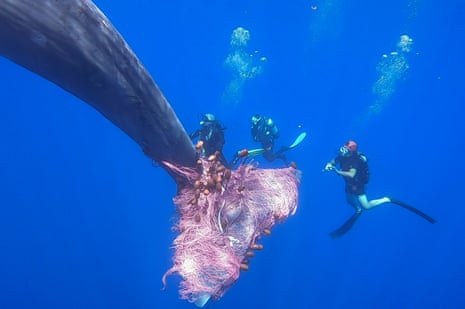
Yet hundreds – if not thousands – of whales perish each year at sea, trussed up with fishing gear or struck by vessels, slowly starving or rotting to death. They die out of sight of the news cycle.
There are places in the world where you can watch these huge animals from the shore, their powerful bodies rolling round one another in the surf. We seem powerless in the face of their fate. Yet we are none of us innocent, says Michael Moore, a veteran whale scientist, in his book, We Are All Whalers, “as we all benefit from global shipping of consumer goods and fuel, which … leads to fatal collisions with whales”.
Last year in Europe we saw a large number of strandings of rarely seen, deep-diving beaked whales, from western Ireland to Orkney and the Netherlands – a cluster that has raised fears that the animals might have been driven into shallow water by human-generated noise.
Since January this year, in a largely unreported phenomenon, at least 10 sperm whales – gigantic toothed whales, also deep-divers – have stranded on coasts from Cornwall to Denmark and Germany.
While sperm whales have been stranded on these shores for centuries, humpback whales appear new to the North Sea, only having being seen there in number since the beginning of the millennium. Yet their remains are – as a recent scientific paper published by the Royal Society shows – present in archaeological sites.
Humpback whale bone fragments have even been found in the Viking settlement of Haithabu, very close to where the German whale stranded, suggesting the remarkable notion that humpbacks, which swam in the North Sea and Baltic Sea 1,000 years ago, are now regaining feeding grounds from which they were driven by whaling in medieval times.
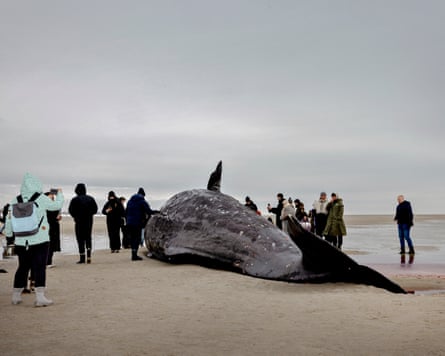
The German stranding also has recent counterparts. A stranded humpback in the Netherlands in 2012 also remained alive for days, and its plight – and disputes over its treatment – provoked silent protest marches, and the rescuers received death threats for failing to save the animal. Such feverish reactions may be seen as a new intensification of a public sensitivity.
As a result of the plight of the German humpback, even marine rescue centres in the Netherlands have been receiving calls from distressed members of the public.
Responding to the German stranding, the International Whaling Commission issued a statement commending “palliative care, eg keeping the animal wet and maintaining a calm and quiet environment” as “the only responsible, humane and pragmatic response to a situation in which no straightforward solution exists”.
A stranded whale seems like a massive, visceral rebuke for our collective sins. Historically, stranded whales have long been regarded as omens. The stink of their rotting blubber could be smelled from a mile away – a poisonous miasma to some.
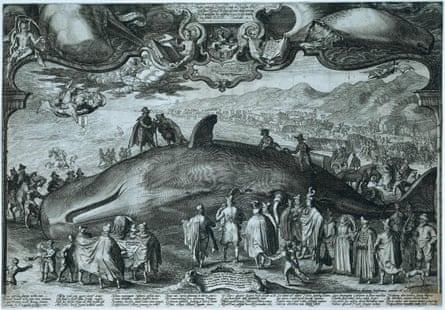
It was claimed that the famous German artist Albrecht Dürer died as a result of his artistic hubris, when he tried to draw a stranded whale in Zeeland in 1521, and supposedly caught an ultimately fatal infection as a result.
Sixteenth and 17th-century engravings provide these “monstrous pictures of whales”, as Herman Melville called them, with astrological interpretations. Yet, ironically, modern science has indicated that their fates may indeed have been seen in the stars. A mass stranding of 30 sperm whales around North Sea shores in January 2016 has since been blamed on solar flares disrupting their natural GPS systems, thus deceiving them into shallow seas.
It is possible that the stranding of sperm whales in Denmark and Germany this past January and February may also have been caused by the same big solar flare that coincided with an impressive display of the northern lights seen over the UK.
Now we create our own sonic storms – from the military sonar of war exercises in our northern seas, to seismic surveys for oil and gas reserves – to perturb them. Whales seem fated in their relationship with us, their mammalian cousins. Condemned, even as we admire their beauty, to persist as perpetual victims of our human folly, in whatever modern shape it may take.
此内容由惯性聚合(RSS阅读器)自动聚合整理,仅供阅读参考。 原文来自 — 版权归原作者所有。