








It is a 113-million-year-old bone of contention.
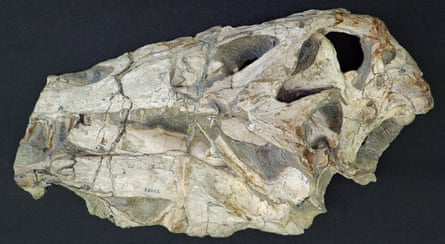
After Stuttgart’s museum of natural history bought a fossilised dinosaur skull in 1991, researchers found it was the most complete spinosaurid skull known to date, belonging to a previously unknown genus of the huge meat-eating dinosaurs.
Palaeontologists studying the skull in 1996 dubbed the genus Irritator – reflecting the annoyance they felt when they discovered the snout had been tinkered with – and the particular species challengeri, after Professor Challenger from Arthur Conan Doyle’s dinosaur adventure novel, The Lost World.
But as study after study was published, other interested parties were watching with irritations of their own: experts in Brazil, where the skull is believed to have originated.
According to a Brazilian law passed in 1942, fossils found in the country belong to the state, and, since 1990, specimens can be exported only with a permit and a partnership with a Brazilian scientific institution.
No one knows exactly when Irritator was dug up, or when it left Brazil, so its precise legal status has been a matter of deep concern.
Now, thanks to what has been described as as a major achievement in global restitution, Irritator challengeri is heading home.
A joint declaration by Germany and Brazil issued this month stated: “Both sides value the scientific cooperation in the field of fossil research, with the aim of utilising the expertise and exhibits available in Germany and Brazil for the mutual benefit of both countries.
“In this context, both governments welcome the willingness of the state of Baden-Württemberg and the state museum of natural history in Stuttgart to hand over the Irritator challengeri fossil to Brazil.”
Concerns about the legal ownership of the skull and the ethics of it being housed outside Brazil led to a campaign to repatriate the Irritator fossil. In recent years, an open letter calling for the skull’s repatriation was signed by 263 experts from around the world, while more than 34,000 members of the public signed an online petition.
Prof Aline Ghilardi, a Brazilian palaeontologist who was part of the campaign, welcomed the announcement and said public mobilisation was decisive.
“Its return is an important and positive step, and I hope that the process moves forward swiftly,” she said.
“I also congratulate this progress and see it as a major achievement in the broader context of global restitution efforts. This fossil will be widely celebrated and holds deep scientific, cultural and symbolic importance for Brazil.”
Prof Allysson Pontes Pinheiro, of Cariri regional university in Brazil, agreed.
“The repatriation of Irritator adds to recent returns of fossil material from France, the United Kingdom, Italy, and the United States, and can be seen as a sign of progress toward a more ethical and less colonial science – one that is more closely aligned with local realities and better respects rights, laws, cultures and identities,” he said.
“I believe that this case can set an important precedent for how museums and research institutions around the world handle fossil material with contested origins.”
No date has been set for the return of Irritator and some experts have expressed disappointment that the joint declaration says the fossil will be “handed over” rather than repatriated or returned.
Ghilardi said this was a “a missed opportunity to more explicitly address the issue in terms of restitution”.
Paul Stewens, a legal researcher at Maastricht University who helped organise the open letter, said the removal of specimens from their country of origin for study elsewhere without the involvement of local scientists or institutions was an example of neo-colonial research practices.
“The research that is being done on these specimens, the output, the museum income, all of these things, they don’t stay in the country from which the fossil originated,” he said, adding that fossils are part of the heritage that connects people to where they are from.
In 2023, another fossil initially given the name Ubirajara was returned from Germany to Brazil after a long campaign. Dr Emma Dunne, of Trinity College Dublin, who helped draft the Irritator letter, said there were “many more specimens that should return home, following in the pawprints of Ubirajara and Irritator”.
David Martill, an emeritus professor at the University of Portsmouth, meanwhile, said that while he was “delighted” to see Irritator return to Brazil, he thought it was “a real shame that some Brazilians turned it into a political hot potato and picked on German museums” when there were many Brazilian specimens in other countries, notably the US.
Martill, who has studied the skull, added: “I hope they look after it, as we spent many man hours preparing the specimen and studying it to make it one of the most important scientific dinosaur discoveries of the 1990s.”
Stewens said he thought it unlikely that Irritator’s return would lead to a host of other fossils being sent back to Brazil. But he said he believed the diplomatic efforts involved – and collaborative relationships established – could pave the way for other approaches, such as programmes to help Brazilian scientists study specimens in Germany.
“I think the trailblazing element about this restitution is the element of cooperation between the governments,” he said. “I think it shows that there is a lot of space for non-zero-sum solutions.”